
 Arabic
Blog
Polyethylene Wax (PE Wax) is one of the most widely used processing additives in the plastics, rubber, coatings, inks, adhesives, and PVC industries. Thanks to its excellent lubrication properties, thermal stability, chemical resistance, and compatibility with numerous polymer systems, PE Wax has become an essential material in modern industrial manufacturing.
As global manufacturing continues to expand, the demand for high-quality Polyethylene Wax has grown steadily. Manufacturers are increasingly seeking reliable suppliers capable of providing consistent product quality, multiple grades, competitive pricing, and dependable international logistics.
However, selecting the right Polyethylene Wax supplier requires more than simply comparing prices. Industrial buyers must understand the differences between wax grades, production methods, technical specifications, and application requirements to ensure the selected product delivers the desired performance.
This comprehensive guide explains everything industrial buyers should know about Polyethylene Wax, including its manufacturing methods, technical properties, industrial applications, available grades, and key factors to consider when sourcing in bulk.
What Is Polyethylene Wax?
Polyethylene Wax, commonly known as PE Wax, is a low molecular weight polyethylene polymer produced through various manufacturing processes. It is characterized by its high melting point, excellent hardness, low viscosity, and superior lubrication properties.
Unlike conventional paraffin waxes, Polyethylene Wax provides significantly better mechanical performance, thermal stability, and wear resistance, making it suitable for demanding industrial applications.
Depending on the production process, PE Wax may be supplied in the form of:
- White flakes
- Granules
- Powder
- Pastilles
Its physical characteristics make it easy to blend with polymers, pigments, fillers, and other additives during manufacturing.
How Polyethylene Wax Is Manufactured
Several production methods are used to manufacture Polyethylene Wax. Each method produces materials with different molecular structures and performance characteristics.
- Polymerization Process
In this method, Polyethylene Wax is synthesized directly through controlled polymerization of ethylene.
Advantages include:
- High purity
- Uniform molecular weight
- Excellent thermal stability
- Consistent quality
Polymerized PE Wax is commonly used in high-performance industrial applications.
- Thermal Cracking Process
Thermal degradation of high molecular weight polyethylene produces lower molecular weight waxes.
This process provides:
- Good lubrication
- Competitive cost
- Wide availability
Cracked PE Wax is frequently used in PVC processing and plastic compounding.
- Oxidation Process
Oxidized Polyethylene Wax is produced by introducing oxygen-containing functional groups into the polymer.
Compared with standard PE Wax, oxidized grades offer:
- Improved dispersion
- Better pigment compatibility
- Enhanced emulsification
- Increased adhesion
These properties make oxidized PE Wax suitable for coatings, inks, and emulsions.
Key Properties of Polyethylene Wax
PE Wax combines several performance characteristics that make it valuable across many industries.
Excellent Lubrication
One of the primary reasons manufacturers use Polyethylene Wax is its outstanding lubrication performance.
It reduces friction between polymer chains and processing equipment, resulting in:
- Easier processing
- Lower energy consumption
- Improved production efficiency
- Reduced equipment wear
High Thermal Stability
Industrial processing often occurs at elevated temperatures.
Polyethylene Wax maintains its properties during processing, helping manufacturers achieve consistent product quality without premature degradation.
Excellent Hardness
Compared with many natural and petroleum waxes, PE Wax offers higher hardness.
This improves:
- Surface durability
- Scratch resistance
- Abrasion resistance
- Mechanical strength
Chemical Resistance
Polyethylene Wax demonstrates excellent resistance to many industrial chemicals, including:
- Dilute acids
- Alkalis
- Salt solutions
- Water
- Moisture
This chemical stability contributes to longer product life in demanding environments.
Low Viscosity
Despite its high melting point, molten PE Wax exhibits relatively low viscosity.
This characteristic improves:
- Mixing efficiency
- Dispersion
- Processing speed
- Flow properties
General Technical Specifications
The following table presents typical specifications for industrial-grade Polyethylene Wax.
| Property | Typical Specification |
| Product Name | Polyethylene Wax (PE Wax) |
| Chemical Name | Polyethylene Wax |
| CAS Number | 9002-88-4 |
| Appearance | White Flakes, Granules or Powder |
| Color | White |
| Density (25°C) | 0.92 – 0.98 g/cm³ |
| Melting Point | 95 – 120°C |
| Drop Point | 100 – 115°C |
| Viscosity (140°C) | 10 – 600 mPa·s |
| Acid Value | ≤1.0 mg KOH/g (Typical) |
| Flash Point | >250°C |
| Ash Content | ≤0.1% |
| Moisture Content | ≤0.2% |
| Water Solubility | Insoluble |
| Chemical Resistance | Excellent |
| Thermal Stability | Excellent |
| Shelf Life | 24 Months |
| Packaging | 25 kg Paper Bag, 500 kg Jumbo Bag, 1000 kg Jumbo Bag |
Specifications may vary depending on the manufacturing process and product grade.
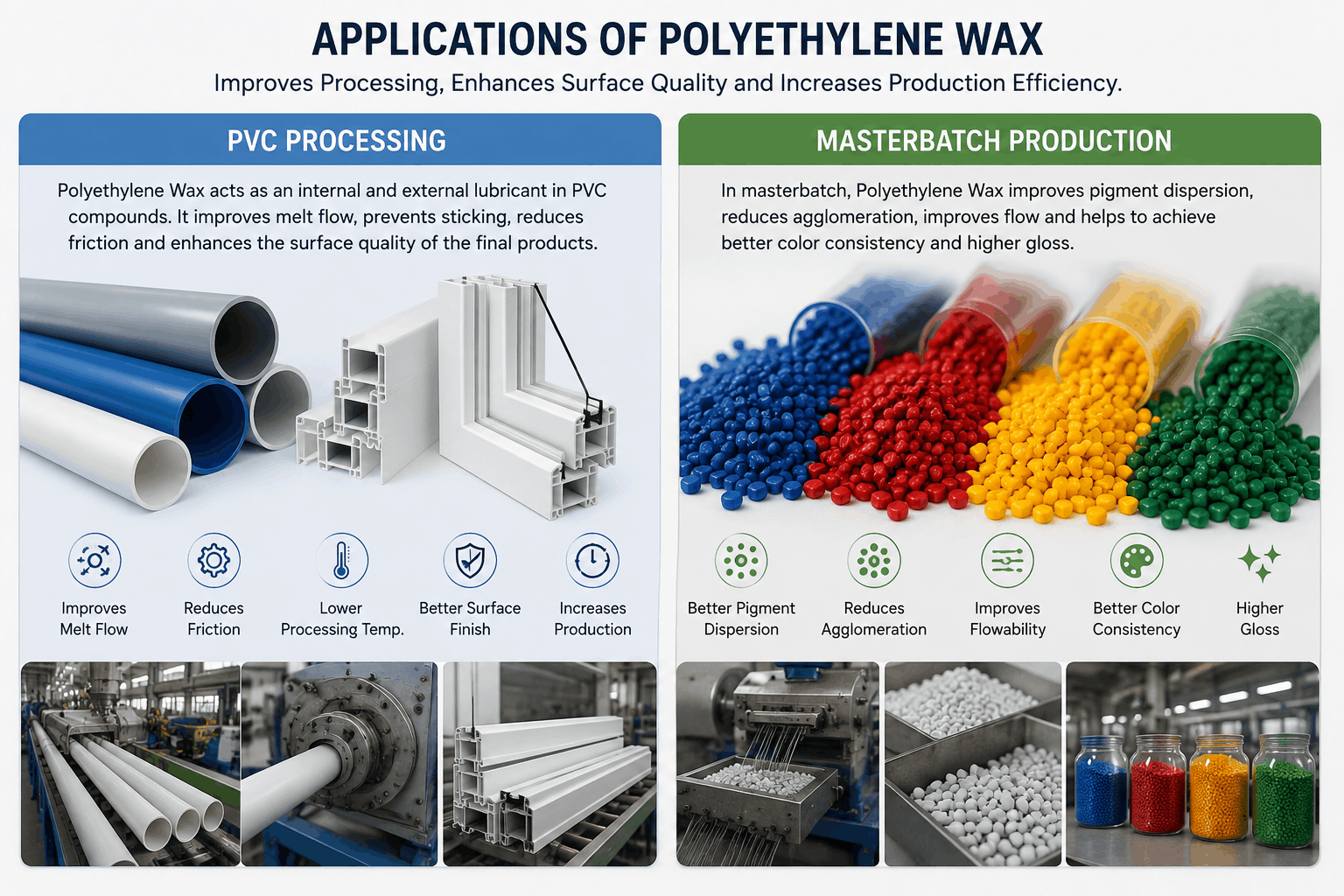
Major Industrial Applications
Because of its versatility, Polyethylene Wax is used across numerous manufacturing industries.
PVC Industry
PE Wax is widely used as both an internal and external lubricant in PVC processing.
Typical PVC applications include:
- PVC pipes
- Window profiles
- Cable compounds
- Sheets
- Flooring
- Fittings
The wax improves melt flow while preventing excessive adhesion to processing equipment.
Plastic Masterbatch
Color masterbatch manufacturers use Polyethylene Wax to improve pigment dispersion.
Benefits include:
- Better color consistency
- Improved processing
- Reduced agglomeration
- Higher production efficiency
Hot Melt Adhesives
PE Wax enhances the performance of hot melt adhesive formulations by improving:
- Melt viscosity
- Flow characteristics
- Setting time
- Heat resistance
Paints and Coatings
In coating formulations, Polyethylene Wax contributes to:
- Scratch resistance
- Slip performance
- Abrasion resistance
- Surface smoothness
- Gloss control
These properties improve the durability and appearance of finished coatings.
Printing Inks
PE Wax is commonly incorporated into printing inks to enhance:
- Rub resistance
- Surface protection
- Slip characteristics
- Print durability
Rubber Industry
Rubber manufacturers utilize Polyethylene Wax to improve processing efficiency and protect finished products from environmental degradation.
Textile Industry
Specialized textile formulations use PE Wax to improve:
- Surface smoothness
- Water repellency
- Lubrication
- Processing efficiency
Advantages of Using Polyethylene Wax
Industrial manufacturers choose Polyethylene Wax because it provides multiple technical and economic benefits.
Some of its most important advantages include:
- Excellent lubrication performance
- High melting point
- Outstanding thermal stability
- Superior hardness
- Excellent abrasion resistance
- Good chemical resistance
- Low volatility
- Easy processing
- Excellent pigment dispersion
- Long service life
- Broad compatibility with polymers
- Cost-effective processing aid
These advantages have made PE Wax an indispensable additive in modern manufacturing industries.
Why Industrial Buyers Should Understand PE Wax
Although Polyethylene Wax may represent only a small percentage of a formulation, its influence on processing efficiency and final product quality can be significant.
Selecting an unsuitable wax grade may lead to:
- Poor dispersion
- Processing difficulties
- Reduced surface quality
- Increased equipment wear
- Lower production efficiency
- Higher manufacturing costs
For this reason, industrial buyers should evaluate technical specifications carefully before selecting a supplier or placing a bulk order.
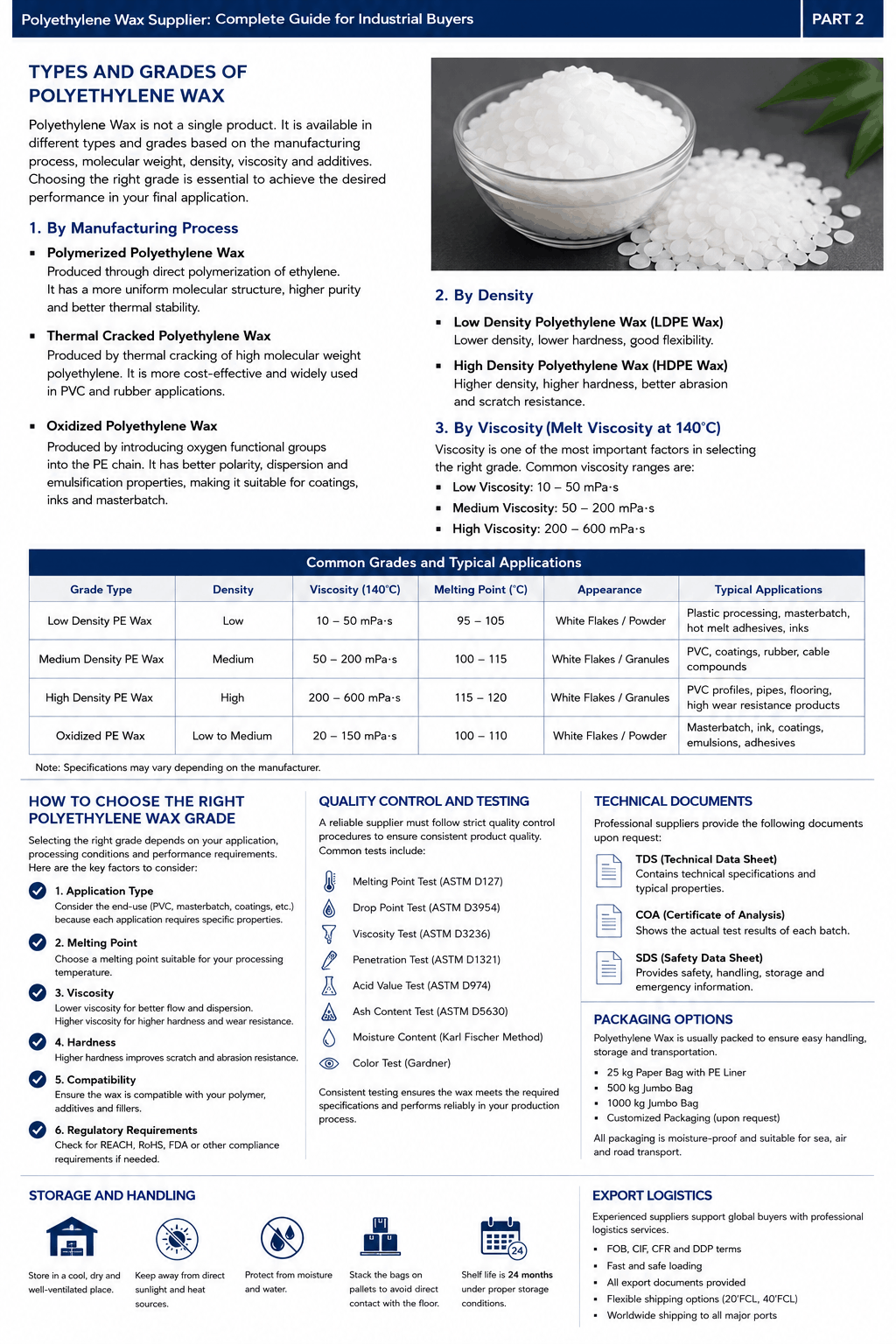
Types and Grades of Polyethylene Wax
Polyethylene Wax is available in various grades designed to meet different industrial processing requirements. Selecting the appropriate grade is essential for achieving optimal production efficiency, product quality, and cost-effectiveness.
The most common classification methods include manufacturing process, molecular weight, density, and chemical modification.
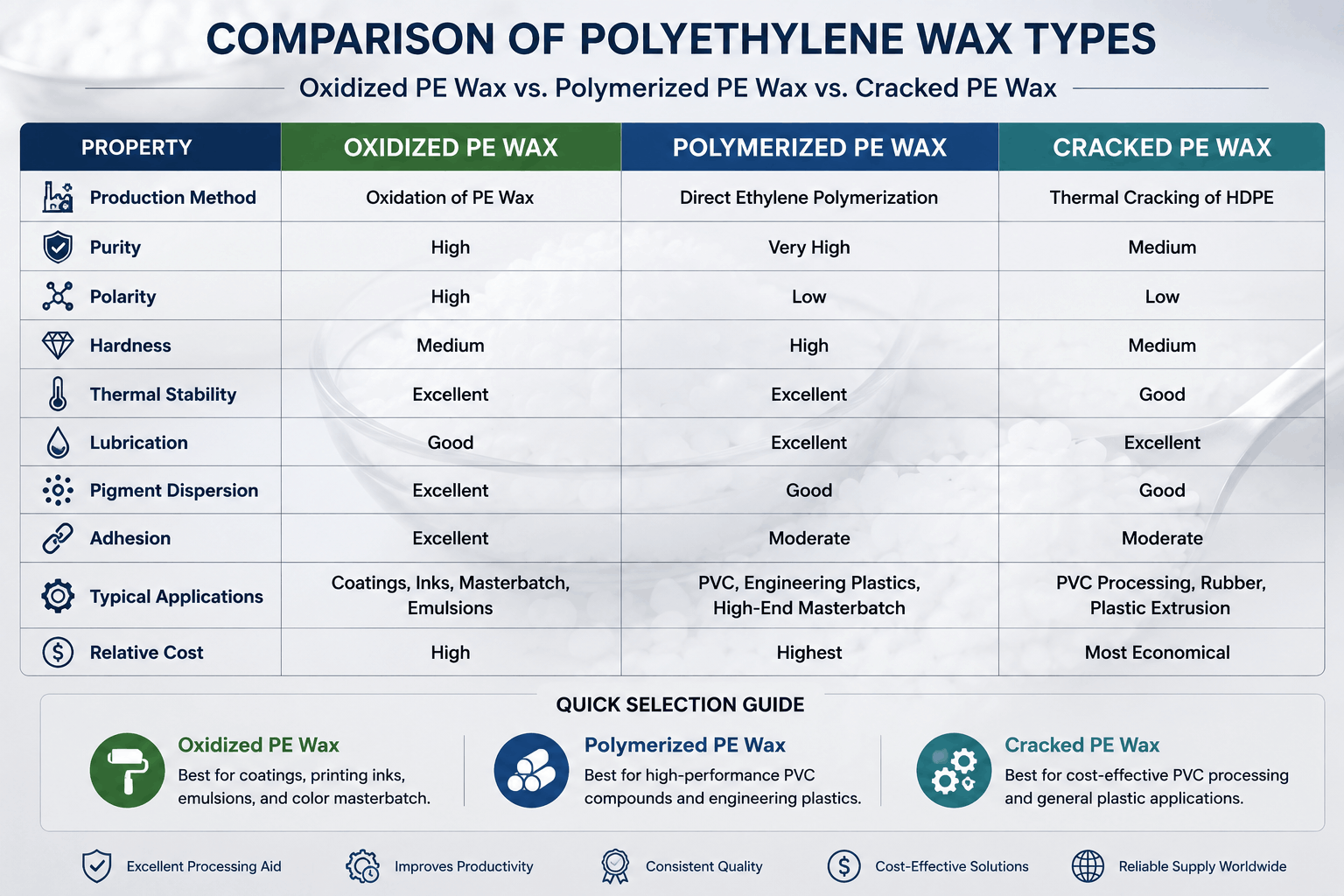
Polyethylene Wax Types by Manufacturing Process
Polymerized Polyethylene Wax
Polymerized PE Wax is produced directly through controlled polymerization of ethylene.
Key Characteristics
- High purity
- Uniform molecular structure
- Excellent thermal stability
- Low impurity content
- Superior consistency
- High hardness
Typical Applications
- PVC processing
- High-quality masterbatch
- Engineering plastics
- Premium coatings
- Industrial compounds
Thermal Cracked Polyethylene Wax
Cracked PE Wax is manufactured by breaking down high molecular weight polyethylene into lower molecular weight polymers.
Advantages
- Cost-effective
- Excellent lubrication
- Good processability
- Stable performance
Typical Applications
- PVC pipes
- PVC profiles
- Plastic extrusion
- Rubber processing
- Cable compounds
Oxidized Polyethylene Wax
Oxidized PE Wax contains oxygen-containing functional groups that improve polarity and compatibility.
Compared with conventional PE Wax, oxidized grades provide:
- Better pigment dispersion
- Improved emulsification
- Enhanced adhesion
- Increased compatibility
- Superior surface finish
Typical Applications
- Water-based coatings
- Printing inks
- Paints
- Textile chemicals
- Emulsion production
- Masterbatch
How to Select the Right Polyethylene Wax Grade
Choosing the correct Polyethylene Wax depends on several technical factors.
- Processing Temperature
Different production lines operate at different temperatures.
The wax melting point should match the processing conditions to ensure efficient lubrication without degrading product quality.
- Viscosity
Viscosity influences flow behavior during processing.
Low viscosity PE Wax is generally preferred for:
- Masterbatch
- Pigment dispersion
- Coatings
- Hot melt adhesives
Higher viscosity grades are commonly used where greater lubrication and mechanical performance are required.
- Hardness
Harder waxes provide:
- Better scratch resistance
- Higher abrasion resistance
- Improved surface durability
These grades are often selected for coatings and printing inks.
- Molecular Weight
Molecular weight directly affects:
- Melting point
- Hardness
- Lubrication
- Processability
- Mechanical performance
Industrial buyers should always request the recommended molecular weight range for their application.
- Compatibility
PE Wax should be compatible with the polymer system being processed.
Compatibility is particularly important in:
- PVC
- EVA
- Polyolefins
- Rubber
- Adhesives
- Masterbatch formulations
Typical Industrial Grades
| Grade | Main Characteristics | Typical Applications |
| Standard PE Wax | General lubrication | PVC Processing |
| High Hardness PE Wax | Better abrasion resistance | Paints & Coatings |
| Low Viscosity PE Wax | Excellent dispersion | Masterbatch |
| Oxidized PE Wax | High polarity | Printing Ink & Emulsion |
| High Purity PE Wax | Uniform quality | Engineering Plastics |
Quality Control
Reliable manufacturers follow strict quality control procedures to ensure consistent product performance.
Typical laboratory tests include:
| Test | Standard |
| Melting Point | ASTM D127 |
| Drop Point | ASTM D3954 |
| Density | ASTM D1505 |
| Viscosity | ASTM D3236 |
| Penetration | ASTM D1321 |
| Acid Value | ASTM D974 |
| Moisture | Karl Fischer |
| Ash Content | ASTM D5630 |
| Color | Gardner Scale |
Consistent testing ensures each production batch meets customer specifications.
Technical Documents Every Buyer Should Request
Professional suppliers provide technical documentation with every shipment.
Technical Data Sheet (TDS)
Contains:
- Physical properties
- Chemical properties
- Processing recommendations
- Typical applications
- Storage information
Certificate of Analysis (COA)
The COA confirms the actual laboratory results of the supplied batch.
It typically includes:
- Melting point
- Density
- Viscosity
- Acid value
- Moisture
- Appearance
Industrial buyers should always compare the COA with the agreed specifications before accepting delivery.
Safety Data Sheet (SDS)
The SDS provides essential information regarding:
- Safe handling
- Storage conditions
- Fire protection
- First aid
- Transportation
- Environmental precautions
Packaging Options
Packaging plays an important role in maintaining product quality during transportation and storage.
Common industrial packaging includes:
| Packaging Type | Capacity |
| Kraft Paper Bag with PE Liner | 25 kg |
| Jumbo Bag | 500 kg |
| Jumbo Bag | 1000 kg |
| Customized Packaging | Available upon request |
Export packaging should protect the material from:
- Moisture
- Dust
- Direct sunlight
- Mechanical damage
Proper labeling with batch number, production date, and net weight is also essential.
Storage and Handling
To maintain product quality, Polyethylene Wax should be stored under appropriate conditions.
Recommended Storage Conditions
- Cool and dry warehouse
- Well-ventilated area
- Away from direct sunlight
- Protected from moisture
- Away from strong oxidizing agents
- Keep bags sealed until use
When stored correctly, Polyethylene Wax typically has a shelf life of 24 months.
Export Logistics
Industrial buyers purchasing Polyethylene Wax in bulk should work with suppliers experienced in international logistics.
Professional suppliers typically offer:
- FOB shipments
- CFR shipments
- CIF shipments
- Container loading optimization
- Export documentation
- Worldwide shipping
Common shipping container options include:
- 20′ FCL
- 40′ FCL
- LCL shipments for smaller quantities
Experienced exporters also provide:
- Commercial Invoice
- Packing List
- Certificate of Origin
- Certificate of Analysis (COA)
- Technical Data Sheet (TDS)
- Safety Data Sheet (SDS)
These documents help ensure smooth customs clearance and efficient international delivery.
How to Choose a Reliable Polyethylene Wax Supplier
Selecting the right Polyethylene Wax supplier is just as important as choosing the correct product grade. A reliable supplier not only delivers consistent product quality but also supports your business with technical expertise, dependable logistics, and responsive customer service.
Industrial buyers should evaluate suppliers based on long-term value rather than price alone.
A professional Polyethylene Wax supplier should demonstrate:
- Consistent product quality
- Stable production capacity
- Multiple PE Wax grades
- Competitive international pricing
- Export experience
- Fast response time
- Professional technical support
- Flexible packaging options
- Reliable delivery schedules
- Complete export documentation
Suppliers that understand international trade requirements can significantly reduce sourcing risks and improve procurement efficiency.
Questions to Ask Before Buying Polyethylene Wax
Before placing a purchase order, buyers should request detailed information regarding the product and supplier.
Important questions include:
- Which production method is used?
- Is the wax polymerized, cracked, or oxidized?
- What is the melting point?
- What is the viscosity at 140°C?
- What is the density?
- Is the product suitable for my application?
- Can you provide a recent COA?
- Is a Technical Data Sheet available?
- What packaging options do you offer?
- What is your monthly production capacity?
- What are the available delivery terms (FOB, CFR, CIF)?
- What is the minimum order quantity (MOQ)?
These questions help buyers compare suppliers more effectively and avoid costly purchasing mistakes.
Factors Affecting Polyethylene Wax Prices
Polyethylene Wax prices vary depending on several market and technical factors.
Raw Material Costs
Ethylene prices and polyethylene feedstock costs have a direct influence on PE Wax pricing.
Manufacturing Method
Generally:
- Polymerized PE Wax commands the highest price due to its purity and consistency.
- Oxidized PE Wax is typically priced higher than standard grades because of its additional processing.
- Thermal cracked PE Wax is often the most economical option.
Product Grade
Premium grades with tighter quality control, higher purity, or specialized properties are usually more expensive.
Order Quantity
Bulk orders often benefit from:
- Lower unit prices
- Reduced packaging costs
- Better freight efficiency
- Preferential commercial terms
Packaging
Packaging type also influences the final cost.
Typical options include:
- 25 kg paper bags
- 500 kg jumbo bags
- 1000 kg jumbo bags
- Customized packaging
Shipping Costs
Ocean freight, container availability, insurance, destination port charges, and fuel prices all affect the final landed cost.
Global Market Trends
The global Polyethylene Wax market continues to expand due to increasing demand from industries such as plastics, coatings, packaging, adhesives, and construction.
Key market trends include:
- Rising demand for PVC products
- Growth of the masterbatch industry
- Expansion of plastic recycling
- Increasing use of high-performance coatings
- Higher demand for hot melt adhesives
- Growth in polymer processing industries
Manufacturers are also investing in improved production technologies to achieve:
- Better product consistency
- Lower impurity levels
- Improved environmental performance
- Greater energy efficiency
Why Long-Term Supplier Relationships Matter
Many industrial buyers focus only on obtaining the lowest possible price.
However, experienced procurement professionals understand that long-term supplier relationships often generate greater value.
Benefits include:
- Stable product quality
- Priority production scheduling
- Better commercial conditions
- Technical assistance
- Faster problem resolution
- Reliable supply during market shortages
- Lower procurement risks
A trusted supplier becomes an important part of your production chain rather than simply a product vendor.
Why Buy Polyethylene Wax in Bulk?
Bulk purchasing provides numerous advantages for manufacturers and distributors.
These include:
- Lower cost per ton
- Reduced freight costs
- Improved inventory planning
- Stable production schedules
- Better price negotiations
- Consistent product supply
For companies with regular production requirements, long-term bulk purchasing agreements can significantly improve operational efficiency.
Frequently Asked Questions (FAQ)
- What is Polyethylene Wax used for?
Polyethylene Wax is used in PVC processing, masterbatch production, rubber manufacturing, paints, coatings, printing inks, hot melt adhesives, textiles, cable compounds, and many other industrial applications.
- Is Polyethylene Wax soluble in water?
No. Polyethylene Wax is insoluble in water but soluble in certain hot organic solvents.
- What is the typical melting point?
Most industrial grades have melting points between 95°C and 120°C.
- What is the difference between oxidized and non-oxidized PE Wax?
Oxidized PE Wax has higher polarity, better dispersion, improved adhesion, and enhanced emulsification properties.
- Which industries consume the largest volumes?
PVC processing, masterbatch production, coatings, adhesives, and rubber manufacturing are among the largest consumers.
- What documents should accompany every shipment?
Professional suppliers normally provide:
- TDS
- COA
- SDS
- Commercial Invoice
- Packing List
- Certificate of Origin
- What packaging options are available?
Standard packaging includes:
- 25 kg paper bags
- 500 kg jumbo bags
- 1000 kg jumbo bags
- How long can PE Wax be stored?
Typically 24 months when stored under recommended conditions.
- Does Polyethylene Wax improve processing efficiency?
Yes. It reduces friction, improves melt flow, enhances dispersion, and lowers equipment wear.
- Can Polyethylene Wax be customized?
Many manufacturers offer customized grades based on customer processing requirements.
- Why is viscosity important?
Viscosity affects dispersion, lubrication, processing behavior, and overall production efficiency.
- Why should buyers request a COA?
The COA confirms that the supplied batch complies with the agreed technical specifications.
- What factors influence quality?
Quality depends on:
- Manufacturing process
- Raw materials
- Molecular weight
- Production consistency
- Quality control procedures
- Is Polyethylene Wax recyclable?
Yes. It is compatible with many polymer recycling processes.
- How do I choose the right supplier?
Look for suppliers with proven manufacturing capability, export experience, consistent quality, technical support, and reliable logistics.
Conclusion
Polyethylene Wax has become an indispensable processing additive across numerous industries due to its excellent lubrication, thermal stability, hardness, chemical resistance, and processing performance. Whether used in PVC processing, masterbatch production, hot melt adhesives, coatings, rubber compounds, or printing inks, selecting the correct grade is essential for achieving consistent product quality and efficient manufacturing.
Equally important is selecting a reliable supplier. A professional Polyethylene Wax supplier should provide not only competitive pricing but also consistent quality, technical support, comprehensive documentation, flexible packaging, and dependable export services.
For industrial buyers, long-term partnerships with experienced suppliers can reduce sourcing risks, improve production efficiency, and ensure a stable supply of high-quality materials.
By understanding product grades, technical specifications, quality requirements, and market trends, buyers can make informed purchasing decisions and establish successful, long-lasting business relationships.
Source : IRANCORPS