

 Arabic
Blog
- Introduction – Why Procurement Managers Care About These Solvents
For procurement managers in chemical, paint, ink, and coating industries, solvent selection is not a laboratory discussion—it is a cost-performance-risk decision.
Every solvent choice directly affects:
- Production cost per ton
- Product quality consistency
- Customer complaints and returns
- Line efficiency and drying time
- Raw material availability and supply chain stability
- Compliance with VOC and environmental regulations
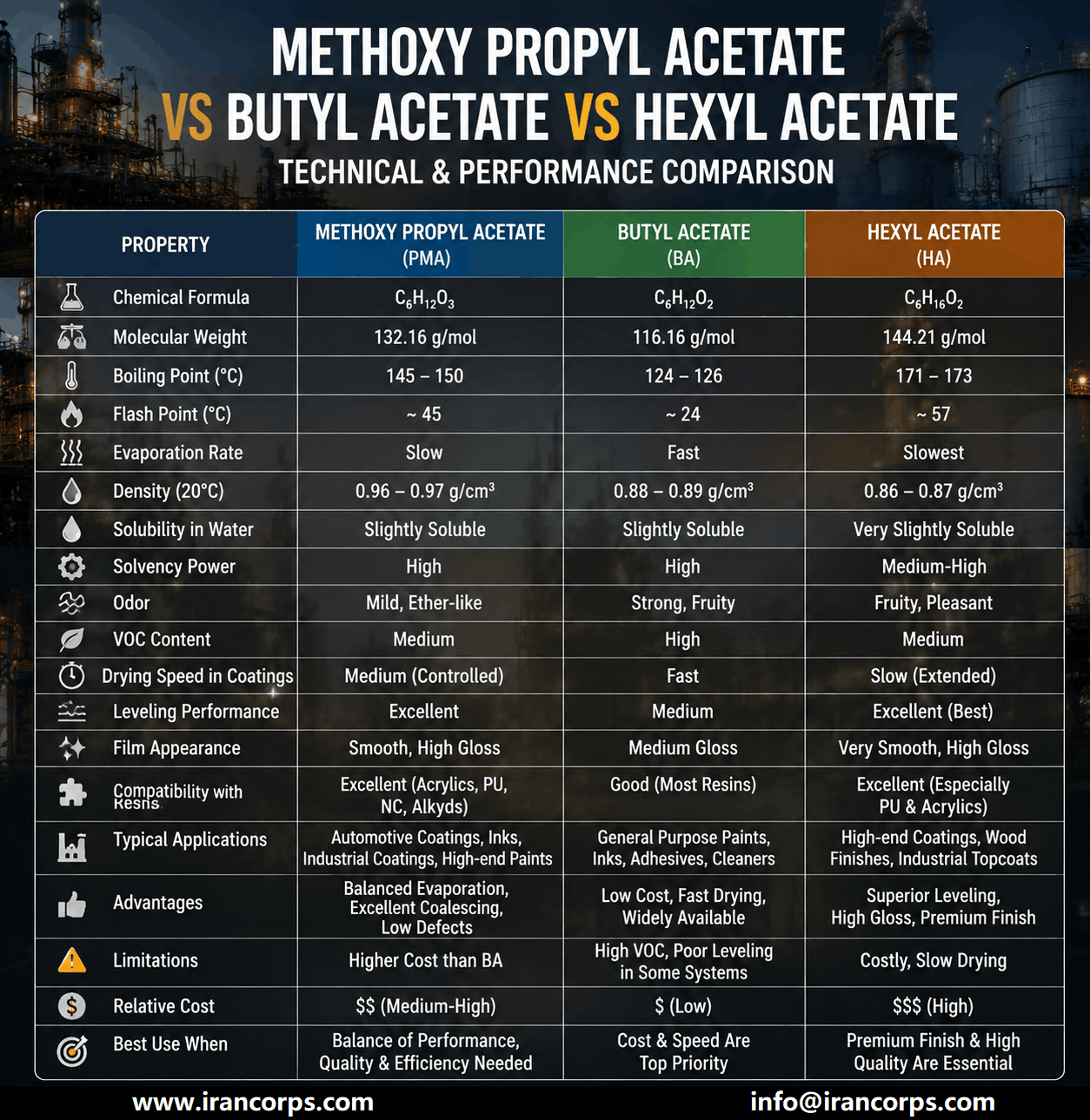
Among industrial solvents, three products are frequently compared:
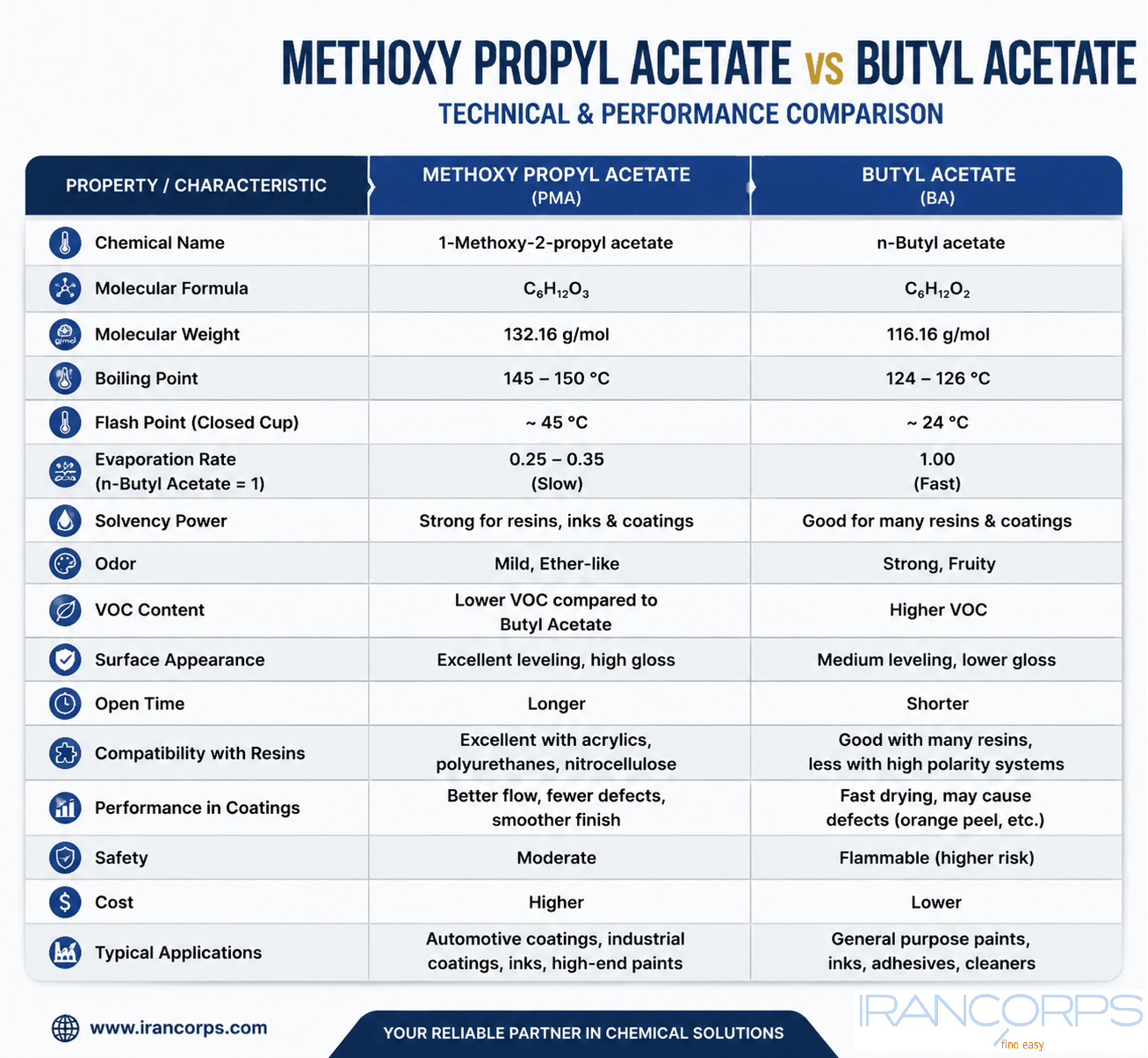
- PMA (Propylene Glycol Monomethyl Ether Acetate)
- Butyl Acetate (BA)
- Hexyl Acetate
Although all three are esters (or ester-like solvents), they behave very differently in real production environments.
This article is written specifically to help procurement managers, technical buyers, and sourcing teams make a clear, practical decision—not just a chemical comparison.
- Executive Summary (Quick Decision View)
If you are a purchasing manager and want a fast answer:
| Requirement | Best Choice |
| Lowest cost solvent | Butyl Acetate |
| Balanced performance + reliability | PMA |
| Premium surface finish | Hexyl Acetate |
| Fast drying systems | Butyl Acetate |
| Automotive OEM quality | PMA |
| High gloss luxury coatings | Hexyl Acetate |
👉 In most modern industrial systems, PMA is becoming the default engineering solvent, while BA remains the commodity option.
- Supply Chain & Procurement Perspective
3.1 Availability in Global Market
Butyl Acetate
- Widely produced globally
- Multiple suppliers in Asia, Europe, Middle East
- Highly commoditized market
👉 Risk: Price fluctuation but easy sourcing
PMA
- More specialized production
- Fewer global manufacturers
- Often linked to large chemical groups
👉 Risk: moderate supply dependency
👉 Advantage: stable industrial demand
Hexyl Acetate
- Specialty chemical
- Lower global production volume
- Often sourced via niche suppliers
👉 Risk: availability fluctuations
👉 Advantage: high margin product
3.2 Procurement Risk Ranking
| Solvent | Supply Risk | Price Stability |
| BA | Low | Medium |
| PMA | Medium | High |
| Hexyl | Medium-High | Medium |
- Cost Structure Analysis (What Buyers Actually Care About)
Cost is not just price per kg—it is cost per performance unit.
4.1 Butyl Acetate – Lowest Entry Cost
Advantages:
- Cheapest solvent among the three
- Bulk availability
- Low procurement complexity
Hidden Cost:
- Higher defect rate in final coating
- Possible rework or waste
- Lower product quality perception
👉 Real outcome: cheap raw material, but not always cheap final product
4.2 PMA – Balanced Cost-to-Performance Ratio
PMA is more expensive than BA but:
- reduces defects
- improves production efficiency
- stabilizes formulation behavior
👉 In procurement terms:
PMA reduces hidden operational costs
4.3 Hexyl Acetate – Premium Cost Structure
- Highest cost per kg impact in formulation
- Used in small percentages only
- Justified in luxury coatings
👉 Value comes from:
- gloss improvement
- premium surface quality
- reduced customer complaints
- Technical Performance in Real Production
5.1 Drying Time Behavior (Production Line Impact)
| Solvent | Drying Speed | Production Impact |
| BA | Very fast | High throughput |
| PMA | Controlled | Stable line performance |
| Hexyl | Slow | Premium finish but slower cycle |
👉 Procurement insight:
Fast drying ≠ better profitability (defect rate matters more)
5.2 Defect Rate Impact (Very Important for Buyers)
| Defect Type | BA | PMA | Hexyl |
| Orange peel | High | Low | Very low |
| Rework rate | High | Low | Very low |
| Customer complaints | Medium | Low | Very low |
👉 PMA and Hexyl reduce downstream cost significantly
5.3 Production Line Stability
- BA → sensitive to temperature changes
- PMA → stable across conditions
- Hexyl → very stable but slower
👉 Procurement conclusion:
PMA is safest for large-scale industrial production
- Application-Based Comparison (Buyer-Oriented View)
6.1 Automotive Industry
Requirements:
- zero defect finish
- high gloss
- consistency across batches
Best choice:
👉 PMA (core solvent)
👉 Hexyl acetate (finishing additive)
BA is only used in low-cost sub-components.
6.2 Industrial Coatings
- BA → cost optimization
- PMA → standard industrial quality
- Hexyl → premium segments
👉 Procurement strategy:
Mix-based purchasing is common here
6.3 Ink Industry (Packaging & Printing)
| Segment | Preferred Solvent |
| Low-cost packaging | BA |
| Premium packaging | PMA |
| Specialty inks | Hexyl |
6.4 Decorative Paints
- BA = mass market wall paints
- PMA = mid-high segment
- Hexyl = luxury finishes
- Total Cost of Ownership (TCO Perspective)
Procurement managers should not evaluate only purchase price.
7.1 Butyl Acetate TCO
✔ low purchase price
❌ higher defect rate
❌ more rework
❌ inconsistent quality
👉 Final result: hidden cost increases
7.2 PMA TCO
✔ higher raw cost
✔ lower defect rate
✔ stable production
✔ less waste
👉 Final result: optimal ROI
7.3 Hexyl Acetate TCO
✔ high quality output
✔ premium product positioning
❌ higher unit cost
✔ low usage percentage
👉 Final result: justified in luxury segments only
- Decision-Making Framework for Procurement Teams
Use this simple framework:
Step 1 – Identify product segment
- commodity → BA
- industrial performance → PMA
- premium product → Hexyl
Step 2 – Evaluate defect cost impact
If defects cost more than raw material savings → avoid BA
Step 3 – Evaluate production speed vs quality
- speed priority → BA
- balance → PMA
- quality priority → Hexyl
Step 4 – Supply chain stability check
- BA = safest
- PMA = stable industrial
- Hexyl = specialty risk
- Industry Trend Analysis (Very Important for Buyers)
Global coating industry is moving toward:
- Reduced fast-evaporation solvents (BA)
Because:
- VOC regulations
- defect issues
- inconsistent quality
- Increased PMA usage
Because:
- stable formulations
- high-performance coatings
- automotive demand
- Growth of Hexyl Acetate in premium segments
Because:
- luxury coatings market expansion
- wood coatings
- high-gloss finishes
- Risk Analysis (Procurement View)
| Risk Factor | BA | PMA | Hexyl |
| Price volatility | Medium | Low | Medium |
| Supply risk | Low | Medium | Medium-High |
| Quality variation | High | Low | Low |
| Regulatory pressure | High | Medium | Medium |
- Final Recommendation Matrix
If you are buying for:
Cost-sensitive production:
👉 Butyl Acetate
Balanced industrial production:
👉 PMA (recommended default choice)
Premium high-end coatings:
👉 Hexyl Acetate
- Key Procurement Insight (Very Important)
Most industrial buyers make a mistake:
They optimize for raw material price instead of production efficiency.
In reality:
- BA reduces purchase cost but increases operational risk
- PMA increases raw cost but reduces total system cost
- Hexyl improves product value but is not cost-efficient for mass production
- FAQ (Procurement-Focused SEO Schema)
Which solvent is most cost-effective overall?
PMA is the most cost-effective when considering total production efficiency.
Is Butyl Acetate still relevant?
Yes, but mainly in low-cost, fast-dry applications.
Why is PMA widely used in automotive coatings?
Because it provides controlled evaporation and defect-free surfaces.
When should Hexyl Acetate be used?
Only when premium surface quality and gloss are required.
Can these solvents be mixed?
Yes, blending is standard in industrial formulations.
- Conclusion – Procurement Strategy Summary
From a procurement and industrial sourcing perspective:
- Butyl Acetate = lowest cost, highest risk system
- PMA = best balance of cost, performance, and stability
- Hexyl Acetate = premium performance, limited usage
👉 The global trend clearly shows:
Industrial buyers are shifting from BA → PMA systems to reduce total operational cost and improve quality consistency.
🚀 Final Insight
If you are a procurement manager:
Don’t buy solvents. Buy production stability.