

 Arabic
Blog
Introduction to Polyethylene Glycol (PEG)
Polyethylene Glycol, commonly known as PEG, is a versatile synthetic polymer widely used across pharmaceutical, food, cosmetic, chemical, and industrial industries.
Due to its unique characteristics, PEG has become one of the most important multifunctional ingredients in global manufacturing.
Polyethylene Glycol is a polymer compound produced through the polymerization of ethylene oxide. Depending on its molecular weight, PEG can exist in different forms ranging from liquid products with low molecular weight to solid wax-like materials with high molecular weight.
The most common commercial grades include:
- Food Grade Polyethylene Glycol
- Cosmetic Grade Polyethylene Glycol
- Industrial Grade Polyethylene Glycol
- Pharmaceutical Grade Polyethylene Glycol
Each grade is designed for specific applications and must meet different quality requirements.
Choosing the correct PEG grade is essential because impurities, molecular weight, viscosity, and purity levels directly affect product performance.
What Is Polyethylene Glycol?
Polyethylene Glycol is a water-soluble polymer belonging to the family of polyether compounds.
The general chemical formula is:
HO-(CH₂CH₂O)n-H
where n represents the number of repeating ethylene oxide units.
The properties of PEG depend mainly on its molecular weight.
Low molecular weight PEG products are usually:
- Transparent liquids
- Low viscosity
- Highly water soluble
Higher molecular weight PEG products are usually:
- Solid
- Wax-like
- More viscous
Main Characteristics of Polyethylene Glycol
Polyethylene Glycol is popular because of its unique combination of properties:
Excellent Water Solubility
PEG dissolves easily in:
- Water
- Alcohols
- Many organic solvents
This makes it valuable in formulations requiring easy mixing and stability.
Chemical Stability
PEG has good resistance against:
- Oxidation
- Temperature variations
- Chemical degradation
Low Toxicity
Certain PEG grades are approved for use in:
- Food applications
- Pharmaceutical formulations
- Cosmetic products
provided they meet required purity standards.
Lubricating Properties
PEG provides excellent:
- Lubrication
- Moisture retention
- Surface protection
making it suitable for industrial and cosmetic applications.
Different Types of Polyethylene Glycol
Polyethylene Glycol is classified mainly according to:
- Molecular Weight
- Purity Level
- Intended Application
The three main commercial categories are:
- Food Grade Polyethylene Glycol
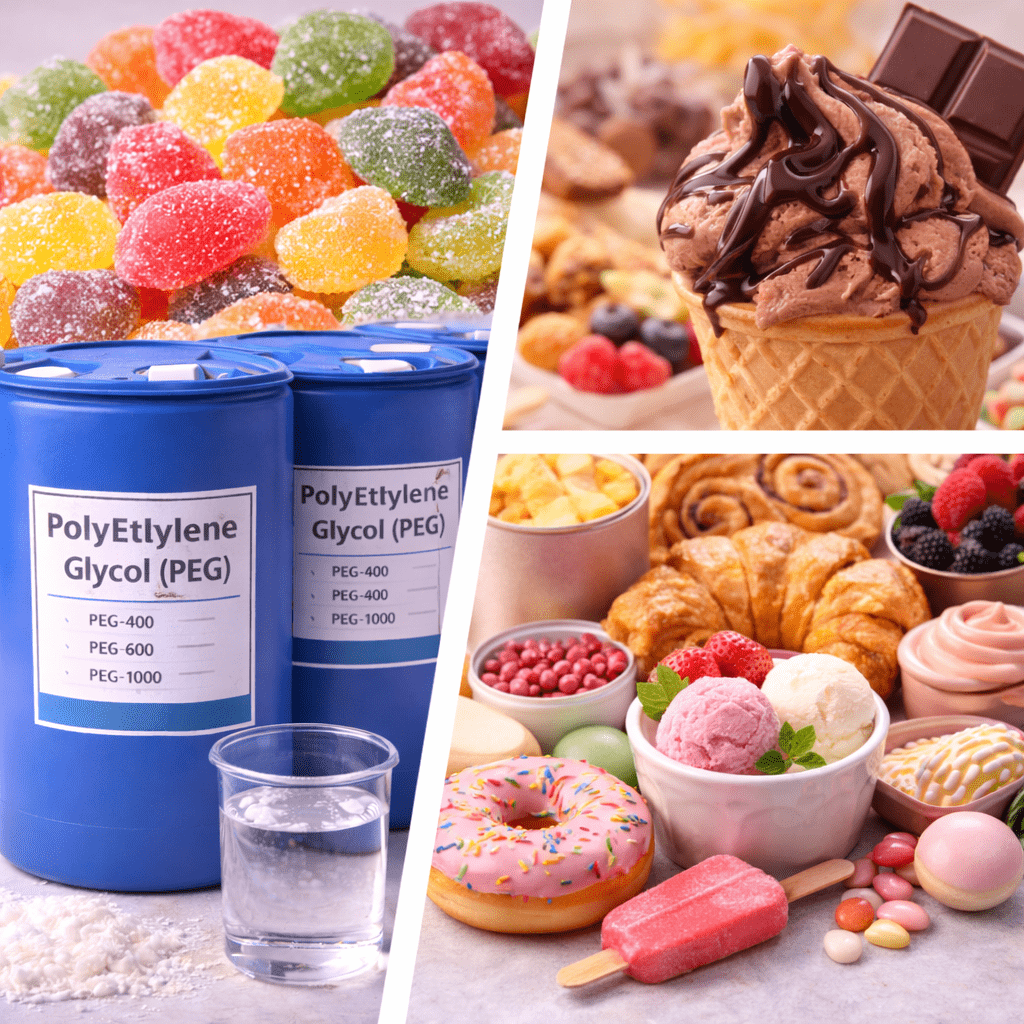
What Is Food Grade PEG?
Food Grade Polyethylene Glycol is a high-purity PEG designed for applications where direct or indirect contact with food products is required.
This grade must comply with strict food safety regulations and have controlled levels of impurities.
Food Grade PEG is commonly used as:
- Food additive
- Processing aid
- Carrier
- Moisture stabilizer
Advantages of Food Grade Polyethylene Glycol
- High Purity
Food-grade PEG undergoes additional purification processes to ensure:
- Low impurity levels
- Controlled heavy metals
- Safety for food applications
- Excellent Solubility
PEG helps manufacturers create:
- Stable formulations
- Uniform mixtures
- Improved texture
- Moisture Control
Food Grade PEG can help maintain:
- Product consistency
- Shelf life
- Desired texture
Applications of Food Grade Polyethylene Glycol
Food Industry
Food-grade PEG is used in:
- Food processing
- Flavor carriers
- Stabilizing systems
- Coating applications
Pharmaceutical and Nutraceutical Products
Used as:
- Tablet binder
- Solvent carrier
- Stabilizing agent
Technical Specifications of Food Grade PEG
| Parameter | Typical Specification |
| Appearance | Clear Liquid or White Solid |
| Purity | High Purity Grade |
| Molecular Weight | PEG 200 – PEG 6000 |
| Color | Colorless to White |
| Water Solubility | Completely Soluble |
| Heavy Metals | Controlled According to Standards |
| pH | Approximately 5–7 |
| Moisture | Controlled |
- Cosmetic Grade Polyethylene Glycol
What Is Cosmetic Grade PEG?
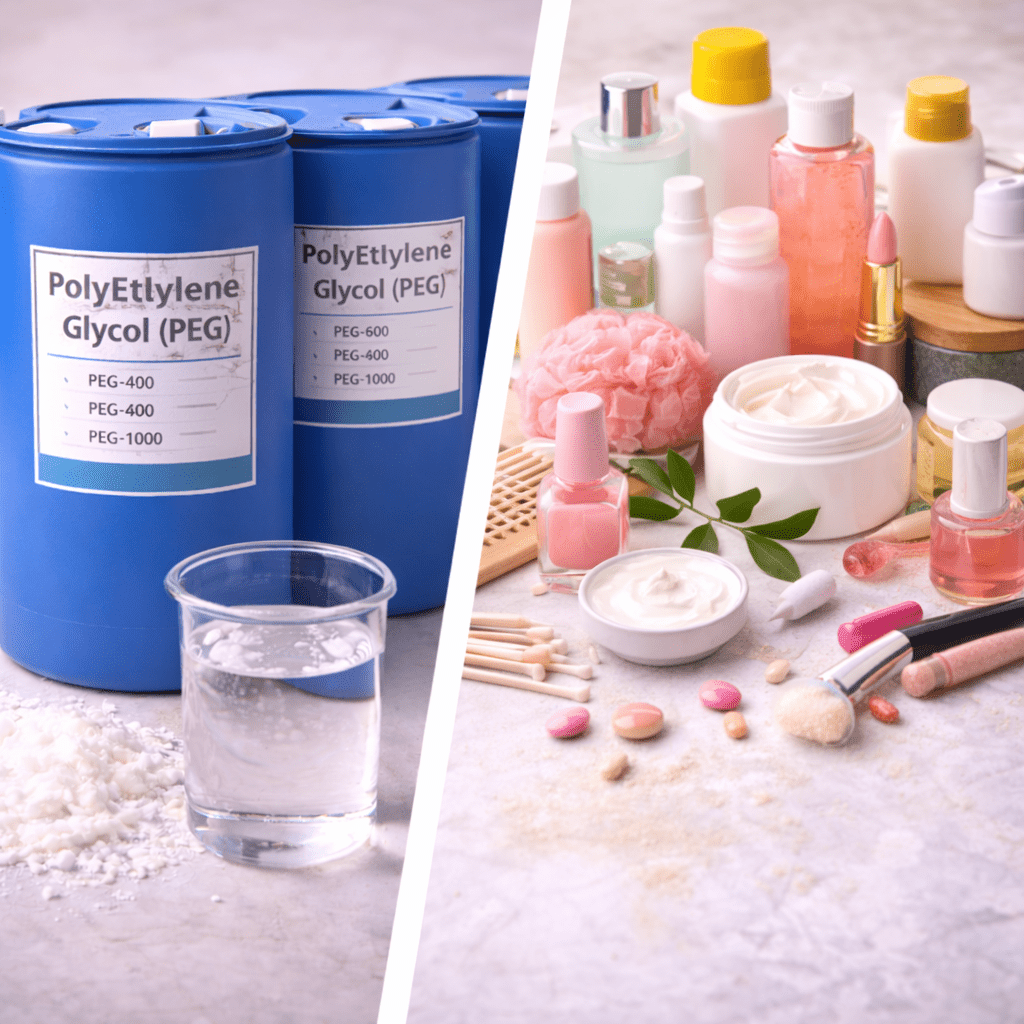
Cosmetic Grade Polyethylene Glycol is specially manufactured for personal care and beauty formulations.
It is widely used because of its:
- Moisturizing ability
- Texture improvement
- Solubility properties
Advantages of Cosmetic Grade PEG
- Excellent Moisture Retention
PEG works as a humectant, helping cosmetic products maintain moisture.
Used in:
- Creams
- Lotions
- Gels
- Skin-care products
- Improves Product Texture
PEG helps create:
- Smooth feeling
- Better spreadability
- Improved consistency
- Formulation Stability
Cosmetic manufacturers use PEG to improve:
- Product stability
- Ingredient compatibility
- Shelf life
Applications of Cosmetic Grade Polyethylene Glycol
Common applications include:
Skin Care Products
- Moisturizers
- Creams
- Serums
- Anti-aging products
Hair Care Products
- Conditioners
- Hair creams
- Styling products
Personal Care Products
- Toothpaste
- Shaving creams
- Body lotions
- Industrial Grade Polyethylene Glycol (PEG)
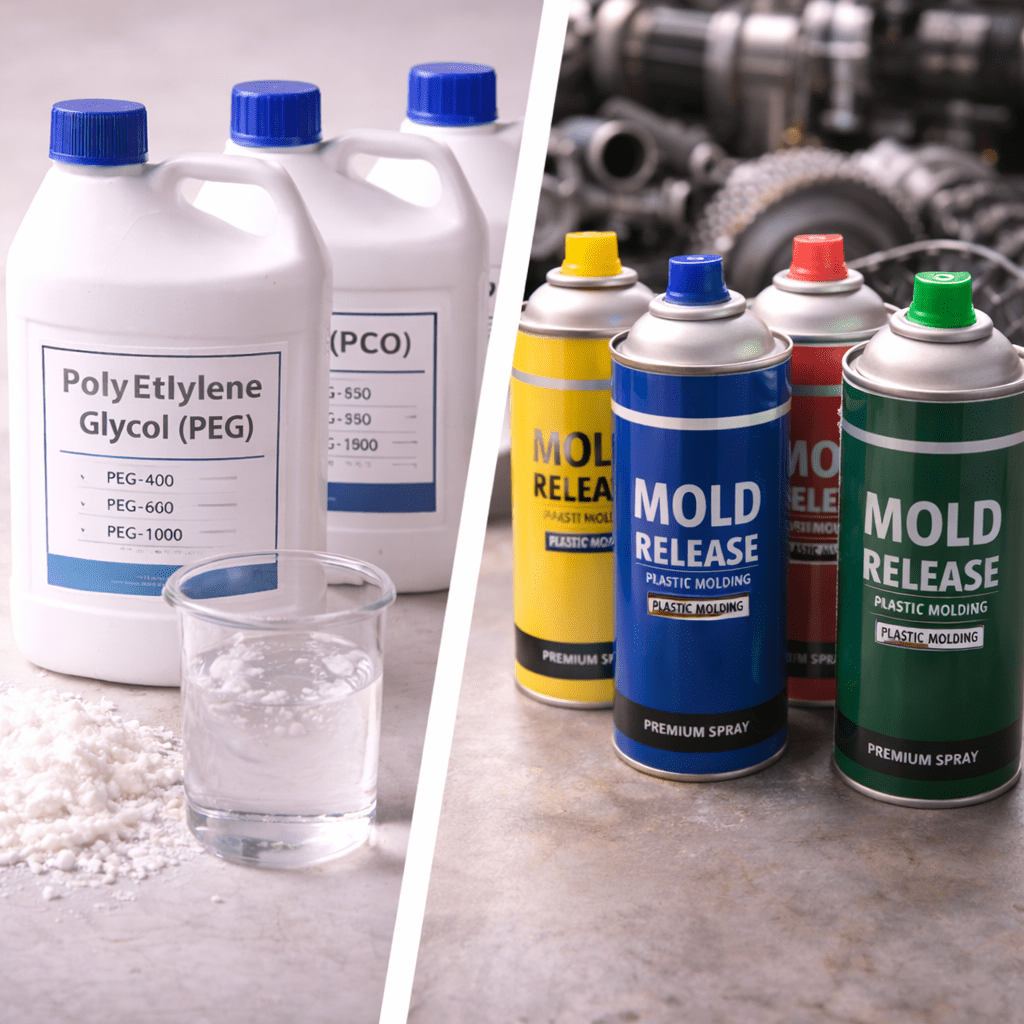
What Is Industrial Grade Polyethylene Glycol?
Industrial Grade Polyethylene Glycol is a versatile chemical material designed for manufacturing processes where high performance, stability, lubrication, and compatibility are required.
Unlike food and cosmetic grades, industrial PEG focuses mainly on technical performance rather than direct human contact requirements.
Industrial PEG is widely used in:
- Chemical manufacturing
- Textile production
- Metal processing
- Plastics industry
- Rubber industry
- Paints and coatings
- Adhesives
- Lubricants
Advantages of Industrial Grade Polyethylene Glycol
- Excellent Lubrication Performance
One of the most important advantages of industrial PEG is its ability to reduce friction.
It is used in:
- Industrial lubricants
- Hydraulic fluids
- Metalworking fluids
- Machinery maintenance products
Benefits:
- Reduces equipment wear
- Improves operational efficiency
- Extends equipment lifetime
- Excellent Solvent and Carrier Properties
PEG can dissolve and transport different chemical components, making it valuable in industrial formulations.
Applications include:
- Chemical processing
- Cleaning formulations
- Industrial additives
- Thermal and Chemical Stability
Industrial PEG maintains performance under demanding conditions, including:
- Temperature changes
- Mechanical stress
- Chemical exposure
- Compatibility With Other Materials
PEG can be easily blended with:
- Water-based systems
- Organic compounds
- Other polymers
This makes it suitable for many industrial formulations.
Applications of Industrial Grade Polyethylene Glycol
- Lubricants Industry
Industrial PEG is used in:
- Synthetic lubricants
- Compressor fluids
- Gear lubricants
- Hydraulic fluids
Required properties:
- Controlled viscosity
- Thermal stability
- Low volatility
- Textile Industry
PEG is used as:
- Softening agent
- Processing aid
- Lubricant during fiber production
Benefits:
- Improves fiber processing
- Reduces friction
- Enhances fabric quality
- Paints and Coatings
Industrial PEG can be used as:
- Dispersing agent
- Additive
- Flow improvement agent
Benefits:
- Better pigment dispersion
- Improved coating quality
- Enhanced stability
- Plastic and Polymer Industry
PEG is used as:
- Processing aid
- Plasticizer
- Additive
Advantages:
- Improves flexibility
- Enhances processing performance
- Adhesives Industry
PEG improves:
- Adhesive flexibility
- Moisture control
- Product stability
Technical Specifications of Industrial Grade PEG
| Parameter | Typical Specification |
| Appearance | Clear Liquid or White Solid |
| Molecular Weight | PEG 200 – PEG 10000 |
| Color | Colorless to White |
| Solubility | Soluble in Water |
| Viscosity | Depends on Molecular Weight |
| Moisture Content | Controlled |
| Purity | Industrial Grade |
| Applications | Lubricants, Textile, Chemical, Coatings |
Comparison Between Food Grade, Cosmetic Grade, and Industrial Grade PEG
Choosing the correct PEG grade is one of the most important factors when purchasing this product.
The main differences are related to:
- Purity level
- Manufacturing standards
- Intended application
- Regulatory requirements
Complete Comparison Table
| Feature | Food Grade PEG | Cosmetic Grade PEG | Industrial Grade PEG |
| Main Purpose | Food & Pharmaceutical Applications | Personal Care Products | Industrial Manufacturing |
| Purity Level | Very High | High | Technical Grade |
| Safety Requirement | Strictest | Strict | Based on Industrial Needs |
| Heavy Metal Control | Very Strict | Controlled | According to Industrial Standards |
| Main Benefit | Food Safety | Skin Compatibility | Performance & Cost Efficiency |
| Common Grades | PEG 200, PEG 400, PEG 600 | PEG 400, PEG 600, PEG 1000 | PEG 200–PEG 10000 |
| Main Industries | Food, Pharma, Nutraceutical | Cosmetics, Personal Care | Chemical, Textile, Manufacturing |
4.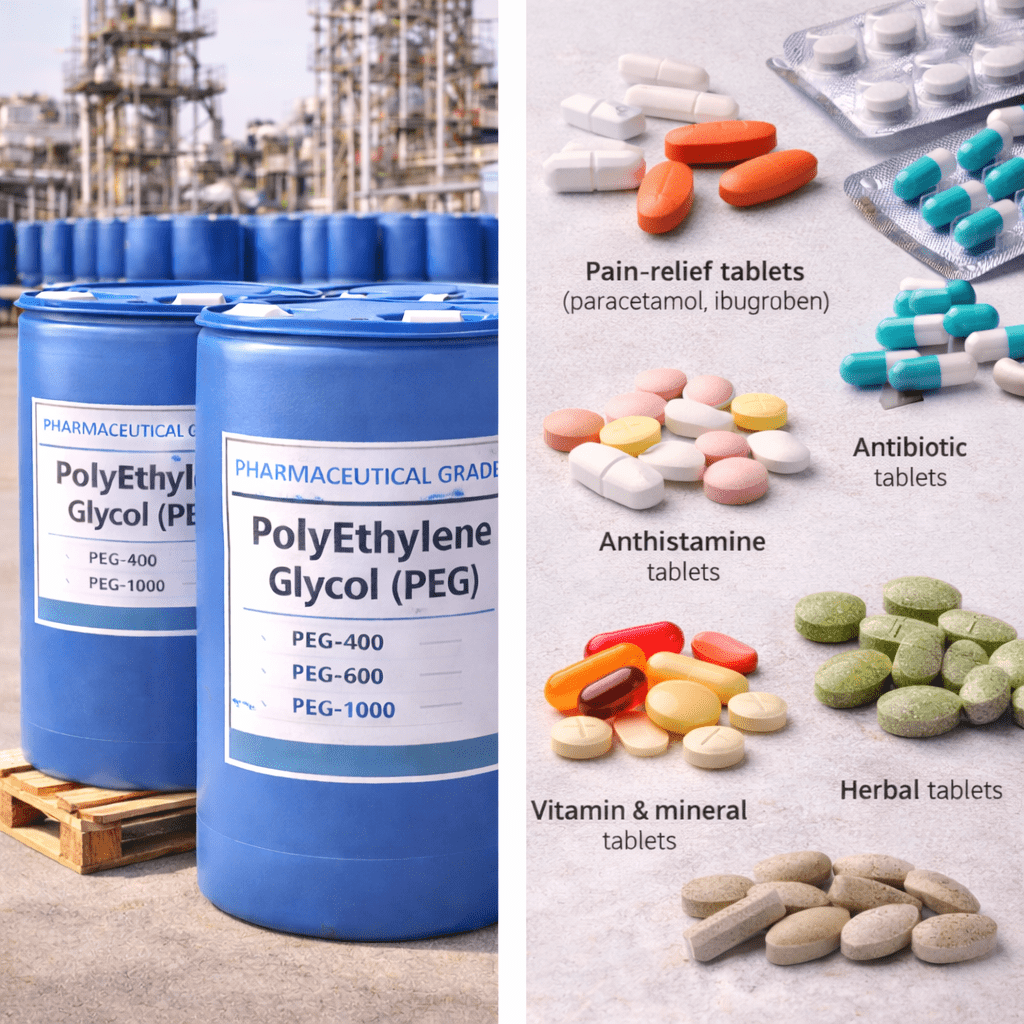 (PEG)
(PEG)
What Is Pharmaceutical Grade Polyethylene Glycol?
Pharmaceutical Grade Polyethylene Glycol is a highly purified grade of PEG specifically manufactured for use in pharmaceutical formulations and medical applications.
Due to its excellent solubility, chemical stability, low toxicity, and compatibility with active pharmaceutical ingredients (APIs), PEG has become one of the most widely used excipients in the pharmaceutical industry.
Pharmaceutical Grade PEG is produced under strict quality control conditions to ensure compliance with pharmaceutical standards and regulatory requirements.
Common pharmaceutical grades include:
- PEG 200
- PEG 300
- PEG 400
- PEG 600
- PEG 1000
- PEG 1500
- PEG 4000
- PEG 6000
The selection of PEG grade depends mainly on molecular weight, viscosity, physical form, and the intended pharmaceutical application.
Advantages of Pharmaceutical Grade Polyethylene Glycol
- High Purity and Strict Quality Control
Pharmaceutical PEG must meet strict requirements regarding:
- Purity
- Heavy metal content
- Residual impurities
- Microbial control (where applicable)
This ensures safe use in pharmaceutical formulations.
- Excellent Solubility and Compatibility
PEG is highly soluble in water and compatible with many pharmaceutical ingredients.
This makes it suitable as:
- Solvent
- Carrier
- Stabilizer
- Formulation aid
- Improved Drug Delivery Performance
PEG can improve the performance of pharmaceutical products by helping:
- Dissolve active ingredients
- Control release rates
- Improve formulation stability
- Wide Range of Molecular Weights
One of the major advantages of PEG is the availability of different molecular weights.
Low molecular weight PEG grades:
PEG 200, PEG 300, PEG 400
are usually liquid and used as solvents or carriers.
Higher molecular weight PEG grades:
PEG 4000, PEG 6000
are solid and commonly used as binders and coating materials.
Applications of Pharmaceutical Grade PEG
- Tablet and Capsule Manufacturing
High molecular weight PEG grades such as PEG 4000 and PEG 6000 are used as:
- Tablet binders
- Tablet coating agents
- Lubricating agents
Benefits:
- Improved tablet stability
- Better manufacturing process
- Controlled release properties
- Liquid Pharmaceutical Formulations
Low molecular weight PEG grades such as PEG 400 are widely used in:
- Oral solutions
- Syrups
- Liquid medicines
because of their:
- Excellent solvent properties
- Good stability
- Compatibility with active ingredients
- Topical Pharmaceutical Products
Pharmaceutical PEG is used in:
- Creams
- Ointments
- Gels
Functions:
- Improves texture
- Enhances ingredient distribution
- Provides moisture retention
- Suppository Manufacturing
Higher molecular weight PEG grades are commonly used as suppository bases.
Advantages:
- Controlled melting behavior
- Good stability
- Easy formulation
- Drug Delivery Systems
PEG technology is also used in advanced pharmaceutical applications such as:
- Controlled release systems
- Drug carriers
- Modified pharmaceutical formulations
Technical Specifications of Pharmaceutical Grade PEG
| Parameter | Typical Specification |
| Product Name | Pharmaceutical Grade Polyethylene Glycol |
| Appearance | Clear Liquid or White Solid |
| Molecular Weight | PEG 200 – PEG 6000 |
| Purity | Pharmaceutical Grade |
| Solubility | Completely Soluble in Water |
| Color | Colorless to White |
| Odor | Nearly Odorless |
| Heavy Metals | Controlled According to Pharmacopoeia Standards |
| Moisture | Controlled |
| Applications | Tablets, Capsules, Liquids, Creams, Drug Delivery |
Difference Between Pharmaceutical Grade PEG and Other Grades
| Feature | Pharmaceutical PEG | Food Grade PEG | Cosmetic Grade PEG | Industrial PEG |
| Main Use | Medicines | Food Applications | Personal Care | Industrial Production |
| Purity Requirement | Very High | Very High | High | Technical |
| Quality Control | Pharmaceutical Standards | Food Standards | Cosmetic Standards | Industrial Standards |
| Common Grades | PEG 400, PEG 6000 | PEG 200–600 | PEG 400–1000 | PEG 200–10000 |
| Main Advantage | Safety & Compatibility | Food Safety | Skin Formulation | Performance & Cost |
How to Select Pharmaceutical Grade PEG?
Before purchasing pharmaceutical PEG, buyers should confirm:
- Required Pharmacopoeia Standard
Depending on the target market, PEG may need to comply with:
- USP (United States Pharmacopeia)
- EP (European Pharmacopoeia)
- BP (British Pharmacopoeia)
- Molecular Weight Requirement
Examples:
- PEG 400 → Liquid formulations and solvents
- PEG 600 → Creams and formulations
- PEG 4000/6000 → Tablets and solid dosage forms
- Required Documentation
Pharmaceutical buyers should request:
- Certificate of Analysis (COA)
- Technical Data Sheet (TDS)
- Safety Data Sheet (SDS)
- Quality certificates
- Regulatory compliance documents
Understanding PEG Molecular Weight Grades
Polyethylene Glycol is often identified by numbers such as:
- PEG 200
- PEG 300
- PEG 400
- PEG 600
- PEG 1000
- PEG 1500
- PEG 4000
- PEG 6000
The number represents the approximate average molecular weight.
PEG 400
What Is PEG 400?
PEG 400 is one of the most widely used PEG grades.
It is a low molecular weight liquid with:
- Clear appearance
- Low viscosity
- Excellent solubility
Applications of PEG 400
Pharmaceutical Industry
Used as:
- Solvent
- Carrier
- Formulation ingredient
Cosmetic Industry
Used in:
- Creams
- Lotions
- Hair products
Benefits:
- Moisturizing effect
- Smooth texture
Industrial Applications
Used in:
- Lubricants
- Chemical formulations
- Processing aids
PEG 600
What Is PEG 600?
PEG 600 is a slightly higher molecular weight grade compared with PEG 400.
Properties:
- Higher viscosity
- Better thickening ability
- Good stability
Applications of PEG 600
Used in:
- Cosmetics
- Pharmaceuticals
- Industrial formulations
Advantages:
- Improved texture
- Better binding properties
- Enhanced stability
PEG 1000 and Higher Molecular Weight Grades
Higher molecular weight PEG products are usually solid materials.
Examples:
- PEG 1500
- PEG 4000
- PEG 6000
Applications
Used in:
- Tablet manufacturing
- Solid formulations
- Industrial additives
- Polymer processing
How to Select the Right Polyethylene Glycol Grade?
Before purchasing PEG, buyers should evaluate several factors:
- Determine Your Industry Requirement
First question:
Where will PEG be used?
Examples:
| Industry | Recommended Grade |
| Food Products | Food Grade PEG |
| Cosmetics | Cosmetic Grade PEG |
| Lubricants | Industrial Grade PEG |
| Pharmaceuticals | Pharmaceutical/Food Grade PEG |
| Textile | Industrial Grade PEG |
- Select Appropriate Molecular Weight
Lower molecular weight PEG:
Advantages:
- More fluid
- Better solvent properties
- Easier mixing
Examples:
PEG 200, PEG 400
Suitable for:
- Cosmetics
- Pharmaceuticals
- Liquid formulations
Higher molecular weight PEG:
Advantages:
- Higher viscosity
- Solid structure
- Better binding properties
Examples:
PEG 4000, PEG 6000
Suitable for:
- Solid formulations
- Industrial applications
- Check Required Certifications
Depending on the market, buyers may require:
- Certificate of Analysis (COA)
- Safety Data Sheet (SDS)
- Food compliance documents
- Quality certificates
- Technical Data Sheet (TDS)
- Evaluate Supplier Reliability
A reliable PEG supplier should provide:
- Stable quality
- Consistent specifications
- Proper packaging
- Export documentation
- Technical support
Packaging Options for Polyethylene Glycol Export
Common export packaging includes:
25 kg Bags
Suitable for:
- Small quantities
- Distributors
- Laboratories
50 kg Drums
Common for:
- Liquid PEG grades
- Industrial customers
200 kg Drums
Suitable for:
- Large industrial orders
- International shipments
IBC Tanks
Used for:
- Large volume liquid PEG transportation
Advantages:
- Efficient handling
- Lower packaging cost
Buying Polyethylene Glycol (PEG) from Iran: Complete Export Buying Guide
The global demand for Polyethylene Glycol (PEG) is continuously increasing due to its wide range of applications in food, cosmetics, pharmaceuticals, chemicals, and industrial manufacturing.
For international buyers, selecting the right supplier is not only about price. A successful purchase requires:
- Reliable product quality
- Correct technical grade
- Stable supply
- Export experience
- Proper documentation
- Competitive logistics
Iran has become an important source of chemical products due to its strong petrochemical industry, access to raw materials, competitive production costs, and strategic geographic location.
Through IRANCORPS, international buyers can access qualified Iranian suppliers and simplify the purchasing process.
Why Buy Polyethylene Glycol from Iranian Suppliers?
Iran has a developed chemical and petrochemical industry with experienced manufacturers producing various grades of chemical products.
Buying PEG from Iran can provide several advantages:
- Competitive Pricing
One of the main advantages of sourcing PEG from Iran is cost competitiveness.
Iranian suppliers benefit from:
- Availability of petrochemical raw materials
- Lower production costs
- Competitive manufacturing expenses
This allows international buyers to achieve:
- Better purchasing prices
- Higher profit margins
- More competitive final products
Compared with some international markets, Iranian suppliers can offer attractive pricing while maintaining industrial quality standards.
- Access to Experienced Chemical Producers
Iran has many experienced manufacturers and exporters in the chemical sector.
These suppliers have experience in producing and exporting:
- Polyethylene Glycol
- Industrial chemicals
- Petrochemical products
- Raw materials
Through IRANCORPS, buyers can connect with suitable suppliers based on:
- Required grade
- Quantity
- Destination country
- Application
- Flexible Supply Options
Different buyers have different requirements.
A reliable supplier should be able to provide:
- Small trial quantities
- Regular monthly supply
- Bulk shipments
Iranian suppliers can offer different packaging options including:
- Drums
- Bags
- IBC tanks
- Bulk shipments
- Strategic Geographic Location
Iran has an important geographical advantage because it connects:
- Asia
- Europe
- Middle East
- CIS countries
This provides efficient access to many markets.
Iranian PEG suppliers can serve customers in:
- Turkey
- Iraq
- UAE
- India
- China
- Central Asian countries
- European markets
- Export Documentation Support
International chemical purchases require accurate documentation.
Iranian exporters can provide:
- Commercial Invoice
- Packing List
- Certificate of Analysis (COA)
- Safety Data Sheet (SDS)
- Certificate of Origin
- Technical Data Sheet (TDS)
These documents help buyers complete:
- Customs clearance
- Import procedures
- Quality verification
IRANCORPS: Your Export Marketing Partner for Iranian Products
About IRANCORPS
IRANCORPS is an export marketing group specialized in introducing and connecting international buyers with reliable Iranian suppliers.
Our mission is to simplify international trade by providing access to verified Iranian producers and exporters.
Instead of searching through many suppliers, buyers can use IRANCORPS as a professional sourcing partner.
Advantages of Buying Through IRANCORPS
- Access to Verified Iranian Suppliers
Finding a reliable supplier in a foreign country can be challenging.
IRANCORPS helps buyers by:
- Identifying suitable manufacturers
- Evaluating supplier capabilities
- Connecting buyers with trusted exporters
This reduces the risks of working with unknown companies.
- Saving Time and Reducing Search Costs
International buyers often spend significant time searching for:
- Manufacturers
- Exporters
- Price quotations
- Technical information
IRANCORPS simplifies this process.
Instead of contacting multiple suppliers, buyers can send their requirements once and receive suitable offers.
- Technical Product Matching
Choosing the wrong PEG grade can create production problems.
For example:
A cosmetic manufacturer needs:
- Cosmetic Grade PEG
- Suitable molecular weight
- Proper purity level
An industrial buyer may need:
- Industrial Grade PEG
- Different viscosity
- Different specifications
IRANCORPS helps match buyers with the correct product specifications.
- Communication Support
International trade sometimes faces communication challenges.
IRANCORPS helps facilitate:
- Supplier communication
- Technical discussions
- Price negotiations
- Order coordination
This creates smoother cooperation between buyers and Iranian suppliers.
- Quality Control Assistance
Product quality is one of the most important concerns in chemical purchasing.
IRANCORPS can help buyers review:
- Technical specifications
- COA documents
- Product samples
- Supplier information
This helps reduce purchasing risks.
- Better Price Negotiation
Because IRANCORPS works with multiple Iranian suppliers, buyers can compare available options.
Benefits:
- More competitive prices
- Better payment terms
- Suitable suppliers based on volume
- Export Process Support
International chemical trade requires coordination between different parties:
- Supplier
- Buyer
- Transport company
- Customs agents
IRANCORPS helps coordinate the export process to make transactions easier.
Comparison: Buying Directly vs Buying Through IRANCORPS
| Factor | Direct Factory Purchase | Through IRANCORPS |
| Supplier Search | Buyer must search | Supplier selection support |
| Market Knowledge | Limited | Local market knowledge |
| Negotiation | Buyer alone | Professional support |
| Supplier Verification | Buyer responsibility | Assistance provided |
| Product Selection | Buyer decides | Technical matching |
| Communication | Possible language barriers | Easier coordination |
| Time Required | More time-consuming | Faster sourcing |
| Risk Management | Higher responsibility | Reduced risk |
Why International Buyers Choose Iranian Chemical Suppliers?
Competitive Manufacturing Costs
Iran’s chemical industry benefits from access to domestic raw materials, allowing competitive pricing.
Reliable Production Capacity
Iran has developed chemical production infrastructure capable of supplying domestic and international markets.
Wide Product Portfolio
Iranian suppliers can provide many chemical products including:
- Polyethylene Glycol
- Solvents
- Acids
- Industrial chemicals
- Mineral products
Suitable for Regional Markets
Due to transportation advantages, Iran can efficiently supply nearby regions.
Important Questions Before Purchasing Polyethylene Glycol
Before placing an order, buyers should confirm:
- What Grade Do You Need?
Food Grade?
Cosmetic Grade?
Industrial Grade?
The application determines the required quality.
- What Molecular Weight Is Required?
Examples:
PEG 400:
- Liquid
- Low viscosity
- Solvent applications
PEG 6000:
- Solid
- Higher viscosity
- Binding applications
- What Documents Are Required?
Confirm availability of:
- COA
- SDS
- TDS
- Certificate of Origin
- What Packaging Is Required?
Select based on:
- Order quantity
- Transportation method
- Storage conditions
Polyethylene Glycol (PEG) Technical Specifications by Grade and Application
Selecting the correct Polyethylene Glycol grade requires understanding the relationship between molecular weight, purity, viscosity, and final application.
Different industries require different PEG characteristics. A PEG grade suitable for cosmetics may not be suitable for industrial applications, and food-grade requirements are usually much stricter.
General Technical Data of Polyethylene Glycol
| Parameter | Typical Specification |
| Product Name | Polyethylene Glycol (PEG) |
| Chemical Formula | HO-(CH₂CH₂O)n-H |
| Appearance | Clear Liquid or White Solid |
| Solubility | Completely Soluble in Water |
| Molecular Weight Range | PEG 200 – PEG 10000+ |
| Color | Colorless to White |
| Odor | Nearly Odorless |
| pH Value | Approximately 5–7 |
| Stability | Stable Under Normal Storage Conditions |
| Main Applications | Food, Cosmetics, Pharmaceuticals, Chemical Industries |
PEG Grade Selection Guide Based on Application
Food Industry
Recommended Grades:
- Food Grade PEG 200
- Food Grade PEG 400
- Food Grade PEG 600
Required Properties:
| Property | Requirement |
| Purity | Very High |
| Heavy Metals | Extremely Low |
| Color | Clear and Transparent |
| Odor | Neutral |
| Solubility | Excellent |
Main Uses:
- Food additives
- Processing aids
- Stabilizers
- Carrier systems
Cosmetic Industry
Recommended Grades:
- Cosmetic Grade PEG 400
- Cosmetic Grade PEG 600
- Cosmetic Grade PEG 1000
Required Properties:
| Property | Requirement |
| Purity | High |
| Moisture Control | Excellent |
| Skin Compatibility | Required |
| Texture Improvement | Important |
| Stability | High |
Main Uses:
- Moisturizers
- Creams
- Lotions
- Shampoo
- Hair care products
- Toothpaste
Pharmaceutical Industry
Although this article focuses on food, cosmetic, and industrial grades, PEG is also widely used in pharmaceutical manufacturing.
Common grades:
- PEG 400
- PEG 600
- PEG 4000
- PEG 6000
Applications:
- Tablet coating
- Drug carriers
- Syrups
- Formulation ingredients
Required properties:
- Pharmaceutical purity
- Controlled molecular weight
- Low impurities
Industrial Applications
Recommended Grades:
- PEG 200
- PEG 400
- PEG 600
- PEG 1000+
- PEG 4000
- PEG 6000
Required Properties:
| Property | Requirement |
| Viscosity Control | Important |
| Thermal Stability | High |
| Compatibility | Excellent |
| Cost Efficiency | Important |
Applications:
- Lubricants
- Textile processing
- Metalworking fluids
- Coatings
- Adhesives
- Plastics
PEG 400 vs PEG 600 vs PEG 4000 Comparison
| Feature | PEG 400 | PEG 600 | PEG 4000 |
| Physical Form | Liquid | Liquid / Semi-solid | Solid |
| Molecular Weight | Low | Medium | High |
| Viscosity | Low | Medium | High |
| Water Solubility | Excellent | Excellent | Excellent |
| Main Uses | Solvent, Cosmetics | Cosmetics, Pharma | Tablets, Industrial |
| Appearance | Clear Liquid | Clear Viscous Liquid | White Solid |
Polyethylene Glycol Storage and Handling
Proper storage helps maintain PEG quality during transportation and long-term storage.
Storage Recommendations:
- Keep in a dry and clean warehouse
- Protect from extreme temperatures
- Keep containers tightly closed
- Avoid contamination
Packaging Options
Depending on grade and quantity:
Small Packaging
- 25 kg bags
- 25 kg drums
Suitable for:
- Laboratories
- Small manufacturers
- Distributors
Industrial Packaging
- 50 kg drums
- 200 kg drums
- IBC tanks
Suitable for:
- Large factories
- Export shipments
- Continuous production
How to Buy High-Quality Polyethylene Glycol?
A professional purchasing process should include the following steps:
Step 1: Define Your Application
Before buying, determine:
- Industry
- Final product
- Required performance
Example:
A cosmetics manufacturer requires Cosmetic Grade PEG, while a lubricant producer needs Industrial Grade PEG.
Step 2: Select the Correct Molecular Weight
Low molecular weight:
Suitable for:
- Solvent applications
- Liquid formulations
Examples:
PEG 200, PEG 400
Medium molecular weight:
Suitable for:
- Creams
- Personal care
- Formulation systems
Examples:
PEG 600, PEG 1000
High molecular weight:
Suitable for:
- Solid applications
- Binding systems
Examples:
PEG 4000, PEG 6000
Step 3: Request Technical Documents
Before purchasing, request:
Certificate of Analysis (COA)
Including:
- Purity
- Molecular weight
- Viscosity
- Moisture
- Quality parameters
Safety Data Sheet (SDS)
Including:
- Handling information
- Storage conditions
- Safety instructions
Technical Data Sheet (TDS)
Including:
- Product characteristics
- Recommended applications
Why Choose IRANCORPS for Polyethylene Glycol Supply?
Your Gateway to Reliable Iranian Exporters
IRANCORPS works as an export marketing group connecting international buyers with qualified Iranian suppliers.
Our role is not only introducing suppliers but also helping buyers find the right product, grade, and commercial solution.
Benefits of Working With IRANCORPS
- Reliable Supplier Network
We connect buyers with Iranian producers and exporters who can supply:
- Food Grade PEG
- Cosmetic Grade PEG
- Industrial Grade PEG
- Product Selection Support
Many buyers know the product name but need guidance about:
- Correct grade
- Molecular weight
- Technical requirements
IRANCORPS helps identify the best option according to application.
- Competitive Export Prices
By accessing Iranian suppliers directly, buyers can benefit from:
- Competitive pricing
- Reduced sourcing costs
- Better market access
- International Trade Assistance
We help simplify:
- Supplier communication
- Quotation process
- Documentation
- Export coordination
- Access to Iranian Industrial Capabilities
Iran has strong capabilities in:
- Petrochemical products
- Chemical raw materials
- Industrial minerals
- Agricultural commodities
IRANCORPS helps international buyers access these resources.
Frequently Asked Questions (FAQ)
What is Polyethylene Glycol (PEG)?
Polyethylene Glycol is a water-soluble polymer widely used in food, cosmetics, pharmaceuticals, and industrial applications due to its stability and versatility.
What is the difference between Food Grade PEG and Industrial Grade PEG?
Food Grade PEG requires higher purity and stricter control of impurities because it is used in food-related applications. Industrial Grade PEG is designed mainly for technical applications such as lubricants, coatings, and manufacturing processes.
Which PEG grade is used in cosmetics?
Cosmetic manufacturers commonly use PEG 400, PEG 600, and PEG 1000 because of their moisturizing properties and ability to improve product texture.
What is PEG 400 used for?
PEG 400 is mainly used in:
- Cosmetics
- Pharmaceuticals
- Food applications
- Industrial formulations
because of its excellent solubility and low viscosity.
What is PEG 600 used for?
PEG 600 has higher viscosity than PEG 400 and is commonly used in:
- Creams
- Personal care products
- Pharmaceutical formulations
- Industrial applications
Can PEG be exported internationally?
Yes. Polyethylene Glycol is widely traded internationally. Export requirements depend on destination country regulations and application.
Conclusion
Polyethylene Glycol (PEG) is a highly versatile chemical product with applications across multiple industries. Choosing the correct grade is essential for achieving the desired performance.
The main commercial categories include:
- Food Grade Polyethylene Glycol for food and sensitive applications
- Cosmetic Grade Polyethylene Glycol for personal care products
- Industrial Grade Polyethylene Glycol for manufacturing and technical uses
- Pharmaceutical Grade Polyethylene Glycol for manufacturing medicines
For international buyers, sourcing PEG from reliable Iranian suppliers through IRANCORPS provides advantages including:
- Access to verified exporters
- Competitive prices
- Technical support
- Easier communication
- Reliable export coordination
By selecting the correct PEG grade and working with a professional sourcing partner, buyers can achieve better quality, lower risks, and a more efficient international purchasing process.
To order please visit : www.irancorps.com