
 Arabic
Blog
Cold Plastic Acrylic Resin has become one of the most important raw materials in modern road marking systems, industrial coatings, and construction applications. Its excellent weather resistance, fast curing characteristics, strong adhesion, and long service life make it the preferred choice for manufacturers producing high-performance cold plastic road marking materials.
As global infrastructure projects continue to expand, the demand for premium-quality acrylic resins has increased steadily. Governments and private contractors require durable road marking systems capable of maintaining visibility under heavy traffic, harsh weather conditions, and continuous UV exposure. Consequently, manufacturers and distributors are seeking reliable Cold Plastic Acrylic Resin suppliers who can provide consistent quality, flexible packaging, and dependable international logistics.
For industrial buyers, selecting the right resin involves much more than comparing prices. Factors such as resin grade, molecular characteristics, glass transition temperature (Tg), softening point, adhesion performance, and compatibility with fillers and pigments all influence the performance of the final product.
This guide explains everything buyers, manufacturers, and distributors should know about Cold Plastic Acrylic Resin, including its properties, available grades, industrial applications, technical specifications, and the key factors to consider when selecting a supplier.
What Is Cold Plastic Acrylic Resin?
Cold Plastic Acrylic Resin is a high-performance thermoplastic acrylic polymer specifically designed for the production of cold plastic road marking materials and various industrial coating systems.
Unlike conventional thermoplastic road marking compounds that require heating before application, cold plastic systems cure at ambient temperatures through chemical reactions. The acrylic resin acts as the primary binder, providing excellent adhesion, durability, weather resistance, and mechanical strength.
Depending on the formulation, the resin may be supplied as white flakes, granules, or powder and is later dissolved or dispersed during manufacturing.
Its versatility also makes it suitable for protective coatings, concrete coatings, industrial flooring, and specialty adhesive formulations.
Why Cold Plastic Acrylic Resin Is Widely Used
Modern road marking systems demand materials capable of performing under extremely challenging environmental conditions.
Cold Plastic Acrylic Resin offers several performance advantages:
- Outstanding weather resistance
- Excellent UV stability
- Strong adhesion to asphalt and concrete
- Fast curing performance
- High abrasion resistance
- Long service life
- Chemical resistance
- Excellent color retention
- Easy formulation with pigments and fillers
- Low maintenance requirements
Because of these properties, many countries have gradually shifted from conventional traffic paints toward high-performance cold plastic systems for highways, airports, parking facilities, bicycle lanes, pedestrian crossings, and industrial flooring.
General Technical Specifications
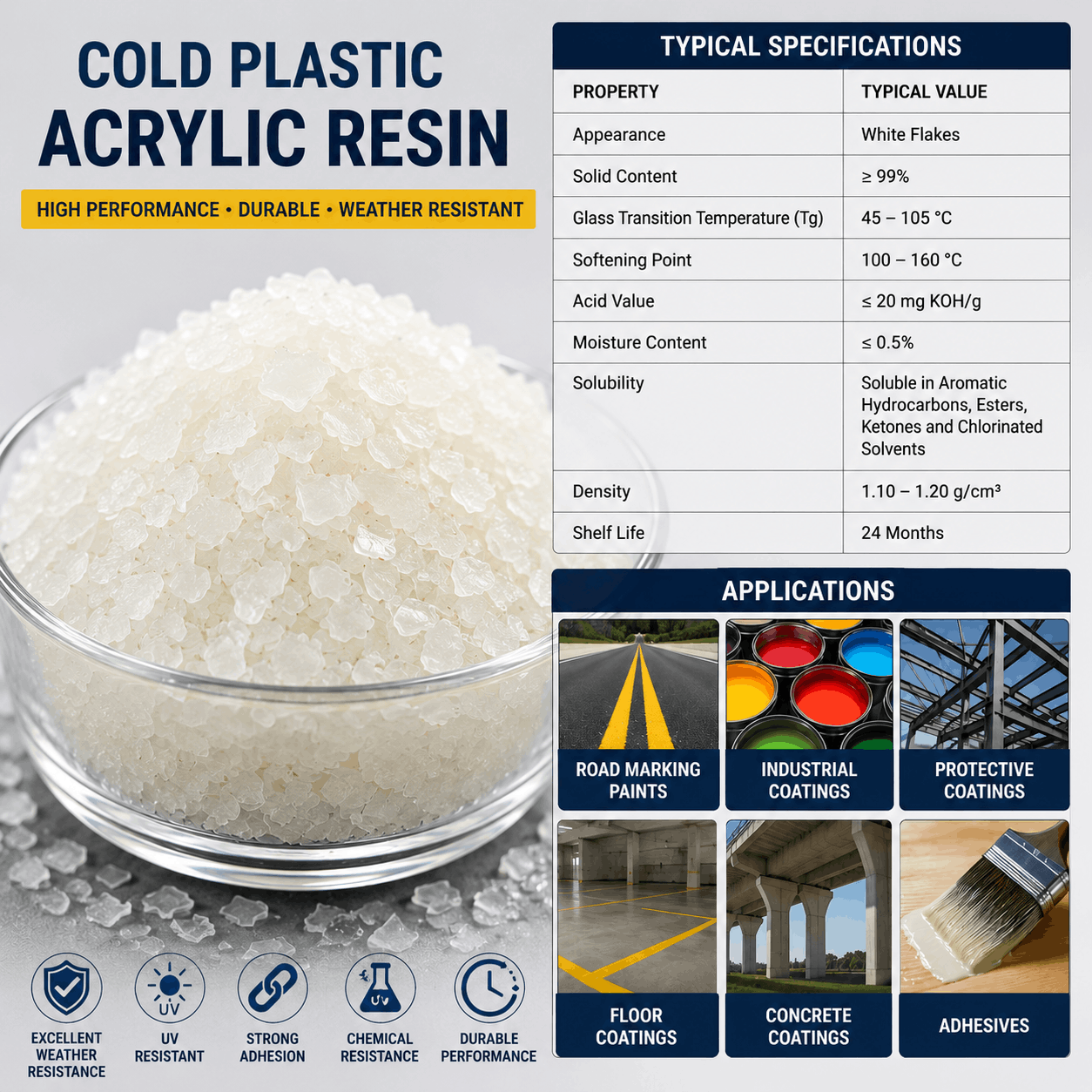
The following table presents typical specifications commonly used for industrial-grade Cold Plastic Acrylic Resin.
| Property | Typical Specification |
| Product Name | Cold Plastic Acrylic Resin |
| Chemical Family | Thermoplastic Acrylic Polymer |
| Appearance | White Flakes or Granules |
| Color | White |
| Solid Content | ≥99% |
| Density | 1.10–1.20 g/cm³ |
| Glass Transition Temperature (Tg) | 45–105°C |
| Softening Point | 100–160°C |
| Acid Value | ≤20 mg KOH/g |
| Moisture Content | ≤0.5% |
| Solubility | Soluble in Aromatic Hydrocarbons, Esters and Ketones |
| Water Solubility | Insoluble |
| UV Resistance | Excellent |
| Weather Resistance | Excellent |
| Abrasion Resistance | Excellent |
| Chemical Resistance | Good to Excellent |
| Adhesion | Excellent |
| Shelf Life | 24 Months |
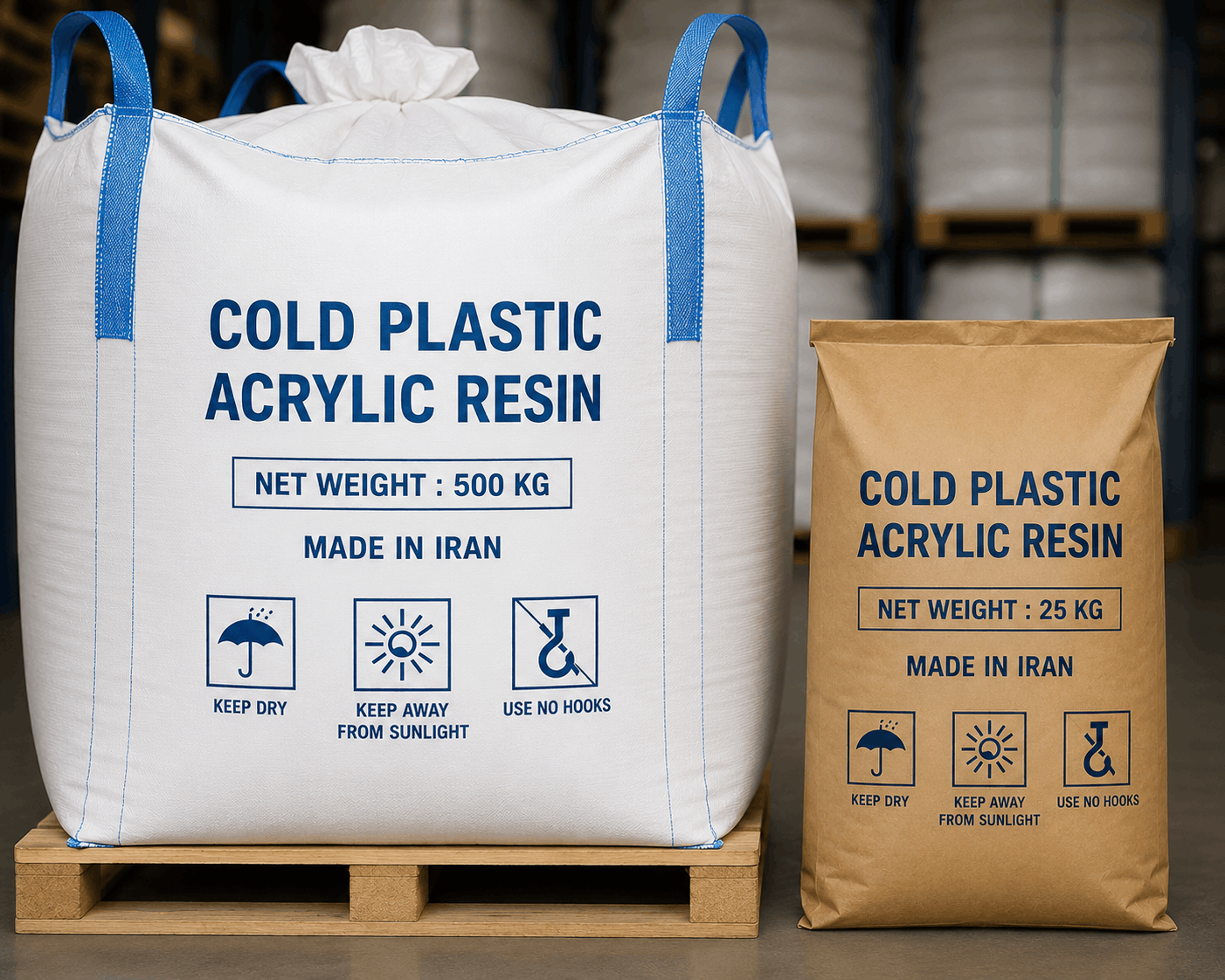
| Packaging | 25 kg Paper Bag, 500 kg Jumbo Bag, 1000 kg Jumbo Bag |
The values shown above are typical specifications. Actual values may vary depending on resin grade and manufacturer.
Chemical Characteristics
Cold Plastic Acrylic Resin belongs to the acrylic polymer family.
Its molecular structure provides:
- Excellent transparency
- Stable molecular backbone
- High mechanical strength
- Superior outdoor durability
- Resistance to yellowing
- Strong compatibility with pigments
- Excellent gloss retention
The resin also exhibits excellent resistance against moisture, ultraviolet radiation, oxidation, and many industrial chemicals.
Key Performance Benefits
Outstanding Weather Resistance
Road markings are continuously exposed to sunlight, rain, snow, temperature fluctuations, vehicle traffic, and environmental pollution.
Cold Plastic Acrylic Resin maintains its mechanical properties under these harsh conditions, helping extend the service life of road markings.
Excellent UV Stability
One of the major causes of coating failure is ultraviolet degradation.
Premium acrylic resins maintain color stability even after prolonged outdoor exposure, minimizing fading and discoloration.
High Abrasion Resistance
Road markings experience constant wear from vehicle tires.
Cold Plastic Acrylic Resin provides excellent resistance to abrasion, helping maintain line thickness and visibility over time.
Strong Adhesion
Proper adhesion is essential for durable road markings.
The resin bonds effectively with:
- Asphalt
- Concrete
- Cement surfaces
- Industrial flooring
- Various mineral substrates
Excellent adhesion reduces peeling, cracking, and premature failure.
Fast Drying Performance
Cold plastic systems cure much faster than many conventional traffic paints.
Fast curing provides several advantages:
- Reduced traffic disruption
- Faster project completion
- Lower labor costs
- Improved productivity
Major Industrial Applications
Although primarily associated with road marking materials, Cold Plastic Acrylic Resin is used in many industries.
Road Marking Systems
This remains the largest application worldwide.
Typical products include:
- Highway lane markings
- Urban traffic lines
- Bicycle lanes
- Airport markings
- Parking lots
- Pedestrian crossings
- Industrial safety markings
Industrial Floor Coatings
Industrial facilities require durable floor coatings capable of withstanding:
- Heavy machinery
- Forklift traffic
- Chemical spills
- Frequent cleaning
Cold Plastic Acrylic Resin contributes to coatings with high durability and excellent adhesion.
Protective Coatings
Manufacturers use acrylic resins to formulate protective coatings for:
- Steel structures
- Concrete infrastructure
- Bridges
- Parking garages
- Warehouses
- Industrial equipment
These coatings help protect substrates against moisture, UV exposure, and environmental degradation.
Concrete Coatings
Concrete surfaces benefit from acrylic resin systems because they offer:
- Improved durability
- Water resistance
- Better appearance
- Reduced dust formation
- Enhanced chemical resistance
Adhesive Formulations
Some specialty adhesive systems incorporate acrylic resin to improve:
- Bond strength
- Durability
- Weather resistance
- Flexibility
Common Packaging Options
Industrial suppliers typically offer several packaging formats depending on customer requirements.
| Packaging Type | Typical Capacity | Recommended For |
| Kraft Paper Bag | 25 kg | Standard industrial supply |
| Jumbo Bag | 500 kg | Medium-volume production |
| Jumbo Bag | 1000 kg | Large-scale manufacturing |
| Customized Packaging | Upon Request | OEM and export customers |
Proper packaging protects the resin from moisture, contamination, and physical damage during transportation and storage.
Why Purchase from a Professional Supplier?
Choosing an experienced supplier provides more than just access to raw materials.
A professional supplier can offer:
- Consistent product quality
- Multiple resin grades
- Stable production capacity
- Technical documentation (TDS, COA, SDS)
- Export packaging
- Flexible logistics
- Technical support
- Competitive international pricing
These capabilities are particularly important for manufacturers who require consistent product performance and uninterrupted production.
Understanding Cold Plastic Acrylic Resin Grades
One of the most important considerations when purchasing Cold Plastic Acrylic Resin is selecting the appropriate grade. Although all acrylic resins belong to the same polymer family, their physical and chemical properties can vary significantly depending on molecular weight, glass transition temperature (Tg), molecular structure, softening point, and intended application.
Choosing the correct grade improves processing efficiency, product durability, and overall manufacturing performance.
Professional suppliers typically offer multiple grades to meet the requirements of different industries and climatic conditions.
Common Resin Grades
Although grading systems differ among manufacturers, Cold Plastic Acrylic Resins are generally classified according to their performance characteristics.
| Grade Type | Typical Characteristics | Main Applications |
| Standard Grade | Balanced performance and cost | General road marking |
| High Tg Grade | Better heat resistance | Hot climate road marking |
| High Adhesion Grade | Superior bonding strength | Concrete and asphalt |
| Fast Cure Grade | Rapid curing | Highway maintenance |
| High Durability Grade | Excellent abrasion resistance | Heavy traffic roads |
| Premium Weather Resistant Grade | Outstanding UV stability | Outdoor infrastructure |
Selecting the appropriate grade depends on the project’s technical requirements rather than price alone.
How to Choose the Right Resin Grade
Industrial buyers should evaluate several technical factors before selecting a resin.
- Climate Conditions
Environmental temperature has a significant influence on road marking performance.
For hot climates:
- Higher Tg
- Better heat resistance
- Improved deformation resistance
For colder regions:
- Better flexibility
- Improved crack resistance
- Enhanced low-temperature performance
- Traffic Volume
Roads carrying heavy truck traffic require resins with:
- High abrasion resistance
- Excellent mechanical strength
- Long-term durability
- Superior adhesion
Low-traffic applications may use more economical grades.
- Surface Type
The substrate affects resin selection.
Examples include:
Asphalt
Requires excellent flexibility and adhesion.
Concrete
Needs stronger bonding and chemical resistance.
Industrial Flooring
Requires high wear resistance and chemical durability.
- Expected Service Life
Permanent highway markings generally require premium resin grades capable of maintaining visibility for several years.
Temporary or low-traffic applications may use standard grades.
Typical Cold Plastic Road Marking Formulation
Cold Plastic Acrylic Resin is only one component of a complete road marking formulation.
A typical formulation may include:
| Component | Function |
| Cold Plastic Acrylic Resin | Primary Binder |
| Titanium Dioxide | White Pigment |
| Colored Pigments | Color Development |
| Calcium Carbonate | Filler |
| Glass Beads | Night Visibility |
| Peroxide Initiator | Polymerization |
| Accelerator | Faster Curing |
| Additives | Performance Improvement |
Each ingredient contributes to the final performance of the road marking material.
Importance of Glass Transition Temperature (Tg)
One of the most critical resin properties is the Glass Transition Temperature.
The Tg represents the temperature at which the polymer changes from a rigid glassy state to a softer, more flexible state.
Higher Tg generally provides:
- Better heat resistance
- Improved abrasion resistance
- Increased hardness
- Better dimensional stability
Lower Tg generally provides:
- Higher flexibility
- Better crack resistance
- Improved low-temperature performance
Professional manufacturers carefully select the Tg according to local climate conditions.
Softening Point
The softening point influences the resin’s behavior during storage, transportation, and service.
Higher softening point offers:
- Better storage stability
- Reduced deformation
- Improved resistance to hot weather
Lower softening point may improve:
- Processing efficiency
- Solubility
- Formulation flexibility
Quality Control
Reliable manufacturers perform strict quality inspections throughout production.
Typical laboratory tests include:
| Test | Purpose |
| Appearance | Visual quality |
| Color | Product consistency |
| Density | Production control |
| Moisture Content | Storage stability |
| Acid Value | Chemical quality |
| Softening Point | Performance verification |
| Glass Transition Temperature | Grade confirmation |
| Solubility | Processing performance |
| Ash Content | Purity control |
Every production batch should be tested before shipment.
Technical Documents Every Buyer Should Request
Professional suppliers provide complete technical documentation with each shipment.
Technical Data Sheet (TDS)
The TDS summarizes the product’s physical and chemical properties.
Typical information includes:
- Product description
- Appearance
- Density
- Tg
- Softening Point
- Solubility
- Shelf Life
- Storage Conditions
- Recommended Applications
The TDS helps engineers determine whether the resin meets formulation requirements.
Certificate of Analysis (COA)
Unlike the TDS, the COA reports actual laboratory results for the shipment.
Typical COA information includes:
- Batch Number
- Manufacturing Date
- Appearance
- Density
- Moisture Content
- Acid Value
- Softening Point
- Test Results
- Quality Approval
Buyers should compare COA values with their purchasing specifications before accepting delivery.
Safety Data Sheet (SDS)
The SDS contains information regarding:
- Safe handling
- Personal protective equipment
- Fire-fighting measures
- Spill response
- Transportation
- Disposal recommendations
Maintaining updated SDS documentation is an important part of industrial safety management.
Packaging Options
Professional suppliers generally provide several packaging formats.
| Packaging | Typical Capacity |
| Kraft Paper Bag | 25 kg |
| Jumbo Bag | 500 kg |
| Jumbo Bag | 1000 kg |
| Customized Packaging | Upon Request |
Packaging selection depends on:
- Production capacity
- Storage facilities
- Shipping method
- Customer preference
Strong export packaging minimizes product damage during international transportation.
Storage Recommendations
Proper storage helps preserve resin quality throughout its shelf life.
Recommended storage conditions include:
- Keep bags tightly sealed.
- Store in a cool, dry warehouse.
- Protect from direct sunlight.
- Avoid excessive humidity.
- Prevent contamination.
- Stack bags properly.
- Use First-In, First-Out (FIFO) inventory management.
When stored correctly, Cold Plastic Acrylic Resin typically has a shelf life of up to 24 months.
Transportation and Export
Bulk shipments are commonly transported by:
- Sea freight
- Truck
- Rail
For international shipments, suppliers should ensure that packaging is suitable for long-distance transportation and complies with export requirements.
Typical export documents include:
- Commercial Invoice
- Packing List
- Certificate of Origin
- Bill of Lading
- Technical Data Sheet (TDS)
- Certificate of Analysis (COA)
- Safety Data Sheet (SDS)
Providing complete documentation helps streamline customs clearance and reduces delays.
Cold Plastic Acrylic Resin Supplier, Grades and Applications (Part 3)
Choosing a Reliable Cold Plastic Acrylic Resin Supplier
Selecting the right supplier is just as important as selecting the right resin grade. A dependable supplier helps ensure consistent product quality, stable deliveries, and long-term production reliability.
When evaluating potential suppliers, industrial buyers should consider more than just the quoted price. Production capabilities, quality assurance systems, export experience, and technical support all play a significant role in building a reliable supply chain.
Key Qualities of a Professional Supplier
A reputable Cold Plastic Acrylic Resin supplier should offer:
- Consistent product quality
- Multiple resin grades for different applications
- Comprehensive technical documentation (TDS, COA, and SDS)
- Flexible packaging options
- Stable production capacity
- Competitive international pricing
- Reliable export logistics
- Responsive customer service
- Technical support for formulation and product selection
Suppliers with experience in international trade are often better equipped to manage customs documentation, shipping schedules, and destination-specific requirements.
Bulk Supply Solutions
Industrial customers require packaging and logistics solutions that match their production scale. Reliable suppliers typically offer a range of bulk packaging options to accommodate different order sizes.
| Packaging Type | Capacity | Typical Use |
| Kraft Paper Bag | 25 kg | Standard industrial orders |
| Jumbo Bag | 500 kg | Medium-scale production |
| Jumbo Bag | 1000 kg | Large-volume manufacturing |
| Customized Packaging | On Request | OEM and private-label projects |
Bulk packaging offers several advantages:
- Lower packaging costs
- Easier warehouse handling
- Reduced waste
- Improved shipping efficiency
- Better inventory management
Export and International Logistics
Cold Plastic Acrylic Resin is supplied to customers worldwide through established international shipping networks.
Common delivery terms include:
- EXW (Ex Works)
- FOB (Free on Board)
- CFR (Cost and Freight)
- CIF (Cost, Insurance and Freight)
The most suitable Incoterm depends on the buyer’s logistics capabilities and destination.
Professional exporters also provide export documentation such as:
- Commercial Invoice
- Packing List
- Certificate of Origin
- Bill of Lading
- Technical Data Sheet (TDS)
- Certificate of Analysis (COA)
- Safety Data Sheet (SDS)
Complete documentation helps facilitate customs clearance and minimizes the risk of shipment delays.
Factors Affecting Cold Plastic Acrylic Resin Prices
Several factors influence the market price of Cold Plastic Acrylic Resin.
Raw Material Costs
The price of acrylic monomers and other feedstocks has a direct impact on production costs.
Resin Grade
Premium grades with enhanced weather resistance, higher Tg, or specialized performance characteristics generally command higher prices than standard grades.
Order Volume
Bulk purchases often benefit from:
- Lower unit costs
- Better freight efficiency
- Reduced packaging expenses
- Preferential commercial terms
Packaging
The choice between 25 kg paper bags, jumbo bags, or customized packaging affects overall costs.
Freight Costs
Ocean freight rates, fuel prices, insurance, and port charges all contribute to the final landed cost of imported materials.
Currency Exchange Rates
Since most international transactions are conducted in major currencies such as USD or EUR, exchange rate fluctuations can significantly impact purchasing costs.
Global Market Trends
Demand for Cold Plastic Acrylic Resin continues to grow due to increased investment in transportation infrastructure and urban development.
Key trends include:
- Expansion of highway construction projects
- Growth in airport and seaport infrastructure
- Increasing demand for long-lasting road marking systems
- Greater focus on road safety and visibility
- Rising adoption of high-performance coating technologies
Manufacturers are also developing resin grades with improved durability, faster curing, and enhanced environmental performance to meet evolving industry requirements.
Why Long-Term Supplier Relationships Matter
Developing a long-term partnership with a reliable supplier offers several benefits:
- Stable product quality
- Consistent supply availability
- Priority production scheduling
- Improved technical collaboration
- Better commercial conditions
- More accurate production planning
- Reduced procurement risks
Strong supplier relationships can contribute to greater operational efficiency and lower total procurement costs over time.
Frequently Asked Questions (FAQ)
- What is Cold Plastic Acrylic Resin?
Cold Plastic Acrylic Resin is a thermoplastic acrylic polymer used as the primary binder in cold plastic road marking materials, industrial coatings, and related applications.
- What are the main applications of Cold Plastic Acrylic Resin?
Its primary applications include:
- Road marking systems
- Traffic safety coatings
- Industrial floor coatings
- Protective coatings
- Concrete coatings
- Specialty adhesive formulations
- How do I choose the right resin grade?
Selection depends on factors such as climate, traffic conditions, substrate type, curing requirements, and desired service life.
- What is Glass Transition Temperature (Tg)?
The Glass Transition Temperature indicates the point at which the polymer changes from a rigid state to a more flexible one. It plays a key role in determining heat resistance and mechanical performance.
- Why is UV resistance important?
Excellent UV resistance helps maintain color stability, gloss, and long-term durability under outdoor exposure.
- How is the resin packaged?
Typical packaging options include:
- 25 kg kraft paper bags
- 500 kg jumbo bags
- 1000 kg jumbo bags
- Customized packaging upon request
- What documents should accompany a shipment?
Standard documentation includes the Technical Data Sheet (TDS), Certificate of Analysis (COA), Safety Data Sheet (SDS), Commercial Invoice, Packing List, and Certificate of Origin.
- What is the typical shelf life?
When stored under recommended conditions, the resin generally has a shelf life of approximately 24 months.
- Is the resin suitable for both asphalt and concrete?
Yes. Cold Plastic Acrylic Resin provides excellent adhesion to both asphalt and concrete when used in properly formulated systems.
- Can the resin be customized?
Many manufacturers offer different grades and performance characteristics to meet specific customer requirements.
- Why is quality consistency important?
Consistent quality ensures reliable processing, predictable performance, and reduced production variability.
- What factors affect pricing?
Pricing depends on resin grade, raw material costs, order volume, packaging, freight rates, and market conditions.
- Why should I request a COA?
A Certificate of Analysis verifies that the supplied batch meets the agreed technical specifications.
- How should the resin be stored?
Store it in a cool, dry, well-ventilated area, protected from moisture, direct sunlight, and excessive heat.
- What should I consider when selecting a supplier?
Evaluate production capacity, quality control, technical support, export experience, packaging flexibility, and responsiveness—not just price.
Conclusion
Cold Plastic Acrylic Resin is a critical raw material for high-performance road marking systems and a wide range of industrial coating applications. Its excellent adhesion, weather resistance, UV stability, abrasion resistance, and durability make it a preferred choice for manufacturers seeking long-lasting performance.
Selecting the right resin grade is essential for achieving the desired balance of curing speed, flexibility, heat resistance, and service life. Equally important is choosing a supplier capable of delivering consistent quality, comprehensive technical documentation, flexible packaging, and dependable international logistics.
For manufacturers, distributors, and procurement professionals, partnering with an experienced Cold Plastic Acrylic Resin supplier can improve production efficiency, reduce supply chain risks, and support long-term business success.
Whether your requirement is a standard grade for general road marking or a specialized resin for demanding industrial applications, careful supplier evaluation and a clear understanding of technical specifications will help ensure the best value and performance.
Source : IRANCORPS