
 Arabic
Blog
Choosing the right vinyl top coat is an important decision for any industrial coating project. The top coat is the final protective layer of a coating system and is often the part of the system that is directly exposed to sunlight, moisture, chemicals, salt, industrial pollutants, abrasion, and changing temperatures.
Selecting the wrong coating can result in premature coating failure, loss of adhesion, blistering, cracking, corrosion under the coating, discoloration, and unexpected maintenance costs. For this reason, choosing a vinyl top coat should not be based only on color, price, or the product name.
Different industrial projects require different performance characteristics. A coating designed to provide a reflective metallic finish may not be the best option for a chemical processing facility. A chemical-resistant coating may not be the most suitable solution when high film thickness is the primary requirement. Similarly, an anticorrosive top coat and a high-build top coat may both protect steel, but they are designed around different priorities.
This guide explains how to select the right vinyl top coat for your project and compares four important product categories:
- Aluminum Pigmented Vinyl Top Coat
- Chemical Resistant Vinyl Top Coat
- Anticorrosive Vinyl Top Coat
- High Build Vinyl Top Coat
The guide also explains the key factors that should be evaluated before purchasing a vinyl top coat and how working with a reliable industrial sourcing platform such as IranCorps can simplify the process of finding suitable manufacturers and obtaining competitive quotations.
What Is a Vinyl Top Coat?
A vinyl top coat is a protective finishing coating based on vinyl resin technology. It is generally applied over a suitable primer or intermediate coating to provide the final layer of protection and appearance.
A complete industrial coating system may include:
- Surface preparation
- Primer
- Intermediate coating
- Vinyl top coat
Each layer has a specific function.
The primer generally improves adhesion and provides the first level of protection for the substrate. The intermediate coat may provide additional barrier protection and increase the total film thickness. The top coat is normally designed to protect the coating system from direct environmental exposure.
Depending on its formulation, a vinyl top coat can provide properties such as:
- Moisture resistance
- Water resistance
- Chemical resistance
- Atmospheric durability
- Corrosion protection
- UV and weather resistance
- Improved surface appearance
- Increased barrier protection
- Resistance to selected industrial environments
- Reflective properties
- Increased dry film thickness
However, not all vinyl top coats provide the same combination of properties. The resin type, pigments, additives, solvents, formulation technology, and application requirements can significantly influence performance.
Why Is Selecting the Correct Vinyl Top Coat Important?
The final coating layer is exposed to the conditions surrounding the asset. These conditions can vary considerably from one project to another.
For example, an outdoor steel tank may experience:
- Direct sunlight
- Rain
- Humidity
- Temperature fluctuations
- Industrial pollutants
A chemical processing plant may additionally experience:
- Acid vapors
- Alkalis
- Solvents
- Chemical splashes
- Process chemicals
A marine structure may face:
- Salt spray
- High humidity
- Continuous moisture
- Severe corrosion conditions
Therefore, the correct vinyl top coat must be selected according to the actual operating environment.
The key question is not simply:
“Which vinyl top coat is the best?”
The more useful question is:
“Which vinyl top coat is best for my specific project?”
The answer depends on the substrate, environmental exposure, chemical exposure, required service life, coating thickness, application method, and the performance objectives of the project.
Four Main Types of Vinyl Top Coats
The four vinyl top coat categories discussed in this article have different primary functions.
| Vinyl Top Coat | Primary Function | Typical Project Requirement |
| Aluminum Pigmented Vinyl Top Coat | Reflective and protective finish | Outdoor exposure and solar reflection |
| Chemical Resistant Vinyl Top Coat | Chemical protection | Chemical plants and aggressive industrial environments |
| Anticorrosive Vinyl Top Coat | Corrosion protection | Steel structures and metal equipment |
| High Build Vinyl Top Coat | Increased film thickness | Heavy-duty barrier protection |
These categories should not always be viewed as completely separate. A single coating can sometimes provide more than one important characteristic.
For example, a high-build vinyl coating may also contribute to corrosion protection. A chemical-resistant vinyl coating may also be suitable for outdoor applications. However, the primary design objective of each product category remains different.
- Aluminum Pigmented Vinyl Top Coat
What Is an Aluminum Pigmented Vinyl Top Coat?
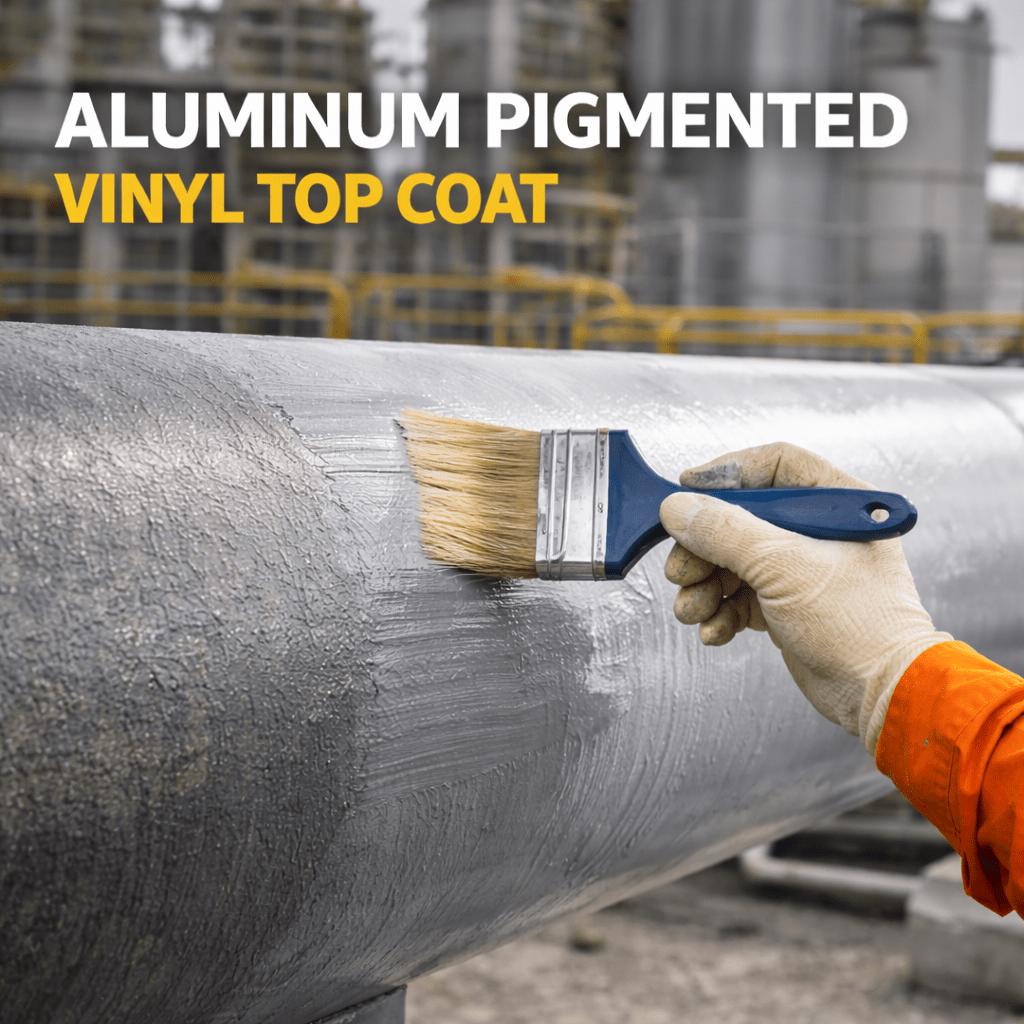
An Aluminum Pigmented Vinyl Top Coat is a vinyl-based protective coating containing aluminum pigments.
The aluminum pigments provide a characteristic silver or metallic appearance. They may also contribute to reflective properties, which can help reduce the absorption of solar radiation by the coated surface.
This can be useful for outdoor equipment and structures exposed to sunlight.
The performance of the coating depends on the complete formulation, including:
- Vinyl resin technology
- Aluminum pigment type
- Pigment concentration
- Additive package
- Film thickness
- Surface preparation
- Compatibility with the underlying coating system
The presence of aluminum pigment alone does not guarantee that every aluminum pigmented coating will provide identical performance.
Main Advantages
Potential advantages include:
- Reflective metallic appearance
- Reduced solar heat absorption
- Good visual appearance for outdoor equipment
- Protection against atmospheric exposure
- Resistance to moisture
- Suitable for selected industrial steel structures
- Improved surface appearance
Typical Applications
Aluminum pigmented vinyl top coats may be used for:
- Storage tanks
- Pipelines
- Outdoor steel structures
- Industrial machinery
- Chemical plant equipment
- Process equipment
- Metal pipework
- Marine-related equipment
- Industrial infrastructure
When Should You Choose It?
This coating type may be suitable when the project requires a combination of:
- Outdoor durability
- Metallic appearance
- Reflective properties
- General atmospheric protection
It may be particularly useful for equipment exposed to strong sunlight where reducing solar heat absorption is important.
However, if the main concern is chemical immersion or severe corrosion, another coating category may be more suitable.
- Chemical Resistant Vinyl Top Coat
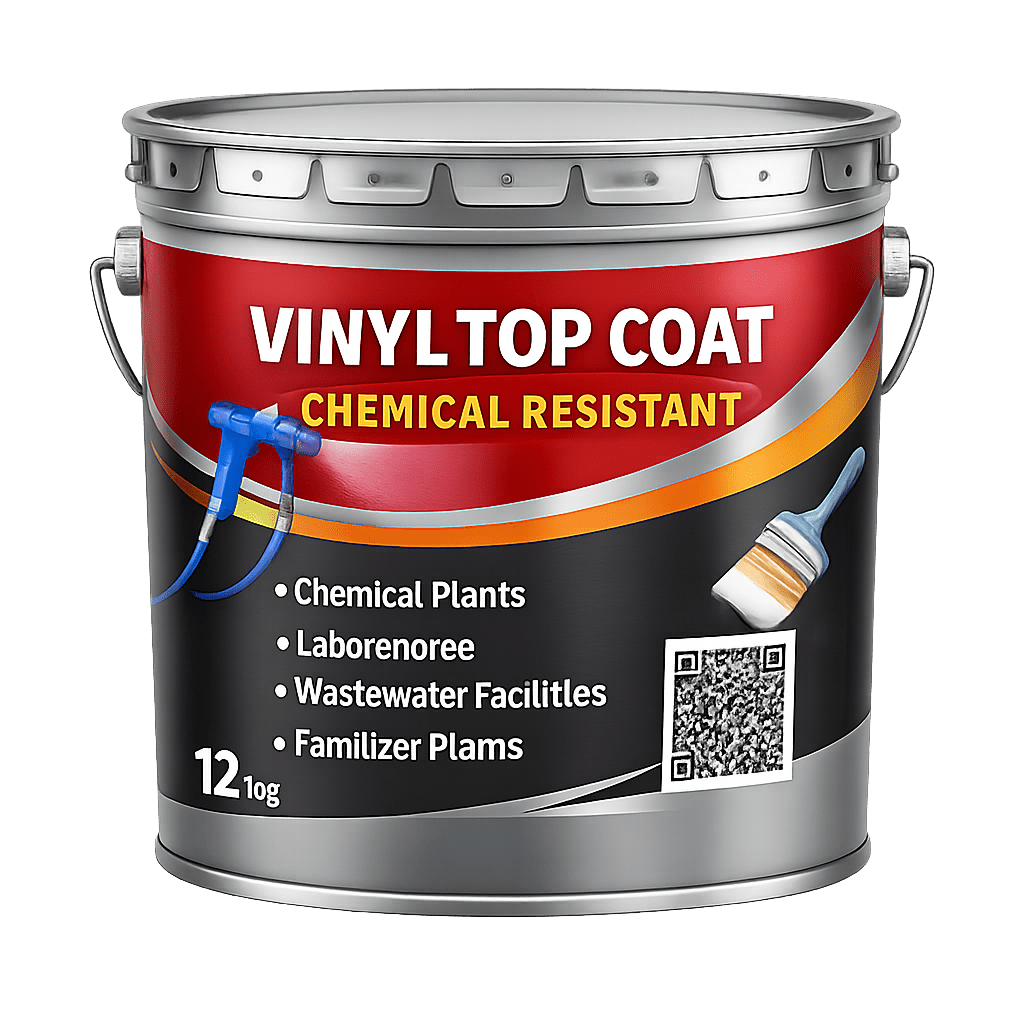
What Is a Chemical Resistant Vinyl Top Coat?
A Chemical Resistant Vinyl Top Coat is formulated to withstand exposure to selected chemicals and aggressive industrial environments.
Chemical exposure can affect a coating in many ways. Depending on the chemical and exposure conditions, the coating may experience:
- Softening
- Swelling
- Discoloration
- Loss of adhesion
- Blistering
- Cracking
- Permeation
- Complete coating failure
A chemical-resistant vinyl top coat is designed to reduce these risks when correctly matched to the chemical environment.
Chemical Resistance Is Not Universal
One of the most important points when selecting a chemical-resistant coating is that no coating should automatically be considered resistant to every chemical.
Performance may depend on:
- Chemical type
- Chemical concentration
- Temperature
- Exposure duration
- Exposure frequency
- Whether exposure is by splash or immersion
- Chemical vapor concentration
For example, occasional contact with a dilute chemical solution is very different from continuous immersion in a concentrated chemical at elevated temperature.
Typical Applications
Chemical resistant vinyl top coats may be used in:
- Chemical processing plants
- Fertilizer plants
- Industrial manufacturing facilities
- Chemical storage areas
- Process equipment
- Wastewater treatment facilities
- Industrial tanks
- Areas exposed to aggressive vapors
- Industrial production environments
When Should You Choose It?
A chemical-resistant vinyl top coat should be considered when chemical exposure is one of the main threats to the coating system.
Before purchasing, the buyer should identify:
- The exact chemicals involved.
- The concentration of each chemical.
- The expected operating temperature.
- The type of contact.
- The expected duration of exposure.
Technical data should be reviewed to ensure that the product is suitable for the actual service conditions.
- Anticorrosive Vinyl Top Coat
What Is an Anticorrosive Vinyl Top Coat?
An Anticorrosive Vinyl Top Coat is designed to contribute to the protection of metal surfaces against corrosion.
Corrosion occurs when metal reacts with environmental elements such as:
- Water
- Oxygen
- Salts
- Humidity
- Industrial pollutants
- Chemicals
Steel structures are particularly vulnerable to corrosion, especially in outdoor, marine, coastal, and industrial environments.
An anticorrosive vinyl top coat can help create a protective barrier between the metal substrate and the surrounding environment.
Corrosion Protection Is a Complete System
A common mistake is to assume that the top coat alone is responsible for corrosion protection.
In reality, corrosion control usually depends on the complete coating system.
A typical system may include:
Surface Preparation
The surface must be free from rust, oil, grease, dust, salts, and other contamination.
Primer
The primer improves adhesion and provides initial protection.
Intermediate Coat
The intermediate layer may increase the total coating thickness and barrier properties.
Anticorrosive Vinyl Top Coat
The top coat protects the underlying system from environmental exposure and contributes to the overall durability of the system.
Typical Applications
Anticorrosive vinyl top coats may be used for:
- Structural steel
- Pipelines
- Storage tanks
- Industrial equipment
- Bridges
- Steel frames
- Power plants
- Oil and gas infrastructure
- Marine structures
- Industrial machinery
When Should You Choose It?
This coating category is particularly relevant when:
- The substrate is carbon steel.
- Corrosion is the primary concern.
- The structure is exposed to moisture.
- Salt exposure is expected.
- Long service life is required.
- Maintenance costs need to be controlled.
The correct product should be selected together with a suitable primer and intermediate coating.
- High Build Vinyl Top Coat
What Is a High Build Vinyl Top Coat?
A High Build Vinyl Top Coat is formulated to provide a greater dry film thickness per coat than a conventional coating.
The main advantage is the ability to build a thicker protective barrier with fewer application layers.
A thicker film may provide:
- Improved barrier protection
- Greater resistance to environmental penetration
- Increased coating durability
- Improved coverage of minor surface irregularities
However, thicker is not always automatically better.
Potential Problems with Excessive Thickness
If a coating is applied beyond its recommended thickness, problems may occur, including:
- Solvent entrapment
- Cracking
- Sagging
- Poor curing
- Loss of adhesion
- Uneven appearance
Therefore, the recommended application thickness must be carefully followed.
Typical Applications
High build vinyl top coats may be considered for:
- Heavy industrial equipment
- Pipelines
- Storage tanks
- Steel structures
- Marine structures
- Industrial machinery
- Infrastructure projects
When Should You Choose It?
A high-build vinyl top coat may be appropriate when:
- A thick protective barrier is required.
- The project requires high dry film thickness.
- Reducing the number of coating layers is important.
- Heavy-duty industrial protection is required.
Detailed Comparison of the Four Vinyl Top Coats
| Property | Aluminum Pigmented | Chemical Resistant | Anticorrosive | High Build |
| Reflective finish | Excellent | Usually limited | Depends on formulation | Depends on formulation |
| Chemical protection | Formulation-dependent | Primary objective | Moderate to high depending on product | Formulation-dependent |
| Corrosion protection | Good as part of a system | Possible | Primary objective | Often important |
| Film thickness | Standard | Standard or specified | Standard or specified | High |
| Outdoor exposure | Very suitable | Depends on formulation | Suitable | Suitable |
| Main advantage | Reflective protection | Chemical resistance | Corrosion control | Barrier thickness |
How to Choose the Right Vinyl Top Coat for Your Project
Step 1: Identify the Substrate
The first step is to identify what the coating will be applied to.
Possible substrates include:
- Carbon steel
- Stainless steel
- Galvanized steel
- Aluminum
- Concrete
- Existing coating systems
Different substrates require different preparation and primer systems.
A coating that performs well on carbon steel may not be suitable for galvanized metal without a compatible primer.
Step 2: Understand the Environment
Ask:
- Is the application indoors or outdoors?
- Is the structure exposed to direct sunlight?
- Is the environment humid?
- Is there salt spray?
- Are industrial pollutants present?
- Is the temperature high or variable?
If sunlight and reflective properties are important, an aluminum pigmented vinyl top coat may be appropriate.
If corrosion is the primary risk, an anticorrosive system may be preferable.
Step 3: Identify Chemical Exposure
If chemicals are present, identify:
- Chemical type
- Concentration
- Temperature
- Exposure frequency
- Exposure duration
This information is essential for selecting a chemical resistant vinyl top coat.
Step 4: Determine the Required Film Thickness
If the project requires a thick protective barrier, a high build vinyl top coat may be suitable.
The required dry film thickness should be established before selecting the product.
Step 5: Consider the Application Method
Application methods may include:
- Airless spray
- Conventional spray
- Brush
- Roller
The coating must be compatible with the selected application method.
Step 6: Check Compatibility
The selected vinyl top coat must be compatible with:
- The substrate
- The primer
- The intermediate coat
- Existing coating layers
Poor compatibility can cause:
- Wrinkling
- Lifting
- Peeling
- Cracking
- Loss of adhesion
Why Surface Preparation Is Critical
A high-quality coating cannot compensate for poor surface preparation.
Before application, the substrate should be:
- Clean
- Dry
- Free from oil
- Free from grease
- Free from dust
- Free from loose rust
- Free from salts and contamination
For steel structures, mechanical cleaning or abrasive blasting may be required depending on the project specification.
Surface preparation influences:
- Adhesion
- Corrosion protection
- Coating durability
- Service life
- Appearance
Many coating failures that appear to be caused by the product are actually caused by poor surface preparation or incorrect application.
Common Mistakes When Buying Vinyl Top Coats
Choosing Only by Price
A low-cost product may not provide the required performance or service life.
Assuming All Vinyl Top Coats Are Equivalent
Different formulations can have significantly different chemical, mechanical, and environmental resistance.
Ignoring the Chemical Environment
A general-purpose product may fail rapidly in aggressive chemical conditions.
Applying Excessive Film Thickness
High build performance does not mean unlimited thickness.
Ignoring Primer Compatibility
The top coat must work with the complete coating system.
Selecting the Wrong Product for the Main Risk
A reflective coating is not automatically the best corrosion coating. A high-build coating is not automatically the best chemical-resistant coating.
Why Source Vinyl Top Coats Through IranCorps?
For international buyers, finding the right vinyl top coat is often more difficult than simply finding a product online.
Industrial coating buyers may need to evaluate:
- Product specifications
- Technical data sheets
- Manufacturer experience
- Production capacity
- Export capability
- Packaging
- Minimum order quantity
- Delivery terms
- Pricing
- Quality documentation
This process can require communication with multiple manufacturers and suppliers.
IranCorps can help simplify this process by connecting international buyers with verified Iranian manufacturers and exporters.
One Request, Multiple Suitable Suppliers
Instead of contacting many suppliers individually, buyers can submit their requirements through IranCorps.
The request can include:
- Product name
- Required coating type
- Technical specifications
- Required quantity
- Packaging requirements
- Destination country
- Delivery requirements
IranCorps can then help identify suitable suppliers for the requested product.
Access to Verified Iranian Manufacturers and Exporters
One of the main advantages of using IranCorps is that buyers can reduce the time spent searching for unknown suppliers.
The platform is designed to help international buyers connect with verified Iranian manufacturers and exporters.
This can be particularly valuable for industrial products such as:
- Protective coatings
- Industrial paints
- Chemical products
- Resins
- Minerals
- Metals
- Petrochemical products
- Industrial raw materials
Compare Technical and Commercial Offers
The cheapest quotation is not always the best offer.
A proper comparison should consider:
- Product quality
- Technical specifications
- Manufacturer capability
- Price
- Packaging
- Delivery terms
- Export experience
By obtaining quotations from suitable suppliers, buyers can make a more informed purchasing decision.
Save Time in Supplier Research
Finding a suitable industrial coating supplier can require:
- Searching online
- Checking company backgrounds
- Requesting technical documents
- Comparing offers
- Communicating with suppliers
IranCorps can help simplify this process by acting as a bridge between international buyers and Iranian suppliers.
Support for International Procurement
International procurement involves more than finding a product.
Buyers may also need assistance with:
- Supplier communication
- Technical clarification
- Commercial negotiations
- Export documentation
- Packaging requirements
- Shipping coordination
For buyers who are unfamiliar with the Iranian industrial market, using a specialized sourcing platform can make the procurement process more efficient.
Which Vinyl Top Coat Should You Choose?
Choose Aluminum Pigmented Vinyl Top Coat If:
- The project is exposed to sunlight.
- A reflective metallic finish is desired.
- Solar heat absorption is a concern.
- Outdoor atmospheric protection is required.
Choose Chemical Resistant Vinyl Top Coat If:
- The coating will contact chemicals.
- Chemical vapors are present.
- Chemical splashing is possible.
- Chemical resistance is the primary requirement.
Choose Anticorrosive Vinyl Top Coat If:
- The substrate is steel.
- Rust prevention is the primary concern.
- The structure is exposed to moisture or salt.
- Long-term corrosion protection is required.
Choose High Build Vinyl Top Coat If:
- A thick protective film is required.
- Barrier protection is important.
- High dry film thickness is needed.
- The project requires heavy-duty industrial protection.
Final Conclusion
Selecting the right vinyl top coat requires a clear understanding of the project environment and the performance requirements of the coating system.
An Aluminum Pigmented Vinyl Top Coat is generally considered when reflective properties, metallic appearance, and outdoor protection are important.
A Chemical Resistant Vinyl Top Coat is more appropriate when the coating must withstand exposure to specific chemicals, vapors, splashes, or aggressive industrial environments.
An Anticorrosive Vinyl Top Coat is designed for projects where protecting steel and other metal substrates from corrosion is the main objective.
A High Build Vinyl Top Coat is suitable when increased dry film thickness and enhanced barrier protection are important requirements.
The final decision should always consider:
- Substrate
- Surface preparation
- Environmental exposure
- Chemical exposure
- Temperature
- Humidity
- Required service life
- Film thickness
- Application method
- Compatibility with the complete coating system
For international buyers, the process of finding a suitable manufacturer can also be a significant challenge. By using IranCorps, buyers can simplify supplier research, submit their technical requirements, connect with verified Iranian manufacturers and exporters, compare suitable quotations, and receive support during the international procurement process.
The best vinyl top coat is not simply the product with the most impressive name or the lowest price. The best product is the one that is correctly matched to the actual requirements of your project.
If you are looking for an Aluminum Pigmented Vinyl Top Coat, Chemical Resistant Vinyl Top Coat, Anticorrosive Vinyl Top Coat, or High Build Vinyl Top Coat, you can submit your requirements through IranCorps and request suitable offers from qualified Iranian manufacturers and exporters.