

 Arabic
Blog
Hexyl Acetate is one of the important ester-based organic solvents widely used in industrial formulations, especially in coatings, paints, inks, and specialty chemical applications. It is known for its mild fruity odor, relatively low volatility compared to lighter esters, and excellent solvency characteristics for various resins used in coating systems.
In modern industrial chemistry, the selection of a solvent is not only about dissolving power but also about evaporation rate, compatibility with resins, odor profile, environmental considerations, and final film performance. Hexyl Acetate offers a balanced combination of these properties, making it a valuable component in high-performance formulations.
This article provides a deep technical and industrial analysis of Hexyl Acetate applications in paint, ink, and coating industries, along with formulation behavior, performance advantages, and market relevance.
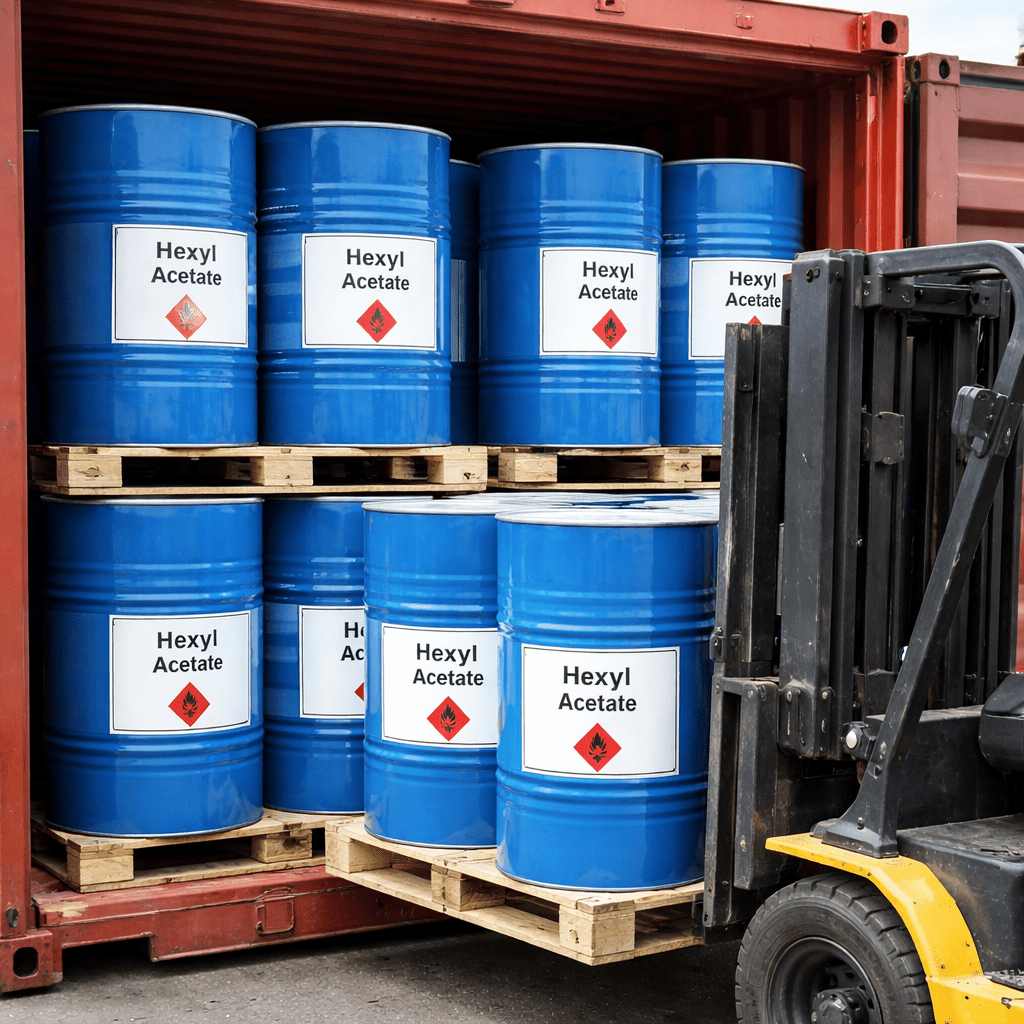
Chemical Overview of Hexyl Acetate
Hexyl Acetate is an ester formed from hexanol and acetic acid. It belongs to the acetate ester family, which includes other widely used solvents such as butyl acetate, ethyl acetate, and pentyl acetate.
Key characteristics influencing industrial use:
- Moderate evaporation rate
- Good solvency power for resins and polymers
- Low water solubility
- Pleasant odor (fruity, apple-like)
- Good compatibility with organic coating systems
These characteristics make it particularly suitable for controlled drying applications and high-quality surface finishing systems.
Role of Solvents in Paint, Ink, and Coating Industries
Before focusing specifically on Hexyl Acetate, it is important to understand the role of solvents in these industries.
Solvents are responsible for:
- Dissolving resins and binders
- Controlling viscosity of formulations
- Regulating drying and evaporation rate
- Influencing film formation and leveling
- Affecting gloss, clarity, and surface smoothness
- Improving application properties (spray, brush, roll)
A poor solvent choice can lead to defects such as:
- Blistering
- Poor leveling
- Orange peel effect
- Cracking or poor adhesion
- Uneven drying
Hexyl Acetate helps to minimize many of these issues due to its balanced evaporation profile and compatibility with coating resins.
Physical and Chemical Behavior in Industrial Systems
Hexyl Acetate has a medium boiling point and moderate evaporation rate, which places it between fast-evaporating solvents like ethyl acetate and slower ones like glycol ethers.
Why this matters:
- Fast solvents dry too quickly → surface defects
- Slow solvents remain too long → sagging or poor curing
- Balanced solvents → smooth film formation
Hexyl Acetate provides this balance, especially in systems where controlled drying is essential.
Key performance behavior:
- Improves flow and leveling in coatings
- Reduces surface tension variations
- Helps uniform film formation
- Enhances gloss retention
- Supports stable viscosity during application
Applications in Paint Industry
The paint industry is one of the largest consumers of ester solvents, and Hexyl Acetate plays an important role in several segments.
- Industrial Coatings
In industrial coatings, performance and durability are critical. Hexyl Acetate is used as a co-solvent in formulations based on:
- Alkyd resins
- Acrylic resins
- Polyurethane systems
- Epoxy-modified coatings
Benefits in industrial coatings:
- Improves resin solubility
- Enhances film smoothness
- Reduces brush and spray marks
- Supports uniform drying across large surfaces
- Automotive Paints
Automotive coatings require high gloss, excellent leveling, and defect-free surfaces.
Hexyl Acetate helps by:
- Improving flow during spray application
- Reducing orange peel effect
- Enhancing surface gloss
- Providing controlled evaporation in multi-layer systems
It is often blended with faster solvents to achieve an optimized evaporation curve.
- Wood Coatings
In wood finishes, clarity and aesthetics are essential.
Hexyl Acetate contributes to:
- Smooth surface penetration
- Enhanced grain appearance
- Reduced brush marks
- Better leveling on porous surfaces
It is especially useful in clear coats and varnishes.
For architectural coatings, user experience and appearance matter.
Advantages include:
- Low odor compared to some solvents
- Improved application smoothness
- Better wall finish consistency
- Reduced defects in roller applications
Applications in Ink Industry
The ink industry relies heavily on solvent systems for gravure, flexographic, and screen printing processes.
- Gravure Printing Inks
Gravure inks require controlled drying rates.
Hexyl Acetate provides:
- Balanced evaporation speed
- Good pigment dispersion stability
- Reduced clogging of printing cylinders
- Smooth transfer on substrates
- Flexographic Inks
Flexographic printing requires fast but controlled drying.
Hexyl Acetate is used to:
- Adjust drying speed in ink blends
- Improve print sharpness
- Prevent smudging
- Enhance adhesion on flexible films
- Packaging Inks
In packaging applications, especially food and consumer goods packaging, performance and safety considerations are important.
Hexyl Acetate helps achieve:
- Consistent print quality
- Stable ink viscosity
- Improved color strength
- Reduced print defects
- Screen Printing Inks
For thicker ink systems:
- Improves flow through mesh screens
- Reduces clogging
- Enhances leveling on substrates like plastics, textiles, and glass
Applications in Coating Industry
The coating industry is the most technically demanding sector for solvents.
Hexyl Acetate is widely used in:
- Protective Coatings
Used in anti-corrosion and protective films for:
- Metal structures
- Industrial equipment
- Marine applications
Benefits:
- Uniform film formation
- Improved adhesion
- Controlled drying in humid environments
- High-Performance Industrial Coatings
These include coatings used in:
- Heavy machinery
- Oil & gas pipelines
- Chemical plants
Hexyl Acetate contributes to:
- Chemical resistance improvement (indirectly via film quality)
- Better resin distribution
- Reduced surface defects
- Specialty Coatings
Such as:
- UV-curable coatings (as co-solvent)
- Heat-resistant coatings
- Electrical insulation coatings
Its moderate evaporation rate helps in achieving controlled curing behavior.

Formulation Advantages of Hexyl Acetate
Hexyl Acetate is not just a solvent but a performance modifier.
Key formulation benefits:
- Controlled Evaporation
It helps balance fast and slow solvents in a formulation, improving overall drying behavior.
- Improved Flow and Leveling
It reduces surface tension variations, leading to smoother finishes.
- Resin Compatibility
It is compatible with:
- Acrylic resins
- Alkyd resins
- Cellulose derivatives
- Polyurethane systems
- Odor Profile
Compared to harsh solvents, it has a mild fruity odor, improving workplace conditions.
- Stability in Blends
It remains stable when mixed with other ester solvents, alcohols, and hydrocarbons.
Comparison with Other Solvents in Industry
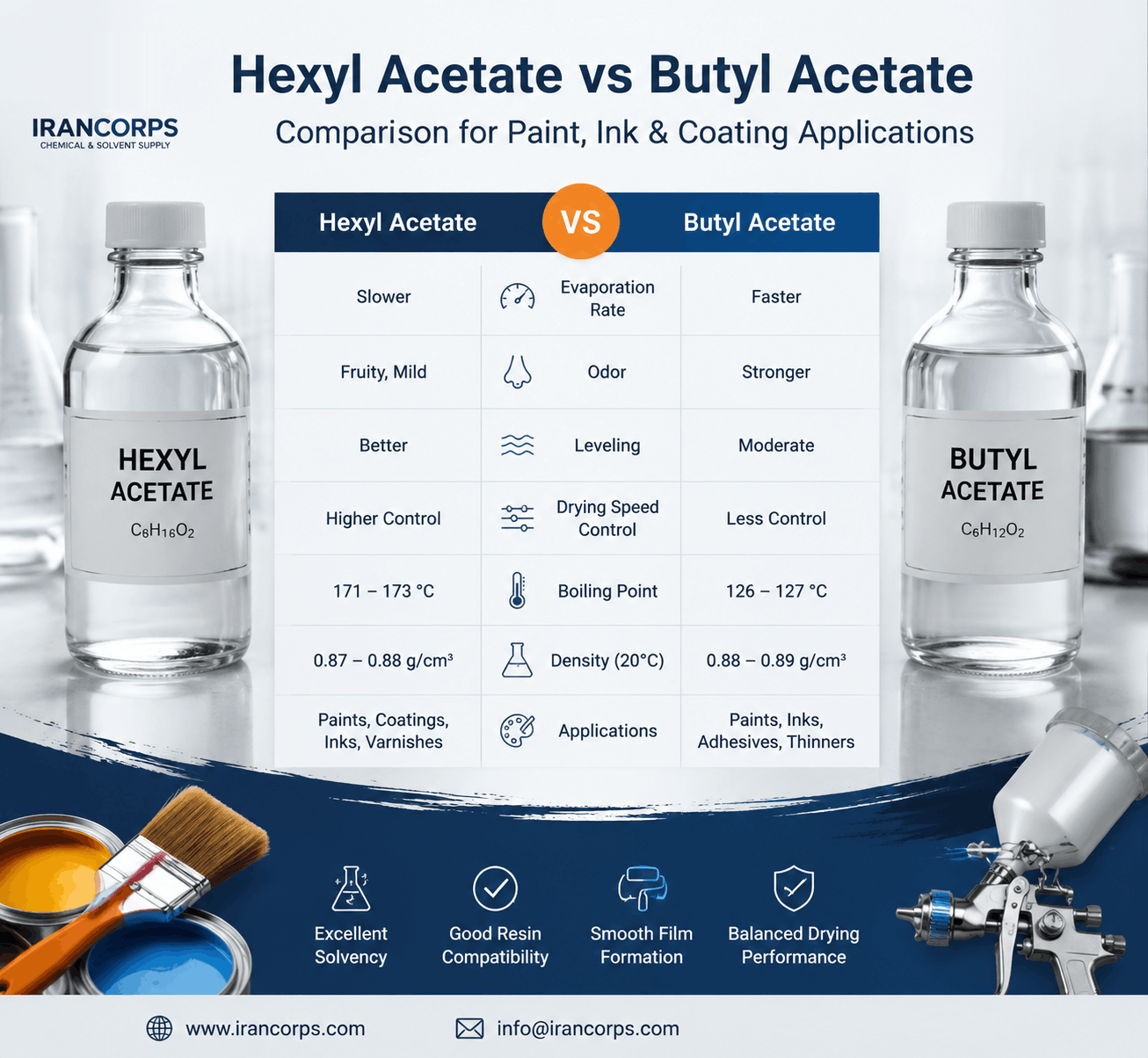
Hexyl Acetate vs Butyl Acetate
| Property | Hexyl Acetate | Butyl Acetate |
| Evaporation rate | Slower | Faster |
| Odor | Fruity, mild | Stronger |
| Leveling | Better | Moderate |
| Drying speed control | Higher control | Less control |
Hexyl Acetate vs Ethyl Acetate
- Ethyl acetate is very fast evaporating
- Hexyl acetate is slower and better for leveling
This makes Hexyl Acetate more suitable for high-quality finishing applications.
Safety and Handling Considerations
Hexyl Acetate is generally considered to have moderate safety risks compared to more aggressive solvents.
Safety guidelines:
- Use in well-ventilated areas
- Avoid direct inhalation
- Use protective gloves and goggles
- Store away from heat and ignition sources
- Keep container tightly closed
It has relatively low toxicity but still requires standard industrial chemical handling procedures.
Environmental Considerations
In modern coating systems, environmental impact is critical.
Hexyl Acetate:
- Is VOC (volatile organic compound)
- Has moderate evaporation rate → lower emissions compared to fast solvents
- Can be used in optimized low-VOC formulations
It is increasingly used in eco-optimized coating systems where balance between performance and emissions is required.
Market Demand and Industrial Importance
Hexyl Acetate demand is driven by:
- Growth of automotive coatings industry
- Expansion of packaging inks market
- Increasing demand for high-gloss finishes
- Shift toward controlled-evaporation solvent systems
Countries with strong coatings and chemical industries often import or produce it for formulation use.
Future Trends
The future of Hexyl Acetate in industrial applications is influenced by:
- Low-VOC formulations
Manufacturers are optimizing solvent blends to reduce emissions.
- High-performance coatings
Demand for defect-free surfaces is increasing.
- Sustainable chemistry
Bio-based production routes may increase in future.
- Advanced ink systems
Packaging and digital printing growth will continue to support demand.
Conclusion
Hexyl Acetate is a highly valuable solvent in paint, ink, and coating industries due to its balanced evaporation rate, excellent solvency power, and superior film-forming characteristics. It plays a critical role in improving surface quality, enhancing leveling, and ensuring controlled drying in various industrial formulations.
From automotive coatings to packaging inks and industrial protective systems, Hexyl Acetate provides a combination of performance and formulation flexibility that makes it a preferred choice among chemists and formulators.
As industries continue to demand higher quality finishes and more controlled environmental performance, the importance of Hexyl Acetate in modern coating technology is expected to grow further.