

 Arabic
Blog
Introduction
Talc powder is one of the most important industrial minerals used in modern manufacturing. From plastics and paints to pharmaceuticals and food processing, talc plays a critical role in improving product performance, reducing production costs, and increasing manufacturing efficiency. Because of its exceptional softness, chemical stability, heat resistance, and lubricating properties, talc has become an essential raw material for hundreds of industries worldwide.
The global talc market continues to grow as manufacturers demand higher-quality mineral fillers and functional additives. Automotive plastics, high-performance coatings, cosmetics, pharmaceuticals, ceramics, paper production, and agricultural formulations all rely on carefully processed talc powder. As a result, buyers increasingly seek reliable suppliers capable of providing consistent quality, technical documentation, and efficient export logistics.
Iran is among the countries with significant talc resources and growing mineral-processing capacity. Iranian talc producers supply industrial, cosmetic, food, and pharmaceutical-grade products to regional and international markets. Through professional export networks, Iranian talc powder is reaching customers across the Middle East, Central Asia, South Asia, Africa, and Europe.
This article follows the entire journey of talc powder—from geological formation deep within the earth to mining, processing, quality control, packaging, transportation, and international trade. It is designed specifically for B2B buyers, importers, distributors, and industrial manufacturers who need a practical understanding of talc sourcing and export operations.
What Is Talc Powder?
Talc is a naturally occurring mineral composed primarily of hydrated magnesium silicate with the chemical formula:
Mg₃Si₄O₁₀(OH)₂
It is the softest mineral on the Mohs hardness scale, with a hardness value of 1. This extreme softness allows talc to be easily ground into very fine powders while maintaining smooth particle morphology.
Commercial talc powder is valued for a unique combination of properties:
- Very soft texture
- High whiteness and brightness
- Excellent lubricating characteristics
- Heat resistance
- Chemical inertness
- Electrical insulation
- Low abrasiveness
- Hydrophobic surface behavior
- Good dispersibility in many formulations
These characteristics make talc suitable for both functional industrial applications and high-purity consumer products such as cosmetics and pharmaceuticals.
How Talc Deposits Form
Talc does not appear randomly in the earth. It forms through specific geological processes involving magnesium-rich rocks over millions of years.
- Metamorphic Formation
One of the most common sources of talc is the metamorphism of dolomite or magnesium-rich limestone. Under high temperature and pressure, these rocks react with silica-bearing fluids and gradually transform into talc-rich deposits.
- Hydrothermal Alteration
Hot mineral-rich fluids circulating through fractures can alter ultramafic rocks such as peridotite and serpentinite. During this process, original minerals are replaced by talc, creating large commercial deposits.
- Serpentine Transformation
Many high-purity talc deposits originate from serpentine rocks that react with carbon dioxide-rich fluids. This transformation can produce exceptionally white talc with low impurity levels, making it valuable for cosmetic and pharmaceutical applications.
The geological origin of a deposit strongly influences the final product. Deposits with low iron, low carbonate content, and minimal quartz contamination generally produce higher-value talc powder.
Exploration and Reserve Evaluation
Before mining begins, geologists conduct extensive exploration programs to determine whether a deposit is economically viable.
Typical exploration activities include:
- Geological mapping
- Surface sampling
- Core drilling
- Mineralogical analysis
- Chemical testing
- Reserve estimation
- Environmental assessment
Laboratory testing is particularly important because buyers require consistent specifications. Parameters such as talc purity, whiteness, magnesium oxide content, silicon dioxide content, and quartz level are evaluated during exploration.
Only deposits capable of producing commercially acceptable grades are developed into mines.
Talc Mining Methods
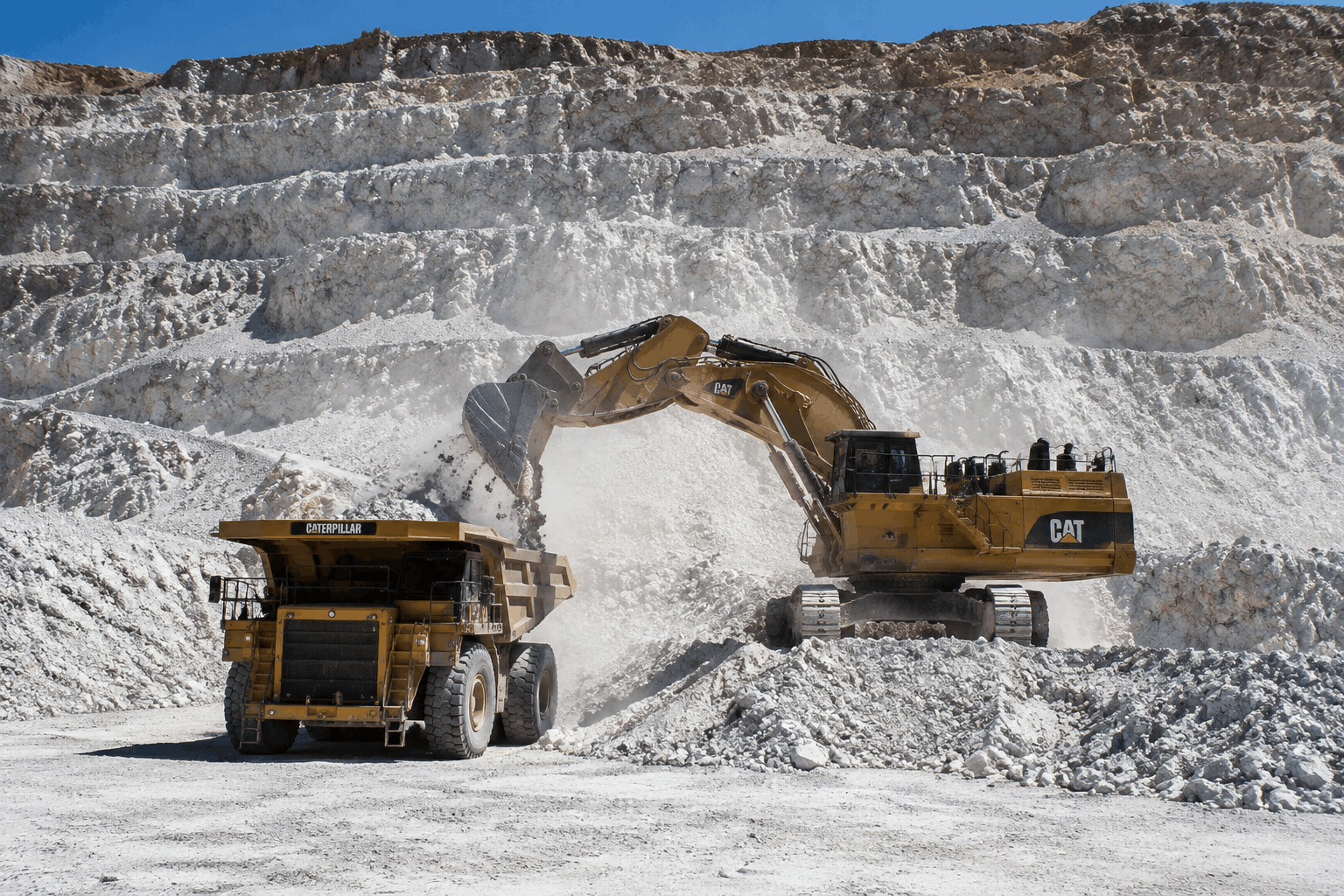
Commercial talc is extracted using either open-pit mining or underground mining, depending on the depth and geometry of the deposit.
Open-Pit Mining
Open-pit operations are common when the ore body is near the surface. The mine is developed in a series of benches that allow safe access for drilling, blasting, loading, and hauling equipment.
Advantages of open-pit mining:
- Lower production cost
- Higher recovery rate
- Easier grade control
- Large-scale production capacity
Underground Mining
When talc deposits occur at greater depth, underground mining may be used. Access tunnels and stopes are developed to extract the ore while minimizing surface disturbance.
Advantages of underground mining:
- Reduced environmental footprint
- Access to deeper high-grade zones
- Lower waste removal requirements
Modern mining operations emphasize selective extraction to avoid contamination from surrounding rock. This is particularly important for cosmetic and pharmaceutical-grade talc, where impurity control is critical.
Transportation from Mine to Processing Plant
After extraction, talc ore is transported to processing facilities using:
- Heavy dump trucks
- Conveyor systems
- Front-end loaders
- Rail transportation (where available)
Different ore grades are usually stored separately. High-whiteness ore destined for cosmetic or pharmaceutical production is often handled independently from industrial-grade material to maintain product purity.
Talc Processing: From Ore to Fine Powder
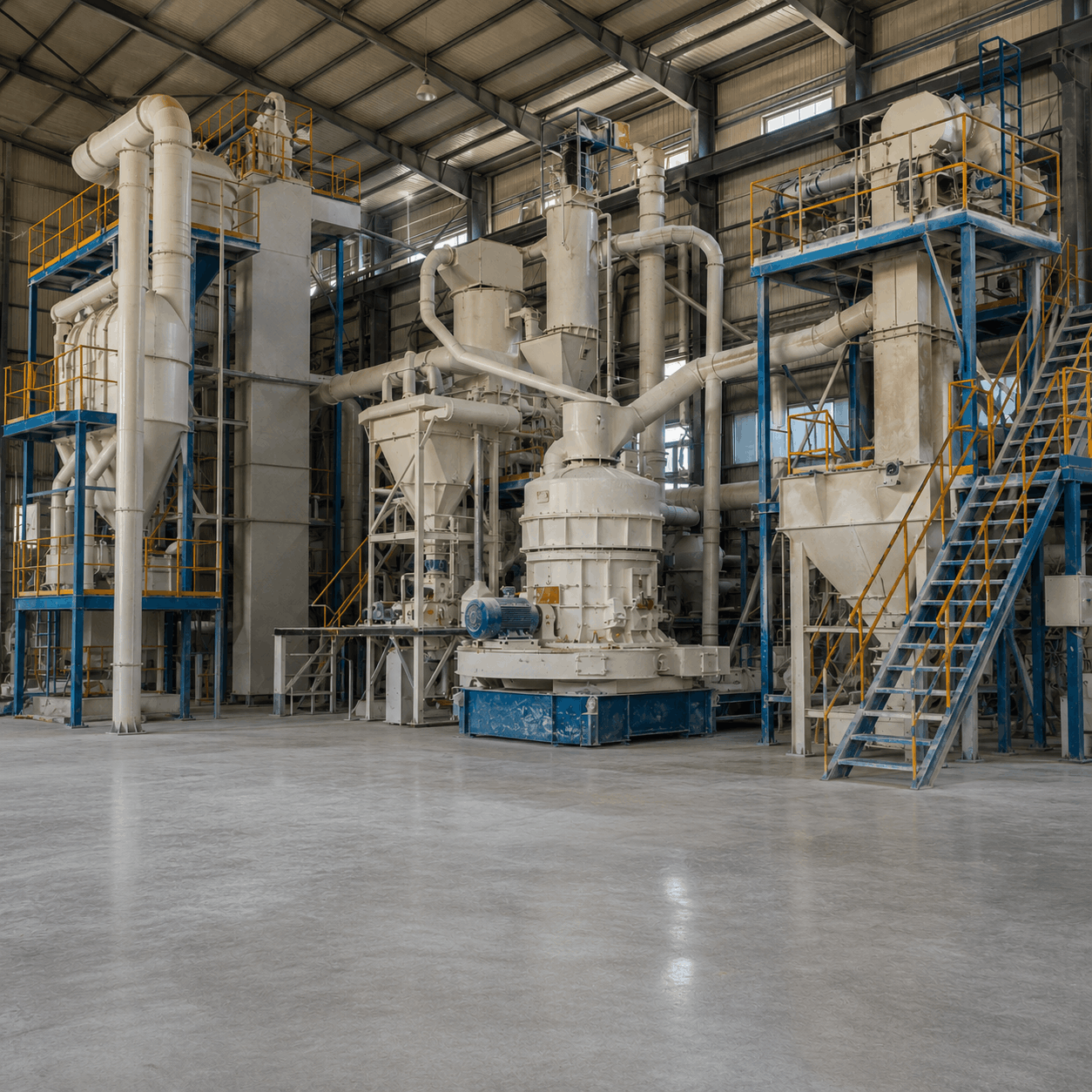
The transformation of raw rock into commercial talc powder requires multiple processing stages.
Primary Crushing
Large ore blocks are reduced to manageable sizes using jaw crushers or gyratory crushers. This stage prepares the material for further processing.
Secondary Crushing
Additional crushing produces a more uniform feed for grinding equipment and improves processing efficiency.
Grinding and Milling
Grinding is the most important stage in talc powder production. Depending on customer requirements, manufacturers use ball mills, roller mills, or advanced micronizing systems to achieve precise particle size distribution.
Common commercial grades include:
| Grade | Typical Size |
| 200 Mesh | 74 μm |
| 325 Mesh | 45 μm |
| 500 Mesh | 25 μm |
| 800 Mesh | 15 μm |
| 1250 Mesh | 10 μm |
| 2500 Mesh | 5 μm |
Air Classification
Fine particles are separated by air classifiers to achieve narrow particle size distributions. This step is essential for applications such as plastics, paints, and cosmetics, where consistent performance is required.
Purification
Advanced purification systems remove unwanted minerals, including:
- Quartz
- Carbonates
- Iron oxides
- Clay minerals
- Other silicate impurities
High-purity grades may undergo additional beneficiation to meet cosmetic, food, or pharmaceutical standards.
Drying
Industrial dryers reduce moisture content to specified levels, typically below 0.5% for high-grade products. Low moisture improves storage stability and flowability.
Physical Properties of Commercial Talc Powder
Buyers commonly evaluate the following physical properties:
| Property | Typical Characteristic |
| Color | White to off-white |
| Texture | Very soft and smooth |
| Odor | Odorless |
| Hardness | Mohs 1 |
| Moisture | Typically ≤ 0.5% |
| Whiteness | 80–98% depending on grade |
| Bulk Density | 0.25–0.55 g/cm³ |
| Oil Absorption | Varies by particle morphology |
These properties influence performance in coatings, plastics, rubber compounds, cosmetics, and pharmaceutical formulations.
Chemical Composition
Although composition varies by deposit, commercial talc typically contains:
| Component | Typical Range |
| Silicon Dioxide (SiO₂) | 55–63% |
| Magnesium Oxide (MgO) | 28–32% |
| Structural Water (OH) | 4–6% |
| Minor Impurities | < 5% |
Lower levels of iron, quartz, and carbonate impurities generally indicate higher-value talc powder suitable for demanding applications.
Types of Talc Powder Based on Application
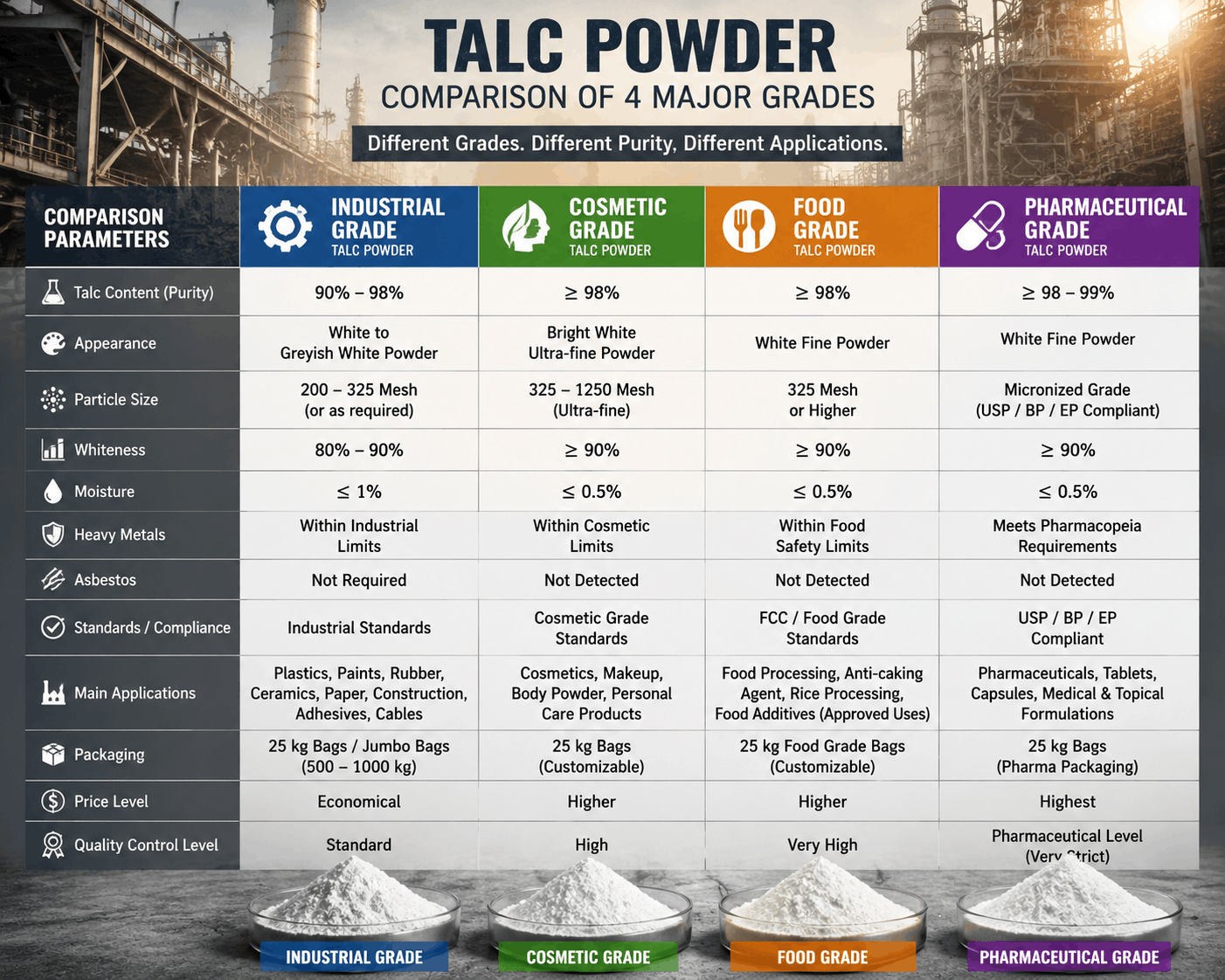
After mining and processing, talc powder is classified into different grades according to purity, particle size, whiteness, chemical composition, and intended application.
Although all talc products are based on the same mineral structure, each industry requires specific characteristics. A talc powder suitable for plastics may not meet the requirements of cosmetics or pharmaceuticals.
The four major commercial categories are:
Pharmaceutical Grade Talc Powder
Each grade requires different levels of purification, testing, documentation, and quality control.
- Industrial Grade Talc Powder
Overview
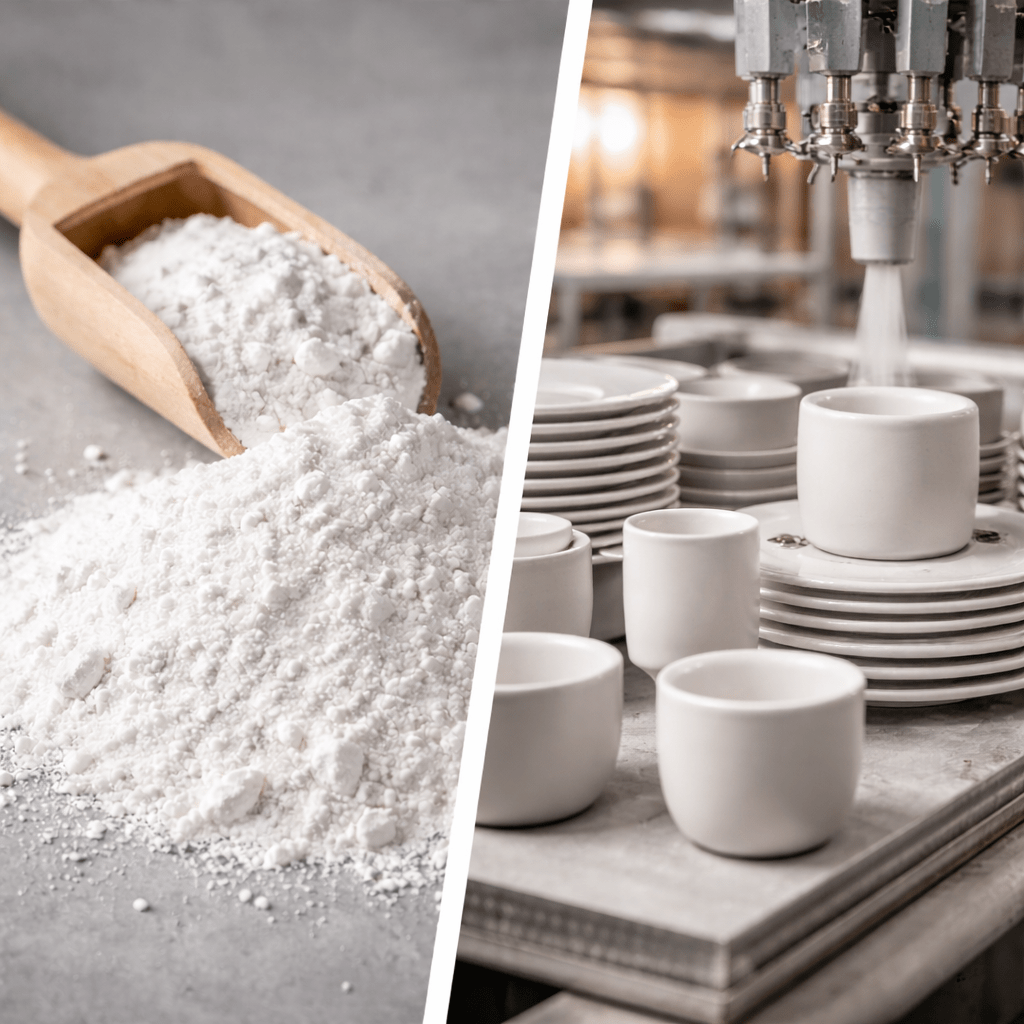
Industrial Grade Talc Powder represents the largest segment of global talc consumption. It is widely used as a functional mineral filler and performance enhancer in manufacturing industries.
Industrial talc is valued for:
Excellent reinforcement properties
Improved dimensional stability
Heat resistance
Reduced shrinkage
Better processing characteristics
Cost optimization
Compared with higher-purity grades, industrial talc allows slightly higher levels of natural mineral variation while maintaining consistent industrial performance.
Applications of Industrial Grade Talc Powder
Plastics Industry
The plastics industry is one of the largest consumers of talc powder.
Talc is added to polymers such as polypropylene (PP), polyethylene (PE), and engineering plastics to improve:
Stiffness
Mechanical strength
Thermal resistance
Dimensional accuracy
Surface appearance
Automotive manufacturers use talc-filled plastics for:
Interior components
Battery housings
Engine parts
Electrical components
Door panels
Talc helps manufacturers produce lightweight components while maintaining strength and durability.
Paints and Coatings Industry
Talc is an important extender pigment in paints and coatings.
Benefits include:
Improved suspension
Better corrosion resistance
Enhanced surface smoothness
Reduced cracking
Improved coverage
Better weather resistance
Fine particle talc improves the appearance and performance of architectural and industrial coatings.
Rubber Industry
In rubber production, talc is used as:
Processing aid
Anti-blocking agent
Mold release agent
Reinforcing filler
Applications include:
Tires
Rubber seals
Hoses
Industrial rubber products
Ceramics Industry
Talc improves ceramic formulations by providing:
Better thermal shock resistance
Improved firing characteristics
Reduced defects
Enhanced mechanical properties
It is used in:
Tiles
Sanitary ceramics
Electrical ceramics
Porcelain products
Paper Manufacturing
In paper production, talc improves:
Paper smoothness
Opacity
Print quality
Ink absorption
Surface finish
Industrial Grade Talc Typical Specifications
Parameter Typical Specification
Talc Content 90–98%
Appearance White to Greyish Powder
SiO₂ 55–63%
MgO 28–32%
Moisture ≤1%
Particle Size 325 Mesh and above
Whiteness 80–90%
Packaging 25 kg Bags / Jumbo Bags
- Cosmetic Grade Talc Powder

Overview
Cosmetic Grade Talc Powder is produced from carefully selected high-purity talc ore and processed under strict quality control conditions.
Cosmetic manufacturers require talc with:
Very fine particle size
Excellent softness
High whiteness
Smooth skin feel
Low impurity levels
Controlled heavy metals
Cosmetic talc is one of the most specialized grades because it directly interacts with human skin.
Applications of Cosmetic Grade Talc Powder
Face Powders and Makeup Products
Talc is widely used in:
Face powder
Pressed powder
Foundation products
Blush formulations
Eye shadow
Its main functions include:
Providing smooth texture
Improving spreadability
Absorbing excess oil
Enhancing product consistency
Body Powders
Talc provides:
Moisture absorption
Soft skin sensation
Reduced friction
It is commonly used in personal care formulations.
Deodorants and Personal Care Products
Talc improves:
Powder flow
Skin comfort
Product stability
Important Quality Requirements for Cosmetic Talc
Cosmetic buyers usually request:
High whiteness
Fine particle size
Asbestos-free certification
Heavy metal testing
Microbial analysis
Safety documentation
Modern cosmetic manufacturers pay particular attention to contamination control throughout mining, processing, and packaging.
Cosmetic Grade Talc Typical Specifications
Parameter Typical Specification
Talc Content ≥98%
Appearance Ultra-Fine White Powder
Whiteness ≥90%
Particle Size 325–1250 Mesh
Moisture ≤0.5%
Heavy Metals Within Cosmetic Limits
Asbestos Not Detected
Packaging 25 kg Bags / Customized
- Food Grade Talc Powder

Overview
Food Grade Talc Powder is manufactured for applications where direct or indirect contact with food products is required.
This grade must meet strict food safety requirements and contain controlled levels of impurities.
Food-grade talc is selected based on:
High purity
Low heavy metals
Chemical stability
Hygienic processing conditions
Applications of Food Grade Talc Powder
Food Processing
Talc may be used as:
Anti-caking agent
Processing aid
Surface treatment agent
Rice Processing
In some regions, food-grade talc is used during rice processing to improve:
Appearance
Flow characteristics
Processing efficiency
Confectionery Industry
Applications include:
Gum manufacturing
Sugar-coated products
Food processing aids
Food Grade Talc Quality Requirements
Food manufacturers commonly request:
Food safety compliance
Certificate of Analysis (COA)
Heavy metal analysis
Microbial testing
Traceability documents
Important controlled elements include:
Lead (Pb)
Arsenic (As)
Mercury (Hg)
Food Grade Talc Typical Specifications
Parameter Typical Specification
Purity ≥98% Talc
Appearance White Fine Powder
SiO₂ 60–63%
MgO 30–32%
Moisture ≤0.5%
Heavy Metals Within Food Limits
Particle Size 325 Mesh or Higher
Packaging Food-Grade Bags
- Pharmaceutical Grade Talc Powder

Overview
Pharmaceutical Grade Talc Powder is the highest-value category of talc products and requires the strictest quality control.
Pharmaceutical talc is used as an excipient in medicine production and must comply with recognized pharmacopeia standards.
Common standards include:
USP (United States Pharmacopeia)
BP (British Pharmacopoeia)
EP (European Pharmacopoeia)
Pharmaceutical manufacturers require extremely consistent materials because talc becomes part of regulated healthcare products.
Applications of Pharmaceutical Grade Talc Powder
Tablet Manufacturing
Talc is used as a pharmaceutical excipient because it provides:
Lubrication
Anti-sticking properties
Improved powder flow
It helps prevent tablets from sticking to manufacturing equipment.
Capsule Production
Talc improves:
Powder flow
Manufacturing efficiency
Product consistency
Medical and Personal Care Products
Highly purified talc may be used in:
Medical powders
Certain topical formulations
Pharmaceutical preparations
Pharmaceutical Talc Quality Requirements
Pharmaceutical buyers typically require:
Chemical Testing
Including:
Magnesium oxide
Silicon dioxide
Loss on ignition
Acid-insoluble substances
Safety Testing
Including:
Heavy metals
Microbial limits
Asbestos absence
Contaminant analysis
Documentation
Professional suppliers provide:
Certificate of Analysis (COA)
Safety Data Sheet (SDS)
Technical Data Sheet (TDS)
Certificate of Compliance
Batch traceability
Pharmaceutical Grade Talc Typical Specifications
Parameter Specification
Purity High Purity Talc ≥98%
Appearance White Fine Powder
Particle Size Controlled Micronized Grade
Heavy Metals Meets Pharmacopeia Requirements
Asbestos Not Detected
Moisture Controlled
Microbial Limits Compliant
Standards USP / BP / EP
Comparison of Talc Powder Grades
Grade Main Industries Main Requirements
Industrial Grade Plastics, Paints, Rubber, Ceramics Performance & Cost Efficiency
Cosmetic Grade Makeup, Body Powder, Personal Care High Purity & Skin Safety
Food Grade Food Processing Food Safety Compliance
Pharmaceutical Grade Medicine Production Pharmacopeia Compliance
Quality Certificates and Documents for International Buyers
Professional exporters should be able to provide:
Technical Data Sheet (TDS)
Contains:
Physical properties
Chemical composition
Recommended applications
Certificate of Analysis (COA)
Confirms:
Actual batch results
Chemical analysis
Quality parameters
Safety Data Sheet (SDS/MSDS)
Provides:
Handling information
Storage requirements
Safety instructions
Certificate of Origin
Required for many international shipments.
Major Industrial Applications of Talc Powder
The unique combination of softness, chemical stability, heat resistance, low abrasiveness, and excellent dispersion properties makes talc powder a valuable raw material across many industries.
Although talc is often considered a simple mineral filler, modern manufacturing uses it as a functional additive that improves product performance, processing efficiency, and final product quality.
Talc Powder in the Plastics Industry
The plastics industry is one of the largest consumers of talc worldwide.
Talc is commonly added to thermoplastics as a reinforcing mineral filler. It improves mechanical and thermal properties while reducing production costs.
Main Benefits of Talc in Plastics:
Improved Stiffness
Talc particles increase rigidity and strength, especially in polypropylene compounds.
Better Dimensional Stability
Talc reduces shrinkage during cooling, helping manufacturers produce accurate components.
Higher Heat Resistance
Talc improves the heat deflection temperature (HDT) of plastic products.
Improved Surface Quality
Fine talc grades provide smoother surfaces and better appearance.
Common Plastic Applications:
Automotive components
Electrical housings
Household appliances
Packaging materials
Pipes and profiles
Engineering plastics
The automotive industry particularly depends on talc-filled polypropylene for lightweight vehicle components.
Talc Powder in Paints and Coatings
Talc is an important functional extender in paint formulations.
Unlike simple fillers, talc provides multiple performance advantages.
Benefits in Coatings:
Improves paint consistency
Enhances suspension stability
Reduces settling
Improves surface smoothness
Increases durability
Improves corrosion resistance
Talc is used in:
Architectural paints
Industrial coatings
Powder coatings
Protective coatings
Automotive coatings
Fine particle talc improves opacity and surface finish, making it valuable for premium coating products.
Talc Powder in Rubber Manufacturing
The rubber industry uses talc as both a processing aid and functional filler.
Functions of Talc in Rubber:
Prevents sticking between rubber sheets
Improves mold release
Enhances processing efficiency
Controls surface properties
Improves dimensional stability
Applications include:
Tires
Rubber seals
Conveyor belts
Industrial rubber products
Gaskets
Talc Powder in Ceramics
Talc has been used in ceramic manufacturing for centuries.
Its magnesium silicate structure provides important benefits during firing.
Ceramic Benefits:
Lower firing temperature
Improved thermal shock resistance
Better mechanical strength
Improved glaze compatibility
Reduced production defects
Applications:
Ceramic tiles
Sanitary ware
Electrical ceramics
Porcelain products
Talc Powder in Paper Manufacturing
The paper industry uses talc to improve paper quality and production efficiency.
Talc provides:
Better brightness
Improved smoothness
Enhanced printing performance
Better ink absorption control
Improved opacity
It is used in:
Coated papers
Magazine papers
Packaging papers
Specialty papers
Talc Powder in Adhesives and Sealants
Talc improves the performance of many adhesive systems.
Benefits include:
Improved viscosity control
Better reinforcement
Reduced shrinkage
Enhanced processing characteristics
Applications:
Construction adhesives
Industrial sealants
Wood adhesives
Automotive adhesives
Talc Powder in Agriculture
Agricultural applications of talc are growing due to its physical properties.
Uses include:
Seed coating
Fertilizer carrier
Agricultural powder formulations
Flow improvement agent
High-quality talc helps improve powder handling and distribution.
International Quality Standards for Talc Powder
International buyers evaluate talc powder according to application-specific standards.
A supplier producing industrial talc may not automatically qualify for cosmetic, food, or pharmaceutical markets.
Quality requirements depend on:
Purity
Chemical composition
Particle size
Heavy metal limits
Microbial requirements
Contamination control
Important Talc Quality Tests
Chemical Composition Analysis
Determines:
Silicon dioxide (SiO₂)
Magnesium oxide (MgO)
Calcium oxide (CaO)
Iron oxide (Fe₂O₃)
Aluminum oxide (Al₂O₃)
Chemical composition affects performance and grade classification.
Particle Size Distribution
Particle size is one of the most important commercial parameters.
Common measurement methods:
Laser diffraction analysis
Sieve analysis
Micron testing
Different applications require different particle sizes.
Examples:
Plastics: 10–45 micron
Paints: fine micronized grades
Cosmetics: ultra-fine grades
Pharmaceuticals: controlled micronized grades
Whiteness and Brightness Testing
Whiteness is especially important for:
Cosmetics
Paints
Paper
Premium plastics
Higher whiteness generally increases product value.
Moisture Analysis
Low moisture content ensures:
Better storage stability
Improved flow properties
Easier processing
Heavy Metal Testing
Critical for:
Food Grade Talc
Cosmetic Grade Talc
Pharmaceutical Grade Talc
Common tested elements:
Lead (Pb)
Arsenic (As)
Mercury (Hg)
Asbestos Testing
For cosmetic and pharmaceutical applications, asbestos absence is a critical requirement.
Professional suppliers provide asbestos-free documentation based on recognized testing methods.
Packaging Options for Export Talc Powder
Proper packaging protects talc powder from contamination and moisture during transportation.
Common export packaging options include:
25 kg Paper Bags
Advantages:
Easy handling
Suitable for container shipment
Common for industrial buyers
Usually includes:
Multi-layer paper
Inner polyethylene liner
Printed product information
25 kg PP Bags
Advantages:
Strong and durable
Moisture resistant
Cost-effective
Commonly used for industrial applications.
Jumbo Bags (500 kg–1,000 kg)
Advantages:
Reduced handling cost
Faster loading/unloading
Suitable for large industrial users
Used by:
Plastic manufacturers
Paint factories
Ceramic producers
Customized Packaging
Exporters can provide:
Customer branding
Private label packaging
Customized bag printing
Special labeling requirements
Storage Requirements for Talc Powder
Talc powder should be stored under proper conditions to maintain quality.
Recommended storage:
Dry warehouse
Protected from humidity
Away from chemicals
Covered pallets
Clean storage environment
Although talc is chemically stable, moisture exposure may affect:
Flowability
Powder handling
Packaging quality
International Transportation of Talc Powder
Talc powder is commonly exported by:
Sea Freight
The most common option for international bulk shipments.
Typical loading:
20-foot containers
40-foot containers
Land Transportation
Used for neighboring countries and regional markets.
Multimodal Transportation
Combination of:
Truck
Rail
Sea freight
Export planning depends on:
Destination country
Quantity
Delivery schedule
Incoterms
Complete Buyer Purchase Guide for Talc Powder
Selecting the right talc supplier is one of the most important decisions for international buyers.
A low-quality supplier can create problems such as:
Production instability
Higher manufacturing costs
Quality complaints
Shipment delays
The following steps help buyers choose reliable suppliers.
- Define Your Required Talc Grade
Before purchasing, buyers should clearly identify the application.
Questions to answer:
Is the product for plastics?
Paint production?
Cosmetics?
Food processing?
Pharmaceutical use?
Each application requires different specifications.
- Request Technical Documents
Professional suppliers should provide:
Technical Data Sheet (TDS)
Includes:
Chemical composition
Physical properties
Recommended applications
Certificate of Analysis (COA)
Confirms:
Actual batch test results
Quality compliance
Safety Data Sheet (SDS)
Provides:
Safety information
Handling requirements
- Evaluate Technical Specifications
Important parameters include:
Talc purity
Particle size
Whiteness
Moisture content
MgO content
SiO₂ content
Heavy metals
Asbestos status
The correct specifications depend on the buyer’s industry.
- Request Samples Before Bulk Orders
Professional buyers usually request samples before placing large orders.
Sample evaluation may include:
Laboratory testing
Production trials
Performance comparison
This reduces purchasing risks.
- Evaluate Supplier Production Capacity
Important questions:
How much can the supplier produce monthly?
Does the supplier control mining and processing?
Are multiple grades available?
Can quality remain consistent?
Reliable supply is essential for long-term contracts.
- Understand Export Terms
International buyers should clearly define:
FOB price
CFR price
CIF price
Delivery time
Payment terms
Shipping documents
Clear commercial terms prevent misunderstandings.
- Consider Total Value, Not Only Price
The cheapest talc powder is not always the best choice.
A slightly higher-quality product may provide:
Better production efficiency
Lower waste
Fewer defects
More stable manufacturing
The best supplier provides the right balance between:
Quality
Price
Reliability
Service
Why Iran Is a Competitive Source of Talc Powder
Iran is one of the mineral-rich countries in the world, with significant reserves of industrial minerals including talc. The country’s favorable geological conditions, experienced mining sector, competitive production costs, and strategic geographical location make it an attractive sourcing destination for international buyers.
The global mineral industry increasingly looks for alternative suppliers who can provide:
- Consistent product quality
- Competitive pricing
- Reliable supply capacity
- Flexible export solutions
- Professional communication
Iran has the potential to meet these requirements through its expanding mineral-processing industry.
Advantages of Sourcing Talc Powder from Iran
- Abundant Mineral Resources
Iran contains extensive geological formations suitable for industrial mineral production. Talc deposits with different characteristics allow producers to manufacture various grades, including:
- Industrial Grade Talc Powder
- Cosmetic Grade Talc Powder
- Food Grade Talc Powder
- Pharmaceutical Grade Talc Powder
The availability of different mineral qualities enables suppliers to serve diverse international industries.
- Competitive Production Costs
Compared with many traditional mineral-producing regions, Iran benefits from:
- Competitive mining costs
- Experienced workforce
- Established mineral-processing infrastructure
- Accessible energy resources
These advantages allow Iranian producers to offer competitive prices while maintaining acceptable quality standards.
- Strategic Geographic Location
Iran’s location provides access to several important commercial regions:
- Middle East
- Central Asia
- South Asia
- Caucasus
- Europe
- Africa
This geographic advantage reduces transportation distances to many regional markets and creates opportunities for efficient supply chains.
- Growing Mineral Processing Capabilities
Modern Iranian mineral companies are increasingly investing in:
- Advanced grinding systems
- Micronization technology
- Quality control laboratories
- Improved packaging systems
- Export-oriented production
These improvements allow suppliers to meet more demanding international specifications.
Challenges in International Mineral Trading
Although Iran has strong mineral resources, international buyers often face challenges when sourcing directly from unfamiliar suppliers.
Common challenges include:
- Finding qualified manufacturers
- Evaluating product quality
- Communication barriers
- Documentation management
- Export procedures
- Logistics coordination
A professional export partner can help reduce these challenges and create a more efficient purchasing process.
The Role of Irancorps Group in Expanding Talc Powder Export Markets
Connecting International Buyers with Reliable Iranian Suppliers
Irancorps Group works as a bridge between global customers and qualified Iranian producers.
The company focuses on helping international buyers access reliable sources of Iranian products while simplifying the export process.
Through its network and market knowledge, Irancorps supports customers in:
- Identifying suitable suppliers
- Understanding technical specifications
- Comparing available grades
- Coordinating communication
- Supporting export documentation
- Facilitating international transactions
Quality-Oriented Supplier Selection
One of the most important factors in mineral trading is supplier verification.
Irancorps focuses on connecting buyers with producers capable of providing:
- Technical Data Sheets (TDS)
- Certificates of Analysis (COA)
- Safety Data Sheets (SDS)
- Product specifications
- Export documentation
This approach helps international customers reduce sourcing risks.
Supporting Different Customer Requirements
Different industries require different talc specifications.
Irancorps assists customers looking for:
Industrial Grade Talc Powder
For:
- Plastics
- Paints
- Rubber
- Ceramics
- Construction materials
Cosmetic Grade Talc Powder
For:
- Personal care products
- Beauty formulations
- Body powders
Food Grade Talc Powder
For:
- Food processing applications
- Approved industrial uses
Pharmaceutical Grade Talc Powder
For:
- Pharmaceutical manufacturers
- Regulated applications
Building Long-Term International Partnerships
Successful mineral trade is based on long-term relationships rather than individual transactions.
Irancorps aims to support sustainable partnerships through:
- Transparent communication
- Understanding buyer requirements
- Reliable supplier connections
- Market development
- Continuous cooperation
The goal is to help Iranian mineral producers expand their presence in international markets while helping global buyers access competitive supply sources.
Conclusion
Talc powder is one of the most valuable industrial minerals due to its exceptional softness, chemical stability, heat resistance, and versatility. From its geological formation and mining to advanced processing, quality control, packaging, and international export, every stage influences the final product quality.
Understanding the differences between Industrial Grade, Cosmetic Grade, Food Grade, and Pharmaceutical Grade Talc Powder is essential for buyers who want to select the right material for their applications.
Successful sourcing requires careful evaluation of:
- Product specifications
- Supplier capability
- Quality certificates
- Production consistency
- Packaging standards
- Export experience
Iran, with its mineral resources, competitive production environment, and strategic location, has strong potential as a global supplier of talc powder.
Through professional supplier connections, market knowledge, and export support, Irancorps Group helps international buyers access reliable Iranian mineral products and supports the expansion of Iranian exports into global markets.
Frequently Asked Questions (FAQ) About Talc Powder
- What is talc powder?
Talc powder is a finely ground mineral made from hydrated magnesium silicate. It is known for its softness, smooth texture, chemical stability, and wide industrial applications.
- What is the chemical formula of talc?
The chemical formula of talc is:
Mg₃Si₄O₁₀(OH)₂
It mainly consists of magnesium oxide, silicon dioxide, and structural water.
- What are the main grades of talc powder?
The main commercial grades are:
- Industrial Grade Talc Powder
- Cosmetic Grade Talc Powder
- Food Grade Talc Powder
- Pharmaceutical Grade Talc Powder
- What industries use industrial talc powder?
Industrial talc is widely used in:
- Plastics
- Paints
- Rubber
- Ceramics
- Paper
- Adhesives
- Construction materials
- What is cosmetic grade talc powder used for?
Cosmetic talc is used in:
- Face powders
- Body powders
- Makeup products
- Personal care formulations
It provides softness, smoothness, and moisture absorption.
- What is food grade talc powder?
Food grade talc is a high-purity talc product manufactured according to food safety requirements for approved food-related applications.
- What is pharmaceutical grade talc powder?
Pharmaceutical grade talc is a highly purified product used as a pharmaceutical excipient and manufactured according to pharmacopeia requirements such as USP, BP, or EP.
- What tests are performed on talc powder?
Common tests include:
- Chemical composition
- Particle size
- Moisture
- Whiteness
- Heavy metals
- Asbestos testing
- Microbial testing (for applicable grades)
- What particle sizes are available for talc powder?
Common sizes include:
- 200 mesh
- 325 mesh
- 500 mesh
- 800 mesh
- 1250 mesh
- Micronized grades
- How is talc powder packaged for export?
Common export packaging:
- 25 kg bags
- PP bags
- Paper bags
- Jumbo bags
- Customized packaging
- What documents should a talc supplier provide?
Professional suppliers usually provide:
- COA
- TDS
- SDS/MSDS
- Certificate of Origin
- Commercial Invoice
- Packing List
- How can buyers evaluate talc quality?
Buyers should check:
- Purity
- Particle size
- Whiteness
- Chemical composition
- Certifications
- Sample performance
- Is talc powder environmentally friendly?
Talc is a naturally occurring mineral. Responsible mining operations focus on environmental protection, land rehabilitation, and efficient resource management.
- What countries import talc powder?
Major markets include:
- China
- India
- Turkey
- European countries
- Middle Eastern countries
- African markets
- Why buy talc powder from Iran?
Iran offers:
- Mineral availability
- Competitive pricing
- Strategic location
- Experienced producers
- Export opportunities
- What is the difference between industrial and cosmetic talc?
Industrial talc focuses on performance and cost efficiency, while cosmetic talc requires higher purity, finer particle size, and stricter safety controls.
- What is asbestos-free talc?
Asbestos-free talc means the product has been tested and confirmed to contain no detectable asbestos minerals.
- Does particle size affect talc performance?
Yes. Finer particles generally provide better dispersion, smoother surfaces, and improved performance in specialized applications.
- How should talc powder be stored?
Store talc powder in:
- Dry warehouses
- Moisture-free environments
- Sealed packaging
- Clean storage areas
- Can talc powder be customized?
Yes. Suppliers can customize:
- Particle size
- Packaging
- Grade
- Technical specifications
- What is the difference between talc and other mineral fillers?
Talc has unique properties such as softness, lubricity, chemical stability, and heat resistance that distinguish it from many other fillers.
- What is the MOQ for talc powder export?
MOQ depends on:
- Supplier capacity
- Packaging type
- Destination
- Customer requirements
- How is talc powder shipped internationally?
Usually by:
- Sea freight
- Truck transportation
- Multimodal logistics
- What should buyers ask before purchasing talc powder?
Buyers should request:
- Technical specifications
- Sample
- COA
- SDS
- Production capacity information
- How can international buyers source Iranian talc powder?
International buyers can work with experienced export partners such as Irancorps to identify suitable suppliers and manage export procedures.