

 Arabic
Blog
Introduction
The global coatings, inks, adhesives, and chemical manufacturing industries rely heavily on high-performance solvents that provide controlled evaporation, excellent solubility, low toxicity, and environmental compliance. In recent years, the demand for oxygenated ester solvents has increased significantly due to stricter environmental regulations and the shift toward low-VOC (Volatile Organic Compound) formulations.
Among these modern solvents, two important materials stand out:
- Ethylene Glycol Diacetate (EGDA)
- Propylene Glycol Diacetate (PGDA)
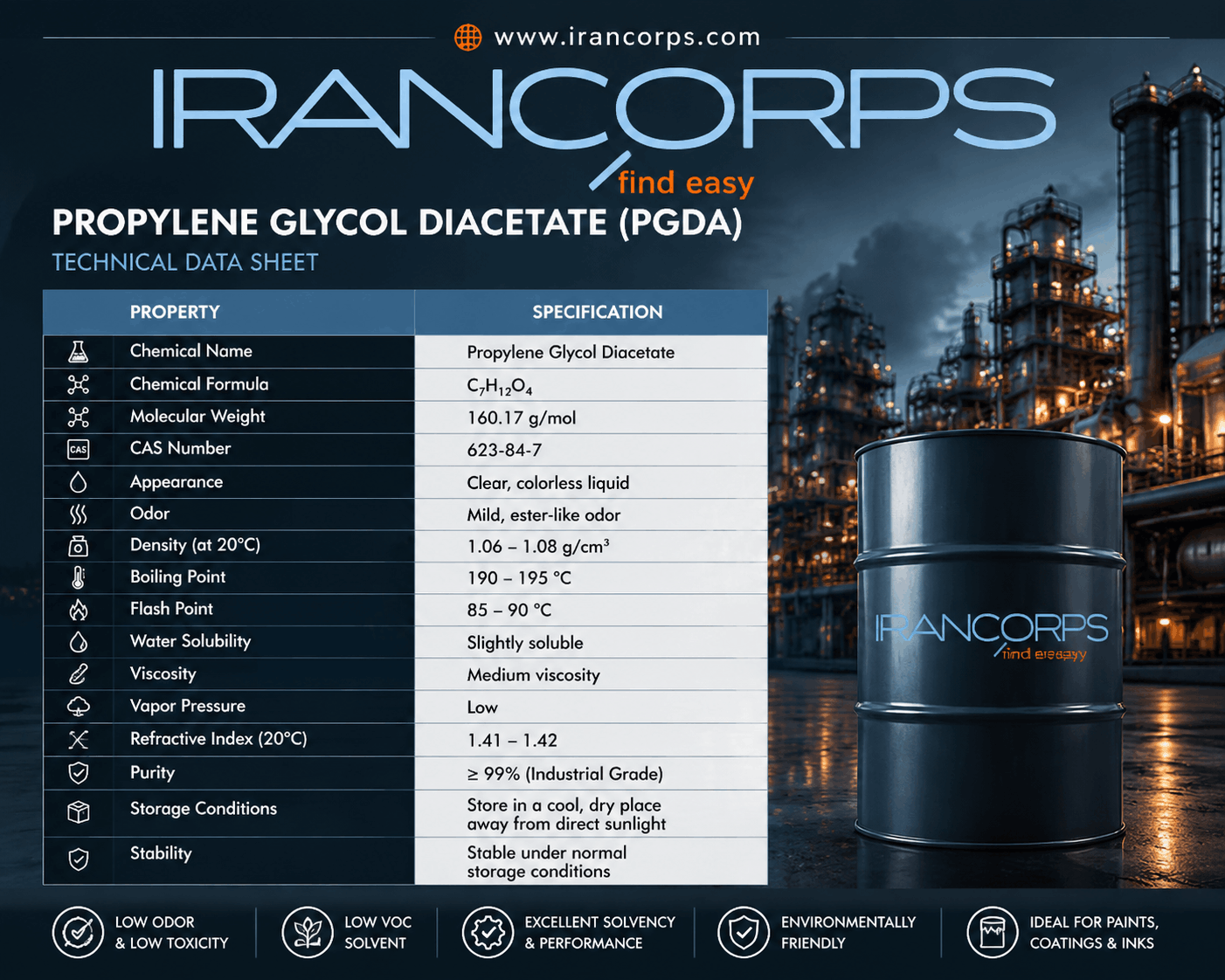
Both are ester-based oxygenated solvents widely used in industrial applications such as coatings, inks, resins, and cleaning formulations. Although they belong to the same chemical family, they differ significantly in structure, performance, safety profile, environmental impact, and industrial applications.
This article provides a deep, technical, and SEO-optimized comparison between EGDA and PGDA to help manufacturers, formulators, and industrial buyers understand which solvent is more suitable for specific applications.
🧪 1. Understanding Ester Solvents in Industry
Ester solvents are organic compounds formed by the reaction of acids and alcohols. In industrial chemistry, glycol diacetates are particularly important because they combine:
- Moderate evaporation rate
- Good solvency power
- Low odor
- Improved environmental profile compared to aromatic solvents
These properties make them ideal replacements for traditional solvents such as toluene, xylene, and ketones.
EGDA and PGDA both belong to this category but are derived from different glycols:
- EGDA → derived from Ethylene Glycol
- PGDA → derived from Propylene Glycol
This structural difference leads to significant variations in performance and safety.
🧪 2. Chemical Structure Comparison
EGDA (Ethylene Glycol Diacetate)
- Chemical formula: C₆H₁₀O₄
- Derived from ethylene glycol
- More compact molecular structure
- Higher polarity compared to PGDA
PGDA (Propylene Glycol Diacetate)
- Chemical formula: C₇H₁₂O₄
- Derived from propylene glycol
- Slightly larger molecule
- More balanced hydrophilic-lipophilic behavior
🔬 Key Structural Difference
The presence of a methyl group in PGDA (absent in EGDA) leads to:
- Lower toxicity profile
- Better flexibility in resin compatibility
- Improved regulatory acceptance
⚙️ 3. Physical and Chemical Properties Comparison
| Property | EGDA | PGDA |
| Molecular Weight | 146.14 g/mol | 160.17 g/mol |
| Appearance | Clear liquid | Clear liquid |
| Odor | Mild ester odor | Mild ester odor |
| Density (20°C) | 1.10–1.12 g/cm³ | 1.06–1.08 g/cm³ |
| Boiling Point | 186–190 °C | 190–195 °C |
| Flash Point | ~82–85 °C | ~85–90 °C |
| Evaporation Rate | Slightly faster | Moderate |
| Solubility | Slightly soluble in water | Slightly soluble in water |
🧠 Interpretation
- EGDA evaporates slightly faster
- PGDA provides more controlled evaporation
- PGDA is generally more stable in coating systems
🧪 4. Solvency Power Comparison
Solvency power is one of the most important parameters in coatings and inks.
EGDA:
- Strong polarity
- Good for fast-dissolving resins
- Effective in nitrocellulose systems
- Sometimes too aggressive for sensitive formulations
PGDA:
- Balanced solvency
- Works well in acrylic and polyurethane systems
- More compatible with modern high-solid coatings
- Better control over film formation
🧠 Key Insight
👉 EGDA = stronger but less controlled
👉 PGDA = balanced and formulation-friendly
🧴 5. Evaporation Rate and Film Formation
EGDA:
- Faster evaporation
- Can lead to surface defects if not controlled
- Useful in fast-drying inks
PGDA:
- Medium evaporation rate
- Excellent leveling properties
- Reduces defects like:
- Orange peel
- Cratering
- Pinholes
🧠 Conclusion
PGDA provides superior film formation quality in most industrial coatings.
🌍 6. Environmental and Regulatory Profile
This section is extremely important for global trade.
EGDA:
- Based on ethylene glycol chemistry
- Higher regulatory scrutiny in some regions
- Less preferred in strict EU formulations
PGDA:
- Based on propylene glycol (safer profile)
- Better REACH acceptance
- More aligned with low-VOC trends
- Preferred in eco-friendly formulations
🧠 Industry Trend
Global coatings manufacturers are gradually shifting from EGDA → PGDA due to environmental regulations.
🧪 7. Toxicity and Safety Comparison
EGDA:
- Moderate toxicity level
- Requires careful handling
- More restrictive workplace exposure limits
PGDA:
- Lower toxicity
- Safer handling in industrial environments
- Reduced health risk in long-term exposure
🧠 Key Point
👉 PGDA is considered a safer next-generation solvent.
🏭 8. Industrial Applications Comparison
🧴 EGDA Applications:
- Nitrocellulose lacquers
- Fast-drying inks
- Specialty coatings
- Chemical intermediates
🧴 PGDA Applications:
- Industrial coatings
- Automotive coatings
- Printing inks (high-end systems)
- Adhesives and sealants
- Low-VOC formulations
🧠 Summary
EGDA → fast & aggressive systems
PGDA → modern & controlled systems
📊 9. Performance Comparison in Coatings
| Feature | EGDA | PGDA |
| Drying Speed | Faster | Controlled |
| Surface Finish | Moderate | Excellent |
| Compatibility | Limited | Wide |
| VOC Compliance | Medium | High |
| Formulation Stability | Medium | High |
🧠 10. Market Trend Analysis
The global solvent market is changing rapidly due to:
- Environmental regulations
- Demand for sustainable chemistry
- Shift toward low-VOC coatings
- Industrial safety improvements
Market movement:
👉 EGDA usage is stable but not growing
👉 PGDA demand is increasing globally
📈 11. Why PGDA is Replacing EGDA in Many Applications
Manufacturers are increasingly choosing PGDA because:
- Better environmental compliance
- Lower toxicity
- More stable coating performance
- Broader formulation compatibility
- Improved safety standards
🧪 12. Cost and Availability Considerations
EGDA:
- Often slightly cheaper
- Available in traditional solvent markets
PGDA:
- Slightly higher cost
- Higher value in high-performance systems
- Better export demand potential
🧭 13. Which One Should You Choose?
Choose EGDA if:
- Fast drying is critical
- Cost is priority
- Working in traditional solvent systems
Choose PGDA if:
- You need modern low-VOC formulation
- Surface quality is important
- Working with advanced coatings
- Export compliance is required
🏁 Conclusion
Although EGDA and PGDA belong to the same family of glycol diacetate solvents, their performance characteristics differ significantly.
EGDA is a faster-evaporating, more traditional solvent suitable for specific applications where speed is critical. However, it comes with higher environmental and regulatory limitations.
PGDA, on the other hand, represents the next generation of industrial ester solvents. It offers a balanced evaporation rate, improved safety profile, better environmental compliance, and superior performance in modern coating systems.
As global industries continue transitioning toward low-VOC and sustainable chemical systems, PGDA is becoming the preferred choice for formulators worldwide.
More products in : https://irancorps.com