

 Arabic
shop
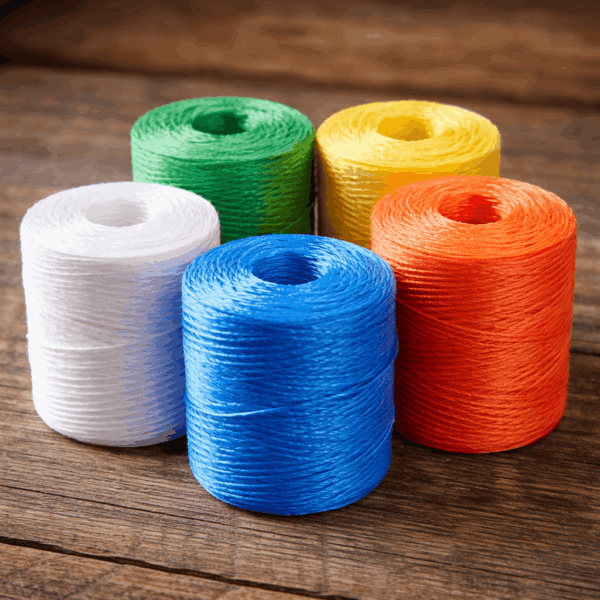
Twine Baler Rope
Commercially available grades of Twine Baler Rope are mainly classified according to linear density (meter per kilogram), tensile strength, length per roll, and application type. Common grades include Standard Baler Twine, Heavy Duty Baler Twine, Extra Heavy Duty Baler Twine, Sisal Replacement Twine, and High Tensile Baler Twine. Standard grades are suitable for general hay and straw baling applications where moderate strength is required. Heavy Duty and Extra Heavy Duty grades are designed for large and dense bales, including silage, corn stalks, and industrial agricultural materials, providing higher knot strength and improved load security. High Tensile Baler Twine is manufactured for professional farming operations using high-capacity balers, offering maximum breaking strength with lower material consumption. Polypropylene grades are preferred as an alternative to natural sisal twine because of their moisture resistance, longer storage life, and consistent quality.
Twine Baler Rope offers many advantages including high tensile strength, excellent resistance to moisture, sunlight, chemicals, and biological degradation, as well as smooth feeding performance through automatic baling machines. Its lightweight design reduces transportation costs and improves handling efficiency, while its uniform diameter and controlled production quality ensure reliable knot formation and bale stability. This product is widely used in agriculture, livestock farming, hay production, straw packaging, biomass handling, and forage storage. With different colors, lengths, and strength levels available, Twine Baler Rope can be customized according to customer requirements, making it a suitable industrial agricultural product for wholesale export markets.
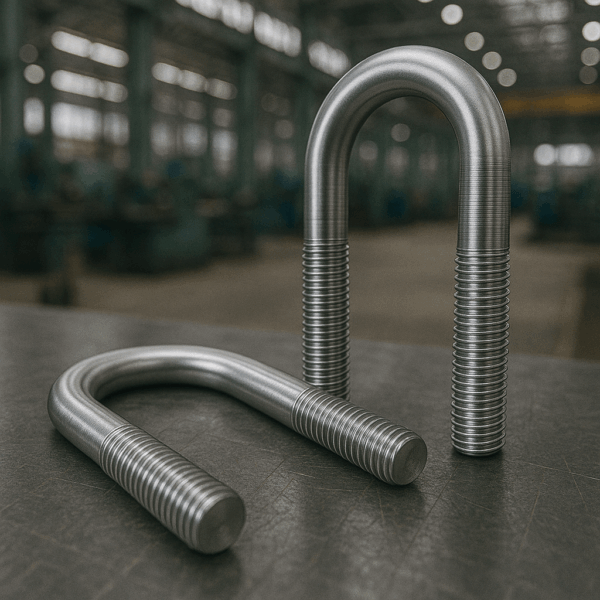
U Shape Bolt
U-bolts are frequently used to secure pipes to supports, walls, or other structural elements, preventing movement and potential damage. U-bolts are essential components in vehicle suspension systems, securing leaf springs to axles. They are used to attach pipes, conduits, and other components to beams, poles, or walls in construction projects and in Marine industries U-bolts are utilized in marine applications due to their resistance to corrosion, particularly in securing boat trailers, dock hardware, and other marine equipment.
Types of U-Bolts:
- Round Bend: Designed for securing cylindrical objects like pipes.
- Square Bend: Used for clamping flat-faced objects like metal rails or ducts.
- Semi-Round: A variation for specific applications.
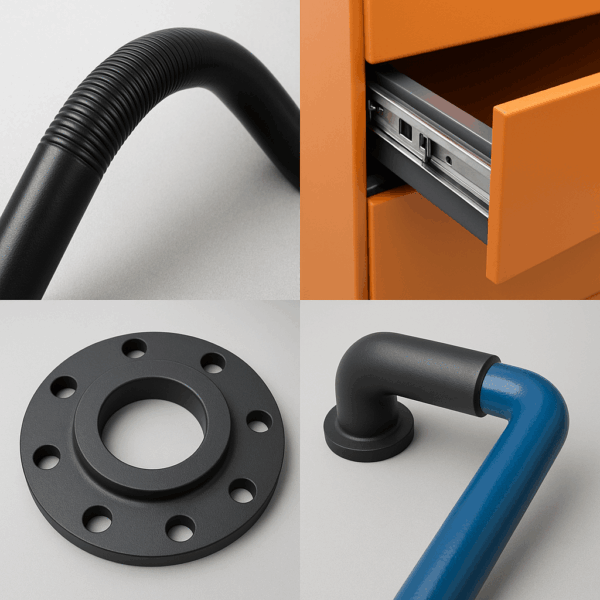
Ultra Flexible Epoxy Powder Coating
Formulated with modified epoxy resins, elastomeric additives, flexible curing agents, anti-corrosion pigments, flow modifiers, and high-performance fillers, the coating forms a tough yet adaptable film with outstanding adhesion. Its unique molecular structure provides smooth application, excellent edge coverage, and superior mechanical performance in harsh industrial environments.
Ultra Flexible Epoxy Powder Coating is widely used for springs, pipe bends, automotive parts, brackets, mechanical joints, electrical housing, flexible connectors, steel furniture, transportation equipment, agricultural tools, and metal components requiring repeated impact or deformation. Its resilience makes it ideal for complex geometries and components undergoing frequent movement that makes it suitable in assembly lines where coated parts must withstand bending during installation.

Unarmored Underground Low-Tension Power Cables
Unarmored Underground Low Tension (LT) Power Cables are designed for reliable electrical distribution at voltages up to 1 kV, providing stable power transfer for residential, commercial, and controlled industrial environments. These cables are produced using high-purity copper or aluminum conductors, insulated with durable PVC or XLPE materials to ensure excellent electrical performance and thermal resistance. Available in single-core and multi-core constructions, they are ideal for installation in ducts, conduits, cable trays, and protected underground pathways where direct exposure to heavy mechanical stress is minimal. The manufacturing process involves precision extrusion and stranding techniques to ensure uniform insulation thickness, smooth conductivity, and long operational life. Offered in a wide range of cross-sectional sizes from 1.5 mm² to 630 mm², these cables support lighting networks, building wiring, feeder lines, and small to medium load power systems with consistent efficiency.
Unarmored LT Underground Cables are widely used in residential power distribution, infrastructure projects, panel wiring, renewable energy systems, and commercial electrical networks. Their main advantages include flexibility, ease of installation, lower weight, cost-effectiveness, and reliable insulation performance in protected pathways. These cables are ideal in areas where mechanical protection is provided externally, reducing the overall project cost while maintaining electrical safety and durability. With proven performance and industry-standard quality, Unarmored Underground LT Power Cables provide a dependable solution for modern electrical installations.
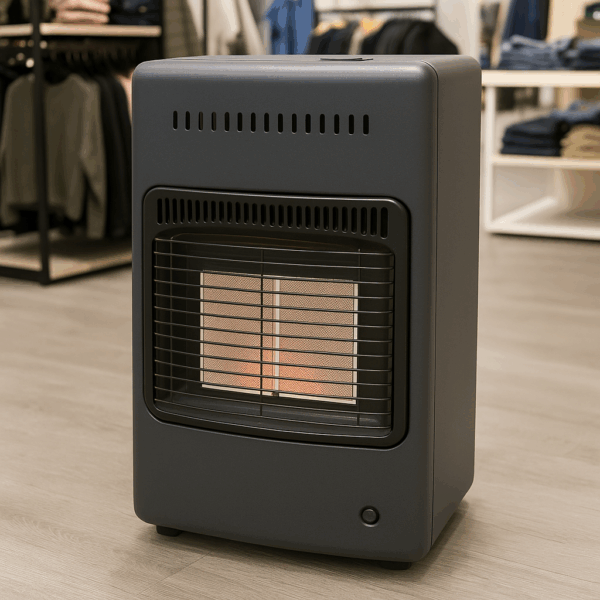
Unflued Gas Heaters
Unflued gas heaters get highly advanced qualities such as remote controls, twin programmable timers, thermostatic control, a child lock function and other safety features. They generally deliver maximum heat of about 6.2 to 6.5 kW with LPG and natural gas heaters. The modern unflued gas heaters have safety features such as an oxygen depletion sensor that will shut off the heater if oxygen levels drop too low.
Unflued gas or vent-free heaters are portable and do not require a flue or chimney for installation. This makes them ideal for renters or those who require heating in rooms with no existing vents.
Advantages
-
Cheaper to install (no flue or venting system).
-
High heating efficiency since all heat stays in the room.
-
Portable versions can be moved between rooms.
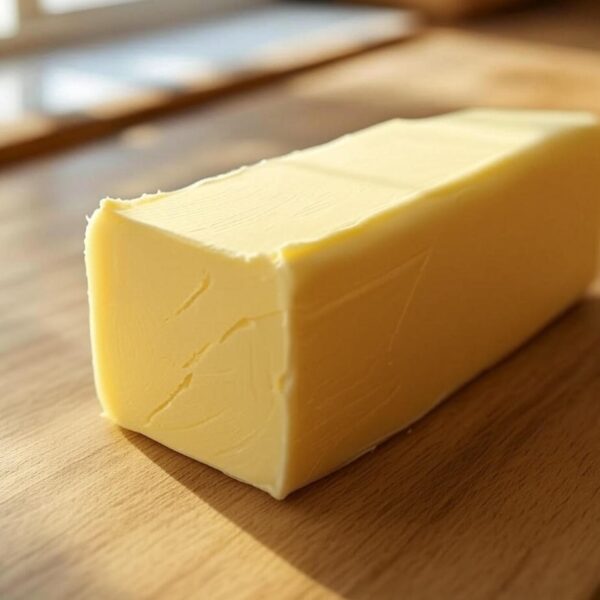
Unsalted Pasteurized Butter
Depending on the production specification, Unsalted Pasteurized Butter can be supplied in different grades, including standard industrial butter, premium butter, bakery-grade butter, confectionery-grade butter, and foodservice-grade butter. The product may be manufactured from sweet cream or cultured cream, with sweet cream butter generally offering a mild and clean dairy profile, while cultured butter provides a more distinctive and slightly tangy flavor. Key quality characteristics include butterfat content, moisture level, non-fat milk solids, texture, color, melting behavior, flavor, aroma, and microbiological quality. High-quality unsalted butter normally has a smooth and homogeneous structure, a natural cream-to-pale-yellow color, and a clean dairy taste without rancid, sour, or foreign flavors.
Unsalted Pasteurized Butter is widely used as a functional ingredient in bakery, confectionery, food processing, dairy products, sauces, prepared foods, and premium culinary applications. Its fat content contributes richness, mouthfeel, aroma, tenderness, flakiness, and desirable browning characteristics to finished products. In bakery applications, it is used in croissants, Danish pastries, puff pastry, biscuits, cookies, cakes, laminated doughs, bread products, and other baked goods where controlled butter performance is important. In confectionery production, unsalted butter is used in creams, fillings, caramels, buttercream, chocolate products, toffees, and other formulations where salt-free butter allows manufacturers to control the final recipe precisely. It is also suitable for sauces, soups, mashed products, ready meals, pasta dishes, compound butter, and foodservice preparations. Commercial varieties can differ in butterfat percentage, moisture, cream type, flavor profile, texture, and intended application. Industrial butter is generally supplied as blocks or slabs designed for efficient handling and large-scale processing, while smaller formats are available for restaurants, bakeries, catering operations, and professional kitchens. Butter can also be supplied in frozen form to extend storage life and facilitate international distribution, while chilled formats are used where shorter supply chains and immediate processing are available.
Unsalted Pasteurized Butter is typically offered in bulk packaging designed to protect the product from contamination, moisture loss, odors, and physical damage during storage and transportation. Common commercial packaging formats include 5 kg, 10 kg, 20 kg, 25 kg, and approximately 25 kg blocks, although packaging weight can vary according to producer, market, and customer requirements. Individual blocks are generally wrapped in food-grade moisture-resistant paper, foil laminate, or other suitable protective materials and may be packed into cartons or other secondary packaging.
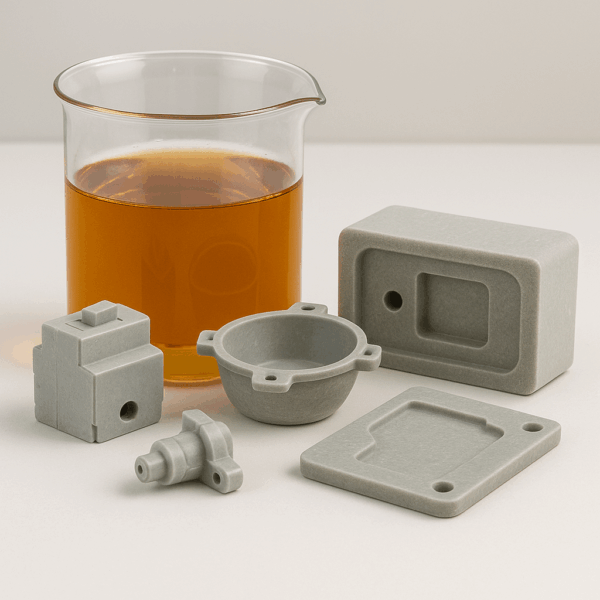
Unsaturated Polyester Resin for BMC (Bulk Molding Compound)
Unsaturated Polyester Resin for BMC is specially formulated to withstand heat, mechanical load, and long-term operational stress and can be used in electrical switchgear housings, circuit breaker parts, insulator bases, automotive headlamp reflectors, appliance handles, pump components, valve casing, lightweight machinery parts, bathroom fittings, and precision molded engineering pieces. BMC materials are widely used in automotive, electrical, household appliance, energy, construction, and industrial molding sectors that require high-strength, low-weight composite parts.
Formulation commonly includes unsaturated polyester resin (ortho/isophthalic), styrene monomer, MEKP initiator, cobalt accelerator, low-profile additives, mineral fillers, glass fibers (chopped strands), thixotropic paste modifiers, mold-release agents, pigments, antioxidant stabilizers, and heat-resistant modifiers. Unsaturated Polyester BMC Resin is a strong, scalable option for industries requiring high-precision molded composites — reliable for global buyers and available from Iranian suppliers with competitive export pricing. Key Advantages include high mechanical strength, excellent electrical insulation, low flammability, dimensional stability, low shrinkage, fast cure rate, surface smoothness, and cost-efficient mass production. BMC-grade UPR allows manufacturers to produce complex shapes, thin-wall structures, and durable technical components with consistent quality and long service life.
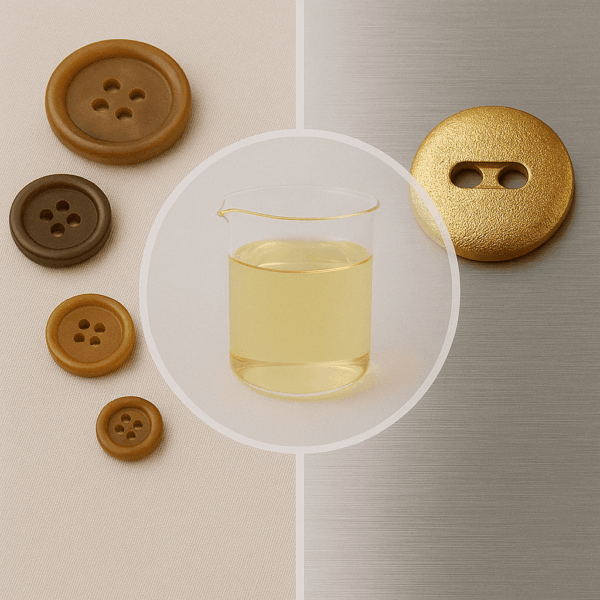
Unsaturated Polyester Resin for Button Making
The fast curing and strong dimensional stability properties of this polyester resin, performs efficiently in high-volume button casting systems. Button Making Polyester Resin can be used in shirt buttons, coat buttons, jeans rivet buttons, children’s clothing accessories, fashion craft components, decorative garment pieces, uniform buttons, luxury pearl-style buttons, molded shapes, and glossy customized fashion materials. It is widely used in textile manufacturing, fashion accessory production, haberdashery wholesale, and decorative polymer goods fabrication. Composition include orthophthalic or isophthalic unsaturated polyester resin base, styrene monomer, MEKP catalyst, accelerator (Co-Naphthenate), thixotropic additives, anti-yellowing stabilizers, pigment carriers, optical brighteners, plasticity modifiers, and molding flow enhancers.
Unsaturated Polyester Button-Grade offers reliability, customizable formulations, and competitive export pricing — ideal for global garment accessory manufacturers seeking high-polish fashion buttons with premium finish. This resin supports marble-pattern, transparent, pearl-effect, glitter-filled, and solid-color button production with outstanding visual quality.
Key Advantages:
- Excellent Clarity, Color Depth
- Smooth Surface Finish
- Low Shrinkage
- High Hardness
- Quick Cure Speed
- Drillability Without Cracking
- Superior Gloss After Polishing
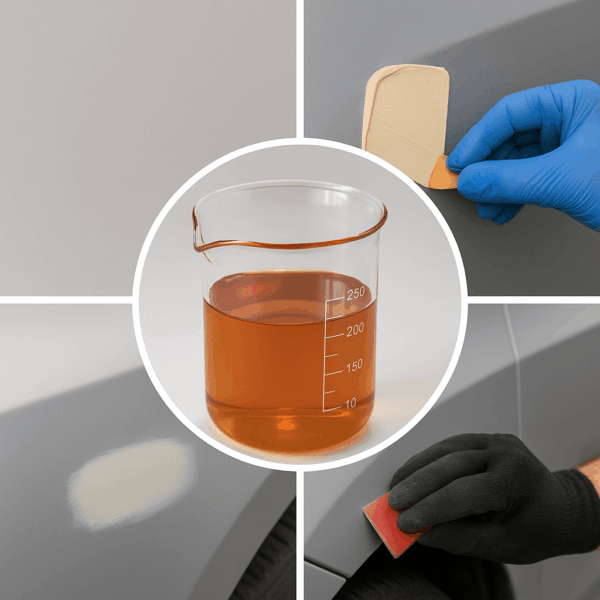
Unsaturated Polyester Resin for Car Putty
Car Putty Polyester Resin has low shrinkage and strong sanding behavior that ensures a uniform finish ready for top-coat painting. Applications include two-component polyester body filler pastes, dent repair compounds, scratch-filling putty, refinishing and leveling of damaged panels, repair of bumpers and fenders, gap-bridging in car restoration, and general automotive refinishing. It is suitable for OEM workshops, collision repair centers, and aftermarket paint shops. Composition typically include orthophthalic UPR base resin, styrene monomer, MEKP hardener, thixotropic agents, micro-fine fillers (talc/CaCO₃), air-release additives, adhesion promoters, anti-pinholes modifiers, wetting agents, accelerators, and stabilizers. Pigments may be added for color identification and ease of application.
The formulation allows smooth finishing without pinholes and supports both professional and industrial automotive repair. Car Putty Unsaturated Polyester Resin that is offered delivers stable curing, consistent quality, and competitive export pricing — making it a reliable choice for automotive putty producers and refinishing industries.
Key Advantages:
- Easy Spreadability
- Excellent Adhesion
- Rapid Curing
- High Sanding Efficiency
- Low Odor
- Minimal Shrinkage
- Strong Hardness Development
- Feather-Edging Finish & Paint-Ready Surface Quality.
Unsaturated Polyester Resin for Casting
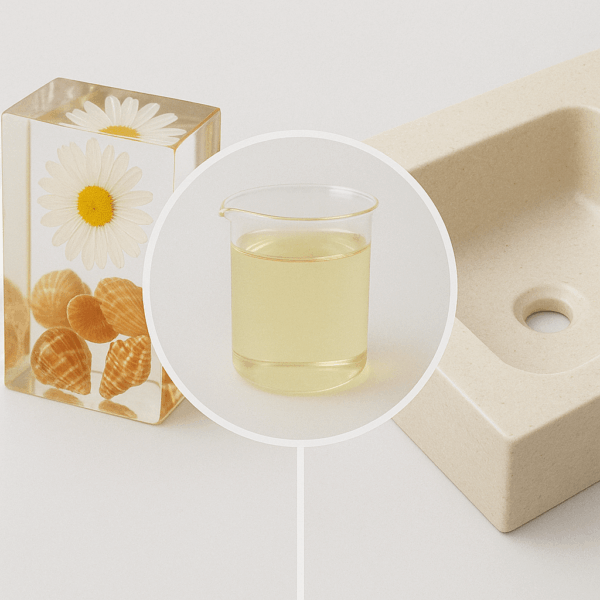
With customizable cure speed and pigment acceptance, this resin is widely preferred for both mass-production factories and custom casting workshops. Casting Polyester Resin as an Unsaturated Resin can be used in transparent cast blocks, sculpture and art pieces, jewelry and fashion accessories, paperweight casting, LED decorative items, embedded flowers/insects, souvenir molds, gift products, table casting, ornaments, translucent architectural components. It can also be used for mineral-filled castings, marble-like designs, pearl patterns, and glitter-embedded displays. These transparent resins are formulated for high clarity, low yellowing, and smooth block curing without cracks or overheating.
In casting production, resin is mixed with pigments or fillers if required, catalyzed, poured into molds, degassed to remove air, cured at controlled temperature, demolded, sanded, and polished to achieve crystal transparency. The Casting Resin has many advantages and properties such as low shrinkage, high transparency, easy pigment dispersion, glossy surface finish, stable curing, adjustable gel time, excellent machinability, and strong hardness development after full cure. This resin enables attractive visual effects, deep optical depth, and premium surface quality ideal for decorative, artistic, and commercial casting industries.
Unsaturated Polyester Resin for Hand Lay Up Composites
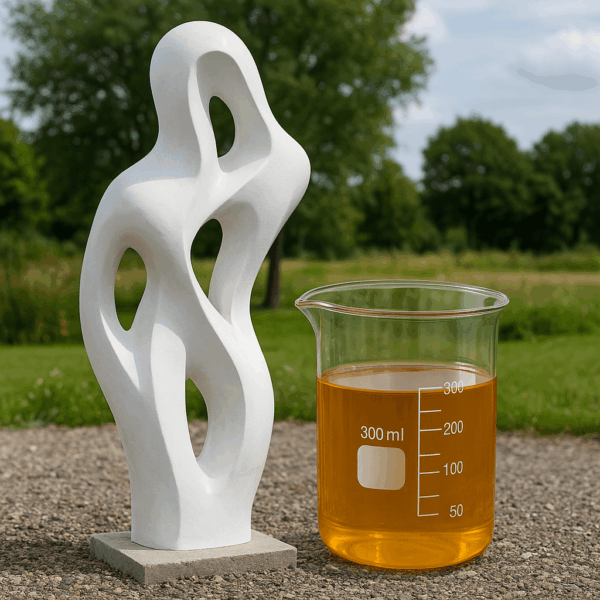
The optimized viscosity of hand lay-up polyester resin allows easy brush-on application, smooth air-release, and strong bonding within multi-layer FRP laminates. This Polyester Resin can be used for producing FRP tanks and vessels, GRP roofing sheets, boat hulls, marine panels, fiberglass pools, water storage containers, chemical-resistant ducting, bathtubs, car body parts, cooling towers, domes, decorative moulding, and industrial composite structures. Widely used in construction, automotive, marine, cooling tower manufacturing, and corrosion-resistant composite fabrication.
Compositions of Hand Lay-up Polyester resins generally include orthophthalic or isophthalic UPR base resin, styrene monomer, cobalt accelerator, MEKP catalyst, thixotropic agents, air-release additives, low-shrink modifiers, pigment dispersion carriers, and optional UV stabilizer packages. The resin is engineered for high filler acceptance, consistent cure, and strong interlaminate adhesion.
Advantages of hand lay-up resin include ease of processing, strong mechanical durability, good chemical resistance, low shrinkage, controlled curing, high glass-fiber wet-out, cost-effective production, and compatibility with standard FRP reinforcement systems. Available grades include general-purpose ortho, corrosion-resistant iso grade, low-styrene emission type, thixotropic grade for vertical lay-ups, and UV-stable outdoor formulations. With reliable performance and scalable production, Unsaturated Polyester Hand Lay-Up Resin is an ideal choice for composite manufacturers seeking efficiency, strength, and high-quality finish — proudly supplied by Iranian producers for export worldwide.
Unsaturated Polyester Resin for Lacquers
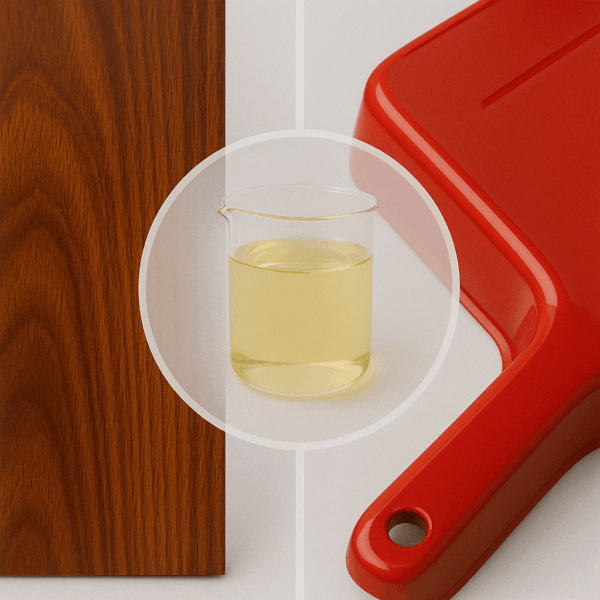
Their balanced reactivity and flow behavior allows smooth levelling, fast curing and superior polishing response. Different types of UP Lacquer Resins are available such as High-Gloss Polyester Lacquer Resin, Fast-Curing Nitocellulose Compatible Resin, Acrylic-Modified Polyester Lacquer Grade, Thixotropic Lacquer Resin for Vertical Surfaces, UV-stable Clear Lacquer Resin, and Low-styrene-emission Eco Formulations. Each grade is engineered for specific finishing speed, hardness profile, flexibility, viscosity and clarity level. The ingredients typically include high-purity phthalic anhydride, maleic anhydride, propylene glycol or neopentyl glycol, styrene monomer, cobalt accelerator, MEKP curing agent and optional acrylic modifiers for enhanced brilliance and weather stability. Flow additives, anti-yellowing stabilizers and wax-free leveling agents may also be incorporated depending on final product requirements.
Key Advantages:
- Very High Gloss Retention
- Deep Mirror Finish
- Strong Adhesion to Wood and Metals
- High Mechanical Hardness
- Excellent Sandability and Buffability, Chemical
- Solvent Resistance
Applications
- Luxury Wood Furniture Lacquer, Piano & Instrument Topcoats
- Automotive Clear Lacquer, Steel and Aluminum Coating
- Plastic Finishing
- Interior Decorative Panels
- Door & Cabinet Finishing
- Flooring Sealers, Parquet Varnish