
 Arabic
Blog
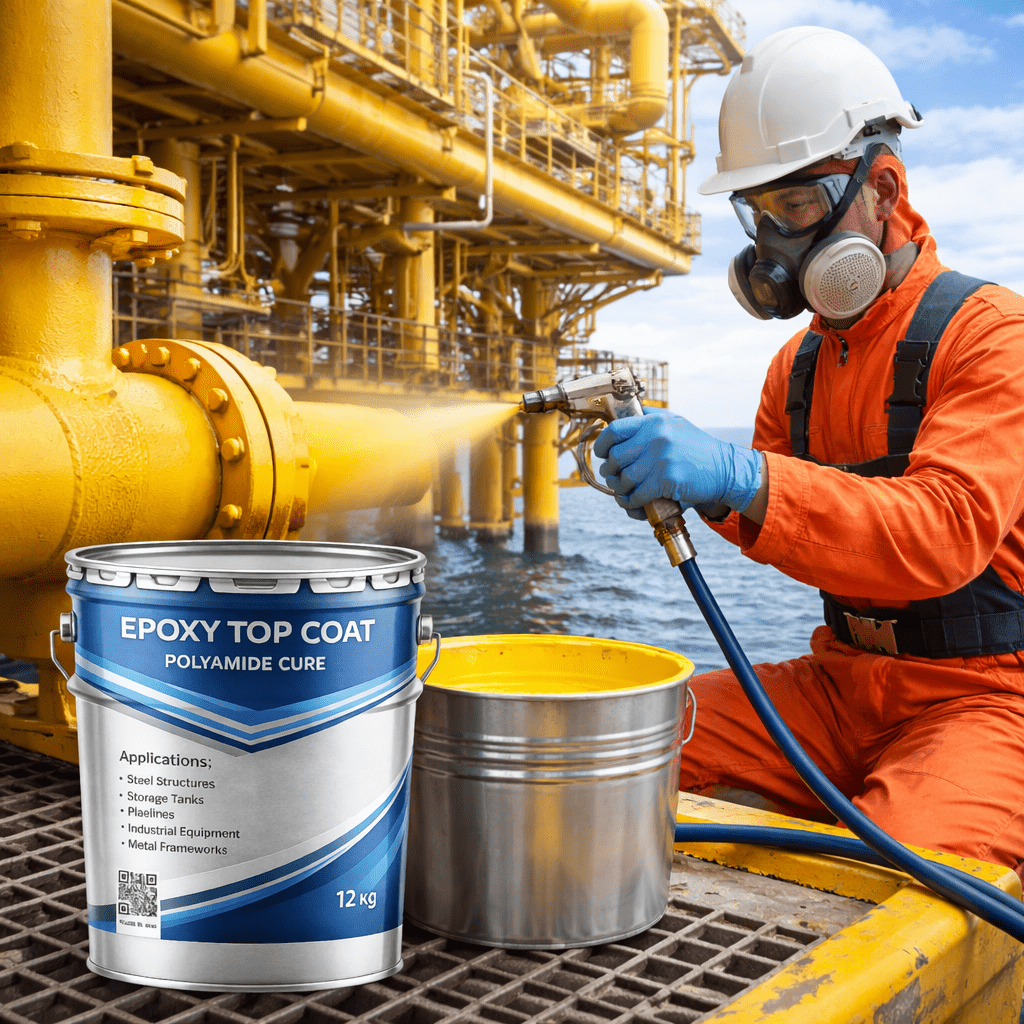
Epoxy topcoats are one of the most important categories of industrial protective coatings, used as the final and most exposed layer in multi-coat paint systems. They are specifically engineered to protect steel, concrete, and other substrates against corrosion, chemicals, abrasion, and harsh environmental conditions. In industrial, infrastructure, marine, and energy sectors, epoxy top coats are selected not only for appearance, but mainly for their long-term protective performance and reliability.
Epoxy top coats are formulated based on epoxy resins combined with different curing agents, pigments, and functional additives. Depending on the curing chemistry, epoxy top coats are classified into polyamide-cured, polyamine-cured, phenolic-modified, and novolac epoxy systems. Each grade offers different mechanical, chemical, and environmental resistance properties, allowing engineers to select the most suitable solution for specific service conditions.
Conventional epoxy top coats are widely used for general industrial protection. They provide good adhesion, corrosion resistance, and mechanical strength, making them suitable for structural steel, machinery, pipelines, storage tanks (external surfaces), and industrial equipment. These coatings offer balanced performance and cost efficiency and are commonly specified in C3–C4 corrosion environments.
High build epoxy top coats are designed to achieve higher dry film thickness in fewer coats. With higher solids content, they provide improved barrier protection, reduced permeability to water and oxygen, and enhanced resistance to mechanical damage. High build epoxies are widely applied on bridges, offshore structures, heavy steel constructions, and power plant equipment where long-term durability is required.
Micaceous Iron Oxide (MIO) epoxy top coats contain lamellar MIO pigments that align parallel to the substrate, creating a “shielding effect” against moisture and corrosive agents. These coatings are especially effective for bridges, offshore platforms, oil & gas facilities, and marine structures. MIO epoxy top coats are valued for their crack resistance, excellent weathering performance, and extended maintenance intervals.
Polyamide-cured epoxy top coats are known for their flexibility, strong adhesion, and good resistance to seawater and moisture. They are widely used in marine environments, offshore facilities, ship decks, and coastal steel structures. Their flexibility helps accommodate thermal expansion and mechanical stress, reducing the risk of cracking.
Polyamine-cured epoxy top coats offer faster curing, higher hardness, and stronger chemical resistance compared to polyamide systems. These coatings are commonly used in industrial floors, storage tanks, pipelines, and chemical plants where resistance to oils, fuels, and chemicals is required. They are suitable for both ambient and low-temperature curing conditions.
Phenolic-modified epoxy top coats are developed for environments with higher chemical and temperature exposure. They provide superior resistance to solvents, fuels, hot water, and mild acids. Typical applications include refinery units, tank exteriors, industrial steel exposed to chemicals, and processing facilities where conventional epoxies may degrade faster.
Novolac epoxy top coats represent the highest grade of epoxy coatings. With very high crosslink density, they offer exceptional resistance to strong acids, alkalis, solvents, and continuous immersion. These coatings are widely specified for chemical storage tanks, reactors, secondary containment areas, petrochemical plants, and offshore installations exposed to aggressive media.
In addition to solvent-based systems, solvent-free epoxy top coats and water-based epoxy top coats are increasingly used to meet environmental and safety regulations. Solvent-free epoxies provide very high film build, zero VOC emission, and excellent chemical resistance, making them ideal for confined spaces and tank linings. Water-based epoxy top coats offer low odor, easy application, and good performance for indoor environments, water treatment plants, and infrastructure projects.
From a technical perspective, epoxy top coats are characterized by excellent adhesion, high mechanical strength, abrasion resistance, low permeability, and strong chemical resistance. Proper surface preparation and compatibility with primers and interlayers are critical to achieving optimal performance. When correctly specified and applied, epoxy top coats significantly extend asset life and reduce maintenance frequency.
Conclusion
In conclusion, epoxy top coats are a versatile and technically advanced group of industrial coatings, available in a wide range of types and grades to suit different environmental and operational demands. From conventional and high build systems to MIO, polyamide, polyamine, phenolic-modified, novolac, solvent-free, and water-based epoxies, each formulation serves a specific purpose in industrial protection.
By selecting the correct epoxy top coat based on corrosion category, chemical exposure, temperature, and mechanical stress, industries can achieve reliable long-term protection and improved operational efficiency. For professional users, epoxy top coats remain a cornerstone of modern protective coating systems, offering proven performance, engineering flexibility, and compliance with international industrial standards.